SDS Drill vs Hammer Drill: What to Choose for Your Project
Compare SDS drills and hammer drills to decide which tool fits masonry, wood, and metal projects. Learn about chuck systems, performance, and budgeting for smarter tool selection.


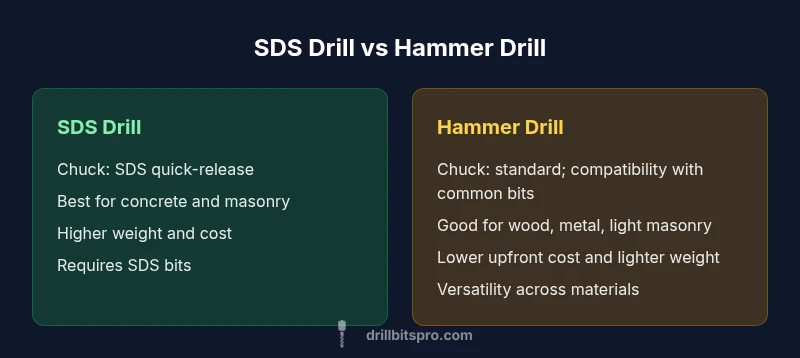
An SDS drill uses a piston hammer and an SDS chuck for fast, secure bit changes and strong concrete performance. A hammer drill uses a standard chuck and an impact mechanism, offering versatility for wood, metal, and light masonry. In practice, SDS excels in dense concrete, while hammer drills are more flexible for mixed-material work.
What is an SDS drill?
According to Drill Bits Pro, an SDS drill uses a piston hammer and an SDS chuck for fast, secure bit changes and superior performance in dense masonry. The SDS stands for Special Direct System, which allows the bit to slide into the chuck and lock with radial pins. This results in less bit slippage and more efficient drilling in concrete and brick when using purpose-built SDS bits. In the broader category of percussion drills, the SDS design distinguishes itself from a typical hammer drill by its retention mechanism and the level of hammering energy delivered in a straight-line motion. For the reader asking what is an sds drill vs hammer drill, the answer hinges on the mechanism and retention: SDS bits require compatible chucks, and the tool is optimized for masonry workloads rather than mixed-material drilling. Use SDS for continuous, high-density concrete work; rely on a standard hammer drill when you need versatility across wood, metal, and lighter masonry tasks.
What is a hammer drill?
A hammer drill is a versatile percussion drill that combines rotation with a pounding hammering action. It relies on a standard (or keyed) chuck to grip conventional bits and deliver impact energy in discrete bursts as the bit rotates. This makes it highly adaptable for a wide range of materials—wood, metal, brick, and light concrete—though it tends to be less efficient than an SDS drill for dense masonry. For DIY projects and mixed-material tasks, a hammer drill offers flexibility and a lower initial cost, which can be advantageous for hobbyists and occasional professionals alike.
How the mechanisms differ: SDS vs traditional hammer
The core difference lies in how the hammer action is delivered and how bits are retained. An SDS drill uses a piston-driven hammer that moves the bit in a straight path, with an SDS chuck that locks bits with radial freedom and a sliding sleeve. This design minimizes bit wobble and increases efficiency in hard materials. A conventional hammer drill uses a rotating spindle with an impact mechanism that drives the bit laterally to create a hammering action. The impact is multi-directional and can be less rigid than the SDS system, which can result in greater bit wear under heavy use. For dense concrete and brick, the SDS approach generally provides deeper penetration with less fatigue on the user’s wrist when paired with appropriate SDS bits.
Bit systems and compatibility
SDS tools come in subspecies such as SDS Plus and SDS Max, with bits designed specifically for each system. The chuck and retention are integral to performance: SDS bits slide into the chuck and lock securely, enabling rapid bit changes and reduced bit slippage. In contrast, hammer drills use a traditional straight or hex chuck that accepts a broader range of standard bits but can suffer from bit slippage under heavy load. When planning a project, verify which system your drill uses and stock compatible bits to avoid slowdowns. If you regularly switch between masonry and other tasks, you may need two drills or a model with quick-change chuck options.
Concrete performance: drilling efficiency
In dense or reinforced concrete, SDS drills generally outperform hammer drills thanks to their robust hammer action and secure bit retention. The ability to use longer SDS bits without chatter allows for cleaner holes and faster progress in challenging substrates. Hammer drills, while adequate for concrete, typically slow down on dense materials and may require more perceptible effort from the operator. If your job requires drilling through thick concrete walls, columns, or masonry with frequent rebar encounters, an SDS drill provides clear efficiency advantages. Always choose the correct SDS bit size and length for the material to maximize performance.
Versatility: wood, metal, and masonry capabilities
Hammer drills shine when your workload includes wood and metal alongside masonry, thanks to a broader range of compatible bits and a lighter footprint in many models. SDS drills excel in masonry operations but can be adapted for non-masonry tasks only with specialized bits or auxiliary chucks, which may limit ease of use. For users who frequently switch between materials, a dedicated hammer drill can reduce tool swapping and maintain a steadier workflow. For most professional masonry tasks, the SDS drill is the preferred tool, while for mixed-material carpentry and renovation projects, the hammer drill remains a strong, versatile option.
Ergonomics, vibration, and safety
SDS drills are often heavier and can produce higher vibration levels due to the piston hammer, which can lead to operator fatigue during long sessions. Modern models address this with vibration-damping handles and anti-vibration features, but the weight remains a consideration for overhead or extended work. Hammer drills, while generally lighter, can still generate significant vibration in hammer mode, particularly on hard materials. When choosing between tools, assess your working angles, session duration, and the availability of anti-vibration accessories. Always wear hearing and eye protection and use dust collection to minimize exposure during masonry work.
Buying considerations: cost, maintenance, and long-term value
Price and maintenance are practical lenses for decision-making. SDS drills usually carry a higher upfront cost and require periodic maintenance of seals and the piston mechanism, but they offer better long-term value for frequent, heavy-duty concrete work. Hammer drills tend to be more affordable and widely available, with lower maintenance demands and a broader selection of compatible bits for light masonry and non-masonry tasks. Drill Bits Pro Analysis, 2026 indicates that for professionals who drill in concrete several times a week, the reduction in cycle time with an SDS drill can offset the initial cost through productivity gains. For hobbyists or occasional users, a hammer drill may deliver similar results at a lower total cost of ownership. Consider your typical project mix, the bits you already own, and how often you’ll need to drill into hard materials to guide your purchase.
Practical usage scenarios and best practices
In practice, start with a clear assessment of your most frequent tasks. If you routinely work with concrete walls, foundations, or blasting through dense brick, an SDS drill is worth the investment, especially if you anticipate hitting rebar or thick substrates. For renovation work that involves framing, cabinetry, or metal fittings, a hammer drill is typically more practical due to its versatility, lighter weight, and cheaper replacement bits. Always use the correct bit type for the job, secure the workpiece to minimize vibration, and apply steady pressure without forcing the bit. For long projects, consider a drill with good anti-vibration features and a comfortable grip to reduce fatigue. Finally, maintain your tools by cleaning dust seals and inspecting the chuck for wear after heavy use.
Comparison
| Feature | SDS Drill | Hammer Drill |
|---|---|---|
| Chuck system and bit retention | SDS chuck with rapid bit changes and secure retention | Conventional chuck with standard retention |
| Drilling in concrete | Excellent performance with piston hammering; ideal for dense concrete | Good performance; less efficient than SDS for dense materials |
| Versatility with other materials | Primarily masonry-focused; limited performance with non-masonry bits | Highly versatile for wood, metal, and masonry with hammer modes |
| Weight and ergonomics | Heavier and more tiring in long sessions | Lighter and easier to maneuver for extended use |
| Cost and value | Higher upfront cost; long-term durability for frequent use | Lower upfront cost; broader availability and flexibility |
| Maintenance considerations | More components; regular maintenance recommended | Fewer moving parts; simpler maintenance |
| Best-use scenarios | Heavy-duty masonry, professional construction, core drilling | Wood/metalworking, home repairs, mixed-material tasks |
| Vibration and operator fatigue | Higher vibration; optimized with anti-vibration features | Lower vibration in many models; comfortable for longer sessions |
What's Good
- Excellent performance in dense concrete and masonry
- Secure, fast bit changes with SDS chuck
- Durable construction suitable for frequent professional use
- Long-term value for frequent concrete work
Negatives
- Higher upfront cost relative to standard hammer drills
- Heavier and bulkier, which can cause fatigue
- Requires compatible SDS bits and regular maintenance
SDS drills are the superior choice for heavy masonry work; hammer drills remain the best all-round option for versatility and budget.
If your project involves frequent concrete drilling and chiseling, the SDS drill saves time and reduces bit wear. For mixed-material tasks, portability and cost make hammer drills a sensible option. The Drill Bits Pro team recommends aligning tool choice with material focus and project frequency.
Got Questions?
What is the main difference between an SDS drill and a hammer drill?
The SDS drill uses a piston hammer and an SDS chuck for secure bit changes, delivering strong masonry performance. A hammer drill uses a standard chuck with an impact action, offering versatility across wood, metal, and light masonry but often less efficiency on dense concrete.
SDS specializes in masonry; hammer drills are more versatile for different materials.
Can an SDS drill drill wood or metal effectively?
SDS drills can drill wood or metal, but they are optimized for masonry. When used on non-masonry tasks, effectiveness depends on bit choice and whether the drill supports non-SDS bits or a chuck adapter.
They can, but they’re not the best choice for wood or metal compared to a dedicated drill.
Is an SDS drill always heavier and more expensive?
In general, SDS drills are heavier and costlier upfront due to their robust masonry-oriented design. There are lighter, more affordable SDS models, but you should expect some premium for serious concrete performance.
Yes, typically heavier and pricier, but there are lighter options.
When should I buy an SDS drill instead of a hammer drill?
Choose SDS when your workload includes frequent, heavy-duty concrete or brick drilling. If you often switch between materials or have a limited budget, a hammer drill may be the smarter, more flexible choice.
If concrete is your main job, go SDS; otherwise, hammer drill can handle most tasks.
What maintenance differences exist between SDS and hammer drills?
SDS drills require more attention to seals, piston mechanism, and chuck integrity due to their high hammering action. Hammer drills have simpler maintenance since they rely on a standard rotary mechanism and basic hammering components.
SDS needs a bit more care because of the pounding action.
Top Takeaways
- Choose SDS for dense concrete and long-term throughput
- Prefer hammer drills for mixed-material projects and budget-friendly tasks
- Match bit type and chuck to your primary material
- Account for weight and fatigue on extended jobs
- Plan maintenance to extend tool life and performance