Which Drill Is More Powerful? A Practical Comparison
An objective side-by-side look at corded vs cordless drills, unpacking power, specs, and real-world performance to help you choose the right tool for wood, metal, and masonry projects.


Corded drills typically deliver more consistent peak power for heavy‑duty work, while high‑voltage cordless models close the gap with improved torque and runtime. The best choice depends on your task, workspace, and need for portability. For many pros and DIYers, a corded option shines in constant-load jobs, whereas cordless drills win on mobility.
Why power matters in drilling
Power is the foundation of drilling performance, yet it isn’t the only factor that determines how well a drill works. According to Drill Bits Pro, the power delivered by a drill directly affects speed, control, and tool longevity under load. When you ask which drill is more powerful, you are really asking how much sustained torque a tool can provide without stalling, how quickly it can advance a bit, and how reliably it maintains that performance as the battery drains or the chuck slips. For the everyday user, power translates to real outcomes: cleaner holes, fewer pauses to recharge, and less struggle when you hit hard or dense materials. The Drill Bits Pro team found that power is best evaluated against your typical tasks, not just maximum numbers on a spec sheet.
Why power matters in drilling (continued)
Think of power as a continuous force that keeps the bit cutting. A drill’s power envelope is defined by its drivetrain and energy source. For instance, a corded drill can supply continuous torque as long as it’s plugged in, while a cordless model relies on battery chemistry and state of charge. This difference matters most when you’re drilling long holes in hardwood, dense metal, or masonry, where the motor must resist stalling and heat buildup. The upshot is: the most powerful drill for your shop is the one that maintains steady performance under the conditions you actually work in, not the one with the highest peak rating.
Why power matters in drilling (closing thoughts)
In practice, power is a balance between capability and practicality. The right choice varies by environment: a workshop with easy access to outlets favors corded solutions, while a site with limited power access benefits from battery-powered tools. The overarching message from Drill Bits Pro is clear: match power characteristics to your typical loads, workpiece materials, and the duration of your projects.
Comparison
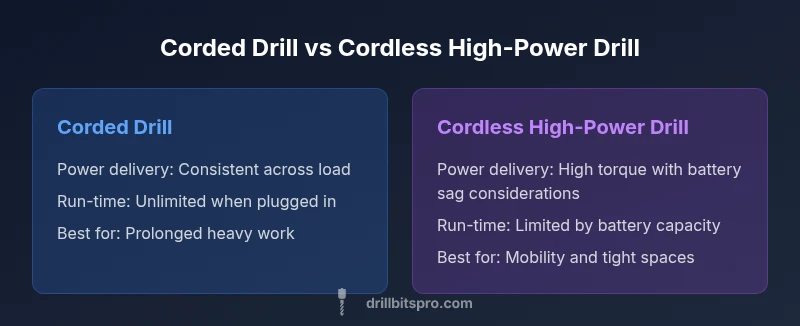
| Feature | Corded Drill | Cordless High-Power Drill |
|---|---|---|
| Power delivery | Consistent maximum power during prolonged use | High output that can drop with battery state but advances quickly |
| Torque range | Broad torque range suited for heavy drilling and driving | Strong torque with modern cells, but influenced by battery health |
| Run-time / charge | Unlimited run-time when plugged in | Limited by battery capacity and charging cycles |
| Weight | Typically heavier due to motor size and cooling | Often lighter to mid-weight, with balance optimized for portability |
| Price range | Moderate to high upfront cost with durable construction | Varies by voltage, battery chemistry, and brand; often higher upfront for high‑power packs |
| Best for | Constant-load tasks, production environments, and long sessions | Mobility-heavy jobs, tight spaces, and outdoor use |
What's Good
- Delivers stable, peak power for tough materials
- No battery sag affecting performance
- Broad accessory compatibility and longer usage life with proper cooling
- Ideal for professional, workshop, and long-duration tasks
Negatives
- Corded models limit mobility and require outlets
- Heavier and less convenient for overhead work
- Cables can get in the way on small jobsites
- Maintenance concerns include cord wear and plug integrity
Corded drills win for sustained power; cordless high‑power models win for portability and flexibility
Choose corded when you need uninterrupted power for heavy drilling. Opt for cordless high-power if you require mobility and acceptable, consistent performance away from outlets.
Got Questions?
What defines power in a drill?
Power is defined by sustained torque, motor capability, and the drivetrain’s ability to maintain speed under load. It also depends on the energy source and how well the tool tolerates heat during continuous use.
Power in a drill means steady torque and speed under load, not just a high peak number.
Are cordless drills as powerful as corded ones?
Corded drills typically offer more consistent power, especially under heavy loads. High‑voltage cordless models have made substantial gains, but battery state and heat limit peak performance in prolonged sessions.
Corded drills usually stay stronger longer, while cordless models are catching up with better batteries.
Does higher voltage guarantee more power?
Higher voltage often enables higher torque, but real-world power also depends on motor design, gear ratios, and battery health. A well‑designed 18–60V system can outperform a lower‑voltage tool in many tasks.
Voltage helps, but the overall design matters just as much.
When should I choose a hammer or impact drill for power?
For masonry, hammer or impact drills deliver the most effective power. They include a separate mechanism for hammering that helps break through concrete much more efficiently than a standard drill.
Use a hammer drill for masonry to get real power at the bit.
How do torque rating and RPM affect drilling speed?
High torque reduces stalling and improves control in tougher materials, while higher RPM speeds up drilling in soft materials when torque is sufficient. The right balance prevents strain on bits and motors.
Torque prevents stalling; RPM speeds up cutting in softer materials.
What scenario benefits most from higher power?
Prolonged drilling in hardwoods, thick metal, or masonry benefits most from higher power and sustained torque. Occasional DIY tasks may do well with mid-range cordless tools.
Hardwoods, thick metal, and masonry need real power.
How can I test a drill’s power before buying?
Test by evaluating sustained performance with a representative material, check for overheating, and compare torque under load. If possible, perform a bench test to observe how the tool handles resistance.
Test torque and heat on a representative material.
Top Takeaways
- Power quality matters more than peak specs
- Corded tools excel in continuous-duty tasks
- High-voltage cordless models narrow the gap with torque
- Choose based on your typical work environment and task duration