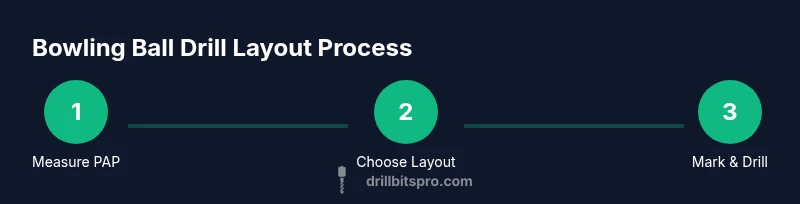
Bowling Ball Drill Layout: A Step-by-Step Guide to Precision
Discover how to plan and apply a bowling ball drill layout that matches your PAP, grip, and release. This educational guide covers layout patterns, measurement methods, tools, safety, and refinement for consistent, repeatable shots.


A bowling ball drill layout is the exact plan for where to place finger holes, core orientation, and balance weights on a bowling ball to match a bowler's grip and axis rotation. The layout uses PAP measurements, finger sizing, and weight distribution to optimize accuracy, spin, and release. Proper layout reduces inconsistent throws and improves comfort.
Why a precise bowling ball drill layout matters
According to Drill Bits Pro, a precise bowling ball drill layout is more than a labeled template on a ball. It translates your hand size, grip style, PAP (Positive Axis Point), and release tendencies into exact hole positions, core orientation, and balance weights. The result is consistent starts, smoother arcs, and improved comfort across long sessions. A well-executed layout reduces finger fatigue, minimizes over-rotation, and helps you repeat your release. When you begin the drilling process, you don’t just choose a pattern; you validate it with measurements that reflect real bowling conditions. In practice, a layout guides the ball’s path through the lane by aligning the axis of rotation with your natural hand position. The initial PAP measurement sets the anchor, then finger hole spacing, then mass bias considerations. The goal is a ball that feels like an extension of your body, not a foreign tool. This section explains why the layout matters and how it informs every drill step that follows.
Core concepts: PAP, axis tilt, and finger sizing
To understand layouts, you must first know the core concepts. The PAP, or Positive Axis Point, is the ball’s anchor for layout decisions and is measured relative to your grip, span, and hand size. Axis tilt describes how the axis of rotation tilts during release, influencing track shape and ball motion through the pins. Finger sizing includes span and finger hole diameters, which affect grip security and release timing. Balance weights and mass bias determine how the ball tracks after it hits the lane. Together, these factors define how a ball will read the lane and respond to your release. Drill layouts are designed to bring your natural hand position into alignment with the ball’s core dynamics, so your shots track consistently from the start to the finish. Hand size, pressure, and release speed all feed into the final hole pattern and weight configuration.
Layout patterns and when to use them
There isn’t a single ‘one-size-fits-all’ layout. The most common families separate layouts by how aggressively they alter the ball’s track. In general, patterns that place the pin near the PAP or along the release track offer more control over hook potential, while patterns with mass bias moved toward the track tend to produce a smoother early read. For many bowlers, starting with a layout that emphasizes a balanced hook potential and keeping the axis rotation in a predictable range is ideal. As you gain feedback from throws, you may shift toward layouts that favor stronger backend reaction or more mid-lane control. The key is to choose a pattern that aligns with your PAP, release style, and lane conditions, then verify with test throws.
Planning your layout: measurement workflow
A robust workflow starts with accurate measurements. Begin by determining your PAP via a player-assisted measurement, then assess finger sizing and span. From there, map hole positions relative to the PAP, choosing a layout that aligns axis rotation with your hand. Document the distances between holes, the pin position, and the balance weight location. Visualizing the layout on the ball before drilling helps prevent mistakes. A well-planned layout reduces drilling errors and speeds up the refinement process.
Tools, measurement techniques, and accuracy tips
Accuracy hinges on securing the ball and using precise measuring tools. A ball drilling jig or a stable drill press setup keeps the ball from turning during drilling. Calipers or a digital micrometer provide precise PAP readings, while a tape measure and ruler help with hole spacing. Marking holes with a permanent marker and masking tape improves visibility during drilling. Always wear safety glasses and work slowly to avoid slippage. Clean the ball surface before marking, and recheck measurements after any setup change. These steps minimize mistakes that can compromise grip and consistency.
Testing, refining, and documenting your layout
After drilling, test with light throws to observe how the ball tracks and hooks. Compare results against your PAP target and adjust as needed. Document hole placements, balance weights, and any observed changes in reaction. Recording measurements makes it easier to reproduce or revise layouts in the future. Regularly revise your notes based on lane conditions, ball surface changes, and spin rate to keep results reliable.
Quick reference checklist for your bowling ball drill layout
- Confirm PAP with a partner and record it.
- Choose a layout pattern that matches your release and lane style.
- Mark hole centers clearly before drilling.
- Secure the ball during drilling to avoid movement.
- Drill pilot holes, then finish with final holes and deburring.
- Validate with test throws and adjust as needed.
- Document all measurements for future reference.
Tools & Materials
- Ball drilling jig or drill press with ball adapter(Secure the ball and prevent rotation during drilling)
- Calipers or digital micrometer(Accurate PAP and finger sizing measurements)
- Tape measure or ruler(Range for hole spacing and distances from PAP)
- Permanent marker and masking tape(Mark hole centers and masking to protect the ball surface)
- Safety glasses(Eye protection during drilling)
- Sanding block or finishing kit(Smooths hole edges and removes burrs after drilling)
- Ball balancing weights or plug kit(Adjusts weight distribution as needed for balance)
- Lubricant or drilling coolant (optional)(Keeps bits cool on longer layouts)
Steps
Estimated time: 60-120 minutes
- 1
Gather tools and verify safety
Set up your workspace, wear safety glasses, and lay out your planned layout on the ball. Confirm you have all required tools before starting to minimize interruptions. This step prevents mid-process mistakes.
Tip: Double-check the ball is resting securely in the jig before any drilling begins. - 2
Measure PAP and hand dimensions
Using calipers, document your PAP coordinates and finger sizing. Record your span and middle finger length to inform hole spacing. Accurate measurements here drive the entire layout.
Tip: Have a partner check PAP measurements for reliability. - 3
Select a layout pattern
Choose a pattern that aligns with your PAP and desired reaction. Consider how the pattern will influence axis rotation and lane-read. Start with a balanced option if you’re new to drilling.
Tip: Note the pin and mass bias positions on a schematic for reference. - 4
Mark hole centers on the ball
Mark the fingertip holes and thumb hole centers with a permanent marker. Use masking tape as a guide to prevent marker smudges. Clear marks help ensure drilling accuracy.
Tip: Mark two alignment points on the ball surface relative to PAP for cross-checks. - 5
Secure the ball in the jig
Place the ball in the jig or drill adapter and tighten the clamps. Ensure no wobble or slip before starting the hole drilling sequence.
Tip: Rotate the ball slowly by hand to verify stability. - 6
Drill the pilot holes
Start with shallow pilot holes to confirm alignment. Keep the bit cool and use light pressure. Pilot holes minimize the risk of enlarging centers accidentally.
Tip: Pause to recheck alignment after each pilot hole. - 7
Drill final finger holes
Progress to the final sizes and depths, following the hole centers you marked. Maintain steady feed and consistent speed. Deburr edges after drilling.
Tip: Use minimal force; let the bit cut rather than push. - 8
Address balance and plug if needed
Calculate balance, test with a gentle roll, and adjust weight distribution or plugs as required. Finalize with a light sanding to smooth edges.
Tip: Document weight changes for future reference. - 9
Test, refine, and document
Perform test throws, observe lane reaction, and refine the layout as needed. Record measurements and outcomes to guide future layouts or revisions.
Tip: Keep a dedicated notebook or digital log for each ball.
Got Questions?
What is bowling ball drill layout and why is it important?
A bowling ball drill layout defines where to place finger holes, balance weights, and core orientation so the ball matches your grip and release style. A good layout improves accuracy, consistency, and comfort.
A bowling ball drill layout is the plan for hole positions and balance to fit your grip and release, boosting accuracy and comfort.
How do I determine my PAP for a layout?
PAP is found by observing the ball’s track and axis shift during a few controlled throws. A coach or experienced partner helps you identify your PAP reliably and repeatably.
Find your PAP by watching the ball’s track on the lane and noting the axis, ideally with a partner.
Can I adjust a drill layout after drilling?
Yes, you can adjust balance and hole positions with plugs or additional weight, but it’s best to plan carefully before drilling to minimize re-drilling.
You can adjust the ball after drilling, but it’s better to plan ahead to minimize changes.
What tools are essential for home drilling?
Essential tools include a ball jig or drill press with a ball adapter, calipers, a marker, tape measure, and safety glasses. These help you measure precisely and drill safely.
You’ll need a jig or drill press, calipers, marker, tape measure, and safety glasses for safety and accuracy.
How long does a typical drill layout take?
A well-planned layout with measurements and setup can take an hour or two, depending on equipment and practice with the process.
Expect about an hour or two if you’re careful and have good tools.
Watch Video
Top Takeaways
- Plan layout around PAP first
- Secure the ball and mark centers precisely
- Drill carefully with pilot and final holes
- Document every measurement for repeatability