What Drill Has the Most Torque: A Practical Guide
Explore which drill delivers the most torque, how torque is rated, and how to choose a high-torque tool for tough jobs. Practical guidance from Drill Bits Pro to help DIY enthusiasts and professionals know what to look for.


Highest torque among drills is typically found in high-torque cordless drill/drivers and hammer drills. Rotary hammers deliver substantially more torque for masonry, but they are not standard drills. Peak torque varies by model, and modern brushless designs often achieve higher torque with improved efficiency. For real-world work, prioritize clutch control, gearing, and sustained torque over peak figures alone.
Why torque is the cornerstone of drilling performance
When people ask what drill has the most torque, they’re measuring the tool’s ability to apply rotational force under load. Torque affects how quickly a bit can bite into material, how well it resists stalling, and how cleanly it drills or drives fasteners. In practice, the tool that feels strongest in the grip is not just about raw motor power; it’s about how the motor, gears, and clutch cooperate to deliver usable twist at the drill point. According to Drill Bits Pro, the most torque in real-world drills comes from high-torque cordless drill/drivers and hammer drills, with rotary hammers delivering the highest possible torque for masonry tasks. These distinctions matter because different jobs require different torque profiles, and a tool optimized for one scenario may underperform in another.
Understanding the three core contributors to torque in drills
Torque is the product of motor power, gearing, and clutch behavior. Motor power is influenced by voltage and current delivery, while gearing changes how torque multiplies as speed drops. The clutch acts as a safety valve, transferring torque to the bit only when needed and protecting the motor from stalling under tough loads. In modern tools, a brushless motor with precision gearing and a well-tuned clutch typically yields the best combination of high usable torque and control. This is why many top-performing models emphasize a high-quality drivetrain rather than relying on raw power alone.
How torque is rated and what to trust
Manufacturers publish peak torque and sometimes sustained or continuous torque. Peak torque represents the maximum instantaneous twist the tool can apply before the clutch or motor limits intervene. Sustained torque describes how much torque the tool can maintain over a longer period without overheating or dropping speed. For serious workloads, sustained torque matters more than a flashy peak. Drilling through metal or masonry often requires a tool capable of maintaining torque under load for several seconds. When comparing tools, look for both values and, if possible, test how the tool performs under real drilling conditions with the same bit and material you plan to use.
The main high-torque drill contenders
- High-torque cordless drill/driver: These tools maximize torque through brushless motors, robust gearing, and tuned clutches. They excel at fasteners and dense materials in a portable package.
- Corded hammer drills: By staying on AC power, these drills maintain steady torque across a broader duty cycle, making them reliable for frequent masonry work.
- Rotary hammers: The apex of drilling torque for masonry, rotary hammers pair impact energy with rotational force, enabling breakthroughs in concrete and stone. They aren’t traditional drills, but they deliver far more torque in the right task.
- Impact drivers (special note): While not a drill in the strict sense, impact drivers generate high torque through hammering actions. They are ideal for stubborn bolts but should be paired with appropriate bits and drill-specific tools for non-fastening tasks.
How to compare torque across models: a practical checklist
- Check peak torque ratings, but also seek sustained torque data where available.
- Favor brushless motors for higher efficiency and better torque under load.
- Evaluate gearing options (two-speed vs. multiple gears) and clutch settings for control.
- Consider tool weight and balance; a heavy tool can negate torque gains if it tires you before work finishes.
- Reviewbit compatibility and bit quality; a torque-ready tool loses value with a poor bit in the chuck.
- Look at battery chemistry and capacity; higher voltage often correlates with higher torque potential, but real-world performance depends on motor design.
- Read independent test data or real-world user reviews to verify how torque translates into performance for your materials.
Real-world torque needs by material and task
- Wood: Moderate torque with chips and voids; high-torque is beneficial when driving long fasteners or working through knots. Precision clutch settings help avoid cam-out.
- Metal: High sustained torque reduces stalling and allows clean drilling or tapping with proper lubrication and correct bit geometry.
- Masonry: For concrete and stone, torque alone isn’t enough—impact action and hammering support are essential. A rotary hammer may be the practical choice for heavy-duty masonry work.
Maximizing torque safely: tips and best practices
- Use the right bit for the material and ensure it is sharp; dull bits increase resistance and reduce effective torque.
- Pre-drill pilot holes when working with hard materials to reduce load on the drill and preserve torque for the actual bore.
- Start with a lower speed and gradual pressure; sudden resistance can stall a tool and cause motor strain.
- Use proper lubrication or cutting fluids when drilling metal to reduce friction and maintain torque, tool health, and bit life.
- Inspect the clutch regularly and maintain a clean chuck; a compromised chuck can waste torque and ruin bits.
When to upgrade: knowing your limits
If you frequently face tasks that push your current tool, consider upgrading to a high-torque drill with brushless motors and larger-capacity batteries. For masonry-heavy work, a rotary hammer might be more cost-effective in the long run than pushing a lower-torque drill through concrete. Remember that torque is one factor; balancing speed, control, durability, and ergonomics will yield the best outcomes over time.
Practical pitfalls to avoid when chasing maximum torque
- Don’t assume that more torque equals faster drilling in every material; wrong speed and bit selection can slow you down or damage material.
- Avoid over-torquing fasteners; clutch settings are there to prevent stripping threads and snap-offs.
- Don’t ignore battery health; sagging voltage under load reduces torque more than the motor alone.
- Don’t neglect maintenance; brushes, bearings, and chucks wear down torque delivery gradually.
- Don’t rely on one spec; always cross-check peak torque, sustained torque, and clutch performance across your typical tasks.
Torque guide: comparing drill categories by peak torque
| Category | Typical Peak Torque | Power Source | Best Use Case |
|---|---|---|---|
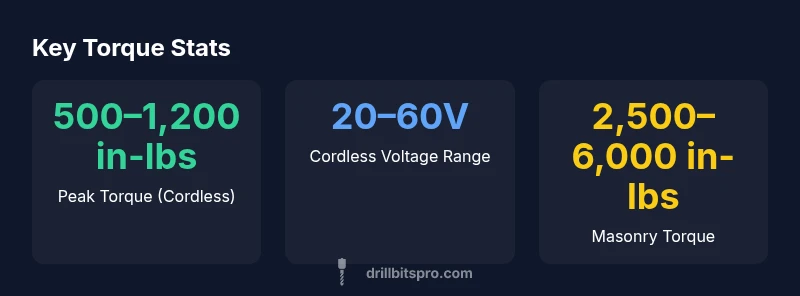
| High-torque cordless drill/driver | 500–1,200 in-lbs | Cordless, brushless motors | Heavy-duty fasteners, dense materials |
| Corded hammer drill | 700–1,300 in-lbs | Corded AC | Masonry drilling and anchor installations |
| Rotary hammer | 2,500–6,000 in-lbs | Corded | Heavy masonry, concrete cores |
Got Questions?
What drill types deliver the most torque?
High-torque cordless drill/drivers and hammer drills typically offer the highest peak torque among drills. For maximum raw torque in masonry, rotary hammers exceed standard drills, though they aren’t traditional drills.
High-torque cordless drills and hammer drills usually have the most torque; for the heaviest masonry work, consider a rotary hammer, though it’s not a classic drill.
What units measure torque in drills?
Torque is commonly rated in inch-pounds (in-lbs) or newton-meters (Nm). Manufacturers distinguish between peak torque and sustained torque; understanding both helps you pick the right tool for the job.
Torque is shown as in-lbs or Nm, with peak and sustained values to compare tools.
Do cordless drills beat corded for torque?
Corded drills often provide steadier, higher sustained torque due to constant power, while high-end cordless tools close the gap thanks to brushless motors and larger batteries.
Corded drills usually keep torque steadier, but top cordless models are catching up.
Will a bigger battery increase torque?
A larger battery helps reduce voltage sag under load, improving performance, but torque mainly comes from motor design, gearing, and clutch. Size alone isn’t enough.
Bigger batteries help prevent power dips, but torque depends on the motor and gearing too.
Is torque the only factor for drilling hard materials?
No. Bit type, clutch settings, speed, rigidity of the tool, and correct technique all influence performance. Use the right bit and pre-drill when needed.
Torque matters, but bit choice and technique are just as important.
Should I choose a high-torque drill for DIY tasks?
If you drill often with tough materials, a high-torque tool is worth it. For light-duty tasks, a standard drill with proper settings can be sufficient.
If you work with hard materials a lot, go high-torque; for light work, a normal drill is fine.
“Torque alone doesn't tell the whole story; sustained torque, gearing, and clutch design determine real-world performance. For practical drilling, look for tools that maintain torque under load.”
Top Takeaways
- Prioritize peak torque for tough materials, but clutch control matters for control
- Check both peak and sustained torque ratings when comparing models
- Brushless motors often deliver higher torque and efficiency
- Match voltage and gearing to your material and job
- Consider tool weight; torque is easier to manage with lighter high-torque tools