Drill Bit Size Chart Fractions: A Practical Guide
Explore fractional drill bit sizes, convert fractions to decimals and millimeters, and apply best practices for wood and metal drilling. Learn how to read charts, avoid mistakes, and build a reliable reference for quick decisions in DIY and professional projects.


A drill bit size chart for fractions translates common fractional inch sizes into decimal inches and millimeter equivalents, so you can pick the right bit quickly. In practice, sizes such as 1/16, 1/8, 3/16, 1/4, and 1/2 inch map to small but distinct decimal values and mm measurements, helping DIYers and professionals size holes confidently.
Understanding Fractional Drill Sizes
Fractional drill sizes are a cornerstone of practical drilling for DIY enthusiasts and professionals. They express diameters in inches using common fractions like 1/16, 1/8, and 3/16. This convention aligns with traditional hardware sizes and many drill kits, making it easier to pick a pilot or final hole size without needing a calculator on the fly. When you’re deciding on a hole diameter, start with the approximate fit you need—loose for dowels or fasteners, snug for mating parts—and then consult a fractional drill size chart to confirm the nearest standard option. Remember that hardwoods, metals, and plastics each respond differently to a given diameter, so expect slight variances and adjust accordingly. Keeping a current fractional chart near your workstation helps you move from measurement to action with minimal downtime.
Converting Fractions to Decimals and Millimeters
The practical utility of a drill bit size chart fractions is to translate fractions into decimal inches and millimeters. Decimal inches are common on calipers, drill presses, and machinist readouts, while millimeters are standard in metric tooling. For quick mental conversions, memorize anchors like 1/8
and 3/16
—then verify with a precise calculation when critical. A precise method is to multiply the numerator by 25.4 and divide by the denominator (for 3/16
)); in everyday work, approximate conversions are acceptable, provided you verify with a gauge when tolerance matters. In practice, always test on scrap to ensure the final fit is correct before committing to the project.
Reading a Drill Bit Size Chart: Fractions at a Glance
A quality drill bit size chart fractions presents columns for Fraction (inches), Decimal (inches), and Metric (mm). Start with the fraction column for quick recognition; read across to see the corresponding decimal and millimeter values. For example, 1/4
is 0.25
mm. Charts may also show tolerances and spacing between sizes to help you plan for material variability. When you’re sizing holes for dowels, choose the closest standard fraction that yields a snug fit; for wood, you’ll often go one size smaller to accommodate compression. In metalworking, lubrication and material hardness influence the final diameter, so factor those in when selecting a bit.
Common Fraction-to-Decimal Conversions You Need
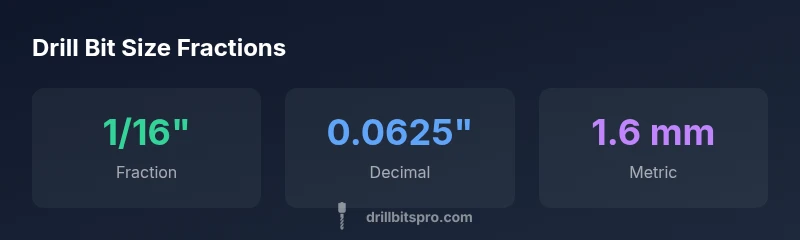
This section lists frequent fractional inches and their decimal counterparts. Keeping these values in mind speeds up bench decisions: 1/16
= 0.0625
≈ 1.6 mm; 1/8
= 0.125
≈ 3.2 mm; 3/16
= 0.1875
≈ 4.8 mm; 1/4
= 0.25
≈ 6.4 mm; 3/8
= 0.375
≈ 9.5 mm; 1/2
= 0.5
≈ 12.7 mm. When precision is critical, use a caliper to confirm and account for manufacturing tolerances. Always verify measurements on scrap to avoid costly mistakes in final assemblies.
Practical Sizing Scenarios in Wood and Metal
Wood projects often benefit from fractional sizing due to the availability of common dowel and screw diameters. Start with a size that provides a slight clearance for the dowel or fastener, and test on scrap wood to confirm ease of assembly. For metal, select bit materials appropriate to the alloy (HSS for general steel, cobalt for tougher materials) and use cutting fluid to manage heat. If you must remove material quickly, stepping up in 1/16
increments while testing can help you meet a precise diameter without over-drilling. Keep in mind that lubrication and feed rate influence the final hole diameter just as much as the bit size.
Pitfalls and Troubleshooting: Avoiding Common Mistakes
Common mistakes include assuming every hole must be exact, ignoring material expansion, and overlooking bit geometry. If a hole is too tight, downsize or ream after an initial drilling. If it’s too loose, move up a size or use a bushing. Dull bits wander, creating oversized holes, so sharpen or replace dull edges promptly. Always secure the workpiece to prevent movement during drilling and check the hole with a caliper. Building a micro-reference for fractions, decimals, and millimeters at the bench minimizes guesswork and ensures consistent results across projects.
Creating Your Personal Fraction Size Reference
A personal reference reduces decision fatigue. Start with a compact two-column chart listing fractions and decimals, then add a metric column. Place this near the drill press or inside your toolkit. Update the chart as you encounter new sizes, and consider organizing sizes by material application (wood, metal, plastic) to speed selection. A laminated, wipe-clean sheet is handy for workshop conditions, and a small caliper or digital gauge nearby helps validate measurements in real time. The more you use the chart, the more intuitive your fraction-to-size decisions become.
Best Practices and Maintenance for Fractional Sizing
Conclude with best practices: keep bits sharp, use the right material for the job, and maintain hole tolerance. Use pilot holes for large diameters, deburr edges after drilling, and apply lubricant when drilling metal. Store bits properly to prevent dulling, and replace worn bits promptly. By following these habits, your fractional-size workflow becomes accurate, repeatable, and efficient across projects of any scale.
Representative fractions with their decimal and metric equivalents
| Fraction | Decimal (inches) | Millimeters (mm) |
|---|---|---|
| 1/16 | 0.0625 | 1.6 |
| 1/8 | 0.125 | 3.2 |
| 3/16 | 0.1875 | 4.8 |
| 1/4 | 0.25 | 6.4 |
| 1/2 | 0.5 | 12.7 |
Got Questions?
What is a drill bit size chart fractions?
A drill bit size chart fractions lists hole diameters in fractions of an inch and shows their decimal and metric equivalents for quick reference. It helps you pick the right bit without guessing.
A size chart shows fractions next to decimals and millimeters, so you can pick the right bit quickly.
How do I convert 3/8 inch to millimeters?
3/8 inch equals 9.525 millimeters (approximately 9.53 mm).
Three-eighths of an inch is about 9.53 millimeters.
When should I choose fractional sizing over other systems?
Fractional sizing is common for DIY woodwork and general kits. For metal and precision parts, metric sizes or standardized numbers may be preferred. Choose based on availability, fit, and project requirements.
Use fractions for quick DIY work and when kits are labeled that way; switch to metric for precision metal work.
Can I use a drill bit size chart fractions for metal drilling?
Yes, but use proper bit material (HSS, cobalt) and lubrication. Material hardness and coolant affect the final hole size.
Absolutely, but pick a suitable bit and keep it cool with lubricant.
How do I avoid oversizing a hole with a fractional size?
Start with a pilot hole and test on scrap material. If the hole is too small, step up gradually in 1/16 inch increments until you reach the desired diameter.
Begin with a pilot hole and test on scrap; go up in small steps if needed.
“Understanding fractional sizes as a base language for hole sizing reduces guesswork and material waste. Pair this with proper pilot holes and you’ll drill cleaner, faster.”
Top Takeaways
- Prioritize a fractional size chart on the bench for quick decisions
- Convert fractions to decimals and mm before drilling
- Choose bit material with regard to the target material
- Test on scrap material to validate hole diameter
- Create a personal reference to streamline future projects