Drill Number Size Chart: A Practical Sizing Guide
A comprehensive drill number size chart guide that explains fractional, No. size, and metric conversions, with practical tips for woodworking, metalworking, and masonry.


Drill number size chart is a quick reference that translates common drill sizes across fractional inches, drill No. numbers, and metric millimeters. It helps you identify the correct bit for wood, metal, and masonry by showing approximate conversions and typical usage for each size.
Understanding the drill number size chart
A drill number size chart consolidates the main size systems you encounter when selecting bits: fractional inches, No. numbers, and metric millimeters. For DIYers and professionals, this chart acts as a bridge across standards, helping you quickly identify the closest size when you only know one reference. Drill Bits Pro emphasizes that a well-maintained chart reduces trial-and-error drilling, saves material, and keeps your project on schedule. When used properly, you can map a size to its equivalent in another system and anticipate the hole diameter you will create. Key sections typically include the common fractional increments (like 1/16, 1/8, 3/16, 1/4), popular No. sizes, and metric millimeter equivalents. In practice, the chart should be accessible at the workbench or in a project binder so you can cross-check types of materials and drill bits you own. The chart also aligns with shank types and coatings that influence guidance on hole quality and driver compatibility. Drill Bits Pro’s approach is practical: focus on sizes you actually use, note the tolerance of your bits, and update the chart as you acquire more tools. You’ll find that keeping a log of successful sizes for typical tasks—pilot holes for joinery, clearance holes for fasteners, and through holes for hardware—helps speed up future projects. As you gain experience, you’ll learn which combinations of fractions and metric sizes yield the most consistent results for your favorite materials.
Fractional sizes: fractions and decimal equivalents
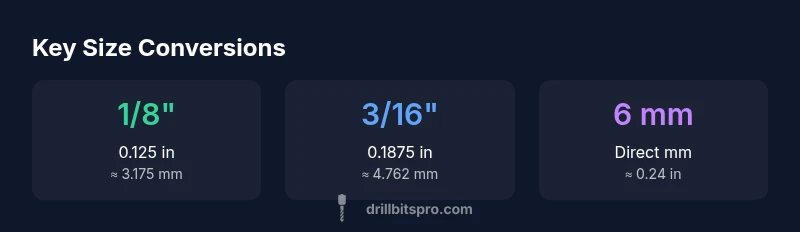
Fractional inch sizes are still the lingua franca for many woodworkers and some hobbyists. A typical reference list includes increments such as 1/16, 1/8, 3/16, 1/4, up to 1/2 inch; larger industrial sets extend beyond these. Each fraction corresponds to a decimal inch value and an approximate metric equivalent. For example, 1/8 is 0.125 inches and about 3.175 mm; 1/4 is 0.25 inches and about 6.35 mm. Remember that these decimal values are approximate because drill bit diameters vary slightly by manufacturer and material; you may see minor tolerances on the jacket of a bit. When reading a drill size chart, note the context: for pilot holes, you typically select sizes a bit smaller than the finished hole to avoid binding. Always confirm material behavior (wood, plastic, metal) and drilling method (punch marks, center punches, pilot holes) before committing to a specific fractional size. To maximize precision, map several common fractions to their metric equivalents and practice quick visual checks against your planned hole diameter.
No. sizes: a numbered system for precision
No. sizes refer to a separate standard, often used in metalworking and high-precision wood tasks. They run in sequences that don't map linearly to inches or millimeters, so you should always consult the chart to find the closest equivalent. In practice, you might see No. 6, No. 8, No. 10, up to No. 60 or higher in catalogs. The exact diameter can vary by manufacturer, so rely on the published table rather than memory. A No. 10 drill typically sits near the boundary between small fractional sizes and the larger metric entries; the chart will show you the closest match in either system. Use No. sizes when a plan specifies a number rather than a measurement, and cross-check with the material's recommended hole diameter.
Metric equivalents: converting to millimeters
Metric sizes are straightforward for most professional workflows, with millimeter values given directly (for example, 2 mm, 3 mm, 4 mm, etc.). A reliable drill size chart provides quick conversion rules: multiply inches by 25.4 to estimate mm; use a conversion table to cross-reference rounded mm values. Practice suggests carrying a small reference card within a notebook or on your digital device. For quick planning, you can create your own chart by listing a handful of commonly used sizes: 2 mm, 3 mm, 5 mm, 6 mm, 8 mm, 10 mm. This helps you compare against fractional and No. sizes when reading plans or catalogs. Drill Bits Pro notes that the grain of metal or wood and the drill type (twist, Forstner, spade) can slightly alter the final hole diameter, so anticipate minor adjustments in your final tolerance.
Reading charts for different materials: wood, metal, masonry
Wood behaves differently from metal; it expands and compresses, so bit selection and size tolerance depend on grain, pre-drilling, and pilot holes. Metal often requires precise hole diameters matched to fasteners or bearings, and you may need to deburr or ream after drilling. Masonry demands carbide-tipped bits and often larger diameters for anchors and fasteners. Use the chart to map hole size to the task: pilot holes for wood, clearance holes for bolts in metal, and anchor holes for masonry. Remember that coatings (HSS, carbide-tipped, cobalt) and shank types influence hole quality and tool life. The goal is to pick the right size with a plan that reduces risk of screw or bolt binding and ensures clean holes with minimal tear-out. Drill Bits Pro recommends testing a couple of sizes on scrap material to validate your chart predictions before committing to the final hole on a project.
Practical mapping examples and quick-reference tips
Here are practical ways to apply the drill number size chart in everyday projects: for a wood project that requires a 6 mm hole, you can look for the closest fractional size (like 1/4") and verify the actual hole diameter produced by your bit. If you only have a No. 8 bit, check the chart to find the closest mm size and decide whether to drill pilot holes or use a different bit. For metalwork, if the plan calls for 5 mm, identify a few options: 3.2 mm, 3.5 mm, 4 mm, and choose the best fit based on the material tolerance and screw size. For masonry, plan for carbide-tipped bits around 6–8 mm for anchors and ensure you have a hammer drill mode engaged. Keep notes on your favorite brands and the slight variances across manufacturers to adjust your chart accordingly. A practical tip is to maintain a small conversion cheat sheet that you can flip between in seconds during a project.
How to build and use your own drill size chart
Create a small laminated sheet or a digital note that includes a compact size map: fractional sizes with corresponding mm values, key No. sizes, and a metric section. Update the chart whenever you acquire new bits, and consider printing a copy for each job site. Practice building a conversion table that you can reuse with different materials. Finally, test a few sizes on scrap material to confirm hole diameters before working on your actual piece. By following these steps, you’ll master the drill number size chart and dramatically speed up sizing decisions on the bench.
Quick reference for common drill size conversions
| Size Type | Example | Approx. In | Approx. mm |
|---|---|---|---|
| Fractional (in) | 1/8" | 0.125 | 3.175 |
| Fractional (in) | 3/16" | 0.1875 | 4.762 |
| Fractional (in) | 1/4" | 0.25 | 6.350 |
| Metric (mm) | 2 mm | 2.0 | 2.00 |
| Metric (mm) | 6 mm | 6.0 | 6.00 |
Got Questions?
What is a drill number size chart?
A drill number size chart consolidates fractional, No. numbers, and metric sizes into a single reference. It helps you select the correct bit and understand approximate conversions across systems. Practically, it reduces trial-and-error drilling and speeds up project planning.
A drill size chart helps you pick the right bit by comparing fractions, numbers, and metric sizes so you can drill accurately the first time.
How do you convert fractional sizes to millimeters?
Convert by multiplying the fractional inch value by 25.4 to get millimeters, then round to the nearest standard size. For example, 1/8 inch equals about 3.175 mm. Always cross-check with your chart for the closest practical size.
Multiply the fraction in inches by 25.4 to get millimeters, then round to the nearest standard size.
What are No. sizes and when should I use them?
No. sizes follow a numbered standard that doesn’t map one-to-one with inches or millimeters. Use No. sizes when a plan or catalog specifies a number rather than a measurement, and cross-check with the size chart for closest equivalents.
No. sizes are a numbered drill size system; use the chart to find the closest fractional or metric size.
Which sizes are best for woodworking vs metalworking?
Woodworking commonly uses fractional and smaller No. sizes for joinery and reveals, while metalworking often uses metric sizes for precise holes. Always consider material properties, bit type, and the hole’s final purpose when selecting a size.
Wood uses smaller fractional or No. sizes; metal often uses metric sizes—check the plan and chart.
Do I still need a chart if I only use metric bits?
Even with metric bits, a chart helps because plans, catalogs, and hardware may reference fractional or No. sizes. A quick cross-reference reduces confusion and speeds decision-making on the bench.
Yes. Plans and catalogs often mix standards, so a chart keeps you accurate and fast.
“A practical drill size chart isn’t just reference material; it’s a workflow multiplier. When you can quickly map sizes across standards, you reduce errors and material waste.”
Top Takeaways
- Keep a current drill size chart at your workstation.
- Know the common size ranges across systems.
- Always verify material tolerance and bit type.
- Cross-check fractional, No., and metric sizes.
- Update your chart as you add new bits or projects.