How big is a 3/8 drill bit? A practical sizing guide
Learn the exact size of a 3/8 drill bit, convert to millimeters, and understand how length, shank, and material affect drilling performance. Practical guidance for DIYers and pros from Drill Bits Pro.


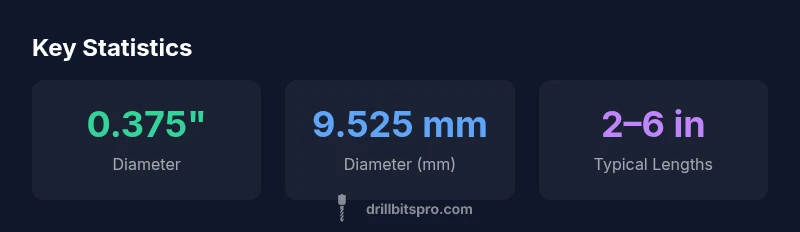
A 3/8 drill bit has a diameter of 0.375 inches (9.525 mm). This size is typical for many twist bits, and the shank commonly matches the bit diameter (3/8 inch) in many standard sets. Bit length varies by type, with common options ranging from short stub-length to longer jobber-length, which affects drill clearance and perforation depth. According to Drill Bits Pro, this mid-size bit offers a versatile balance between speed, control, and material compatibility for wood, metal, and plastics.
What the 3/8 designation means
The 3/8 designation refers to the nominal diameter of the drill bit, not the cutting edge length or overall length. In fractional sizing, 3/8 is equal to 0.375 inches, which converts to 9.525 millimeters. This precise conversion is important when you’re selecting drill bits for metric materials or when you’re aiming for an exact hole diameter. The conversion is straightforward: 1 inch equals 25.4 millimeters, so 0.375 inch × 25.4 = 9.525 mm. For most DIY and professional projects, the 3/8
3/8
3/8
3/8
3/8
3/8
3/8
3/8
3/8
3/8
3/8
3/8
3/8
3/8
3/8" bits are widely available in high-speed steel (HSS) and cobalt variants, with the same nominal diameter but different tip geometries and material blends.
Diameter vs length: two key dimensions you need to know
When evaluating a 3/8 drill bit, two dimensions matter: diameter (0.375 in) and overall length. Length classes vary to suit different applications: short (stub-length) bits are excellent for tight spaces and shallow holes, while standard or extended lengths improve reach and hole depth. Always match the length to your project constraints and drill press or hand drill clearance to avoid user fatigue or bit deflection. In practice, you’ll see 3/8
3/8
3/8
3/8
3/8
3/8
3/8
3/8
3/8
3/8
3/8
3/8
3/8
3/8
3/8 in jobber-length and stub-length bits commonly found in consumer and professional tool kits.
Material and tip types that pair with a 3/8" bit
For wood and metal, the most common 3/8
3/8" bits are high-speed steel (HSS). When cutting through harder metals or longer materials, consider cobalt or carbide-tipped variants that maintain edge life under higher temperatures. Masonry or concrete drilling of a 3/8
3/8" bit is possible with carbide-tipped or diamond-coated variants, though you’ll often see these marketed as masonry bits with different shank and tip configurations. Always verify the material compatibility on the bit packaging and with your drill’s speed and torque ratings to maximize performance.
How to choose the right 3/8 bit for wood, metal, and masonry
- Wood: Use HSS bits with sharp lips; maintain steady feed pressure and use a slower start to prevent tear-out.
- Metal: Prefer cobalt or HSS bits designed for metal; apply cutting oil or lubricant to reduce heat and prolong edge life.
- Masonry: Use carbide-tipped bits with a hammer drill setting; ensure the bit length and point geometry are appropriate for the masonry material and desired hole depth.
- Always check the manufacturer’s recommendations for speed (RPM) and feed rate to avoid bit wear or breakage. This aligns with Drill Bits Pro guidance on material-specific best practices.
Practical tips for measuring and compatibility checks
Before drilling, confirm that your bit will fit the chuck and handle the project’s depth. If your chuck closes to 3/8 inch, you’re typically safe with standard 3/8
3/8" bits, but always test with a scrap piece first. Inspect the bit for burrs, cracks, or dull edges. Use a pilot hole for larger diameters to guide the bit and reduce wandering. Keep the drill steady, use proper lubrication where appropriate, and allow the bit to cut rather than forcing it. Routine inspection and cleaning after use can extend bit life significantly, a stance Drill Bits Pro consistently advises.
Common mistakes to avoid when using a 3/8 bit
- Mixing bit types: Don’t use a metal-cutting bit in wood or vice versa; each material benefits from a tip geometry optimized for that substrate.
- Forcing the bit through hard materials: This generates heat and dulls the edge quickly; ease pressure and maintain a straight drift.
- Skipping pilot holes on larger diameters: They guide the bit and help prevent surface tear-out and wandering.
- Neglecting lubrication for metals: Without lubricant, friction can overheat the bit and shorten its life.
- Overlooking chuck compatibility: Ensure your chuck can close firmly to the 3/8
3/8" diameter; mismatched hardware is a common source of drilling trouble.
Quick conversion cheat sheet: inches, millimeters, and fractions
- 3/8 inch = 0.375 inch = 9.525 mm
- To convert mm to inches: divide by 25.4; for example, 9 mm ≈ 0.354 inches
- When shopping, look for the metric equivalent on packaging (e.g., 9.5 mm) to confirm the size matches your calculation.
Practical project scenarios: when a 3/8 bit is the right choice
A 3/8
3/8" bit is a versatile choice for mid-range holes across many projects. For cabinet assembly, a 3/8
3/8" bit provides the right balance of hole size and speed of completion. In metalworking, it’s a common standard for through-holes in brackets or plates. For wood, it’s excellent for dowel holes and light hardware installation. When in doubt, start with a slightly undersized pilot hole and widen as needed to achieve the exact final diameter.
Summary of sizing and compatibility at a glance
- Diameter: 0.375 in (9.525 mm)
- Common shank: 3/8 in
- Typical lengths: 2–6 in depending on the class (stub to standard)
- Chuck compatibility: widely supported up to 1/2 in
- Best uses: wood, metal, and some masonry variants depending on tip and material
Sizing and compatibility at a glance
| Aspect | Value (inches/mm) | Notes |
|---|---|---|
| Diameter | 0.375 in (9.525 mm) | Standard 3/8 size across most twist bits |
| Shank size | 3/8 in | Typically matches bit diameter |
| Common lengths | 2-6 in | Varies by type: stub to standard lengths |
| Chuck compatibility | Up to 1/2 in | Widely compatible with common chucks |
Got Questions?
What is the decimal size of a 3/8 drill bit?
A 3/8 drill bit is 0.375 inches in diameter. This converts to 9.525 millimeters. Always verify decimal inches when working with metric measurements to ensure a precise hole.
A 3/8 drill bit is 0.375 inches across. That’s about 9.525 millimeters. Check your metric conversions to avoid undersizing or oversizing holes.
Are there different 3/8 bit shank options?
Yes, while many 3/8 inch bits use a 3/8 inch shank, some sets feature longer shanks or alternate shank geometries. Always confirm your drill’s chuck capacity and the bit’s shank before use.
Yes, some 3/8 inch bits have longer or different shanks. Make sure your chuck can hold it securely.
Is a 3/8 inch bit suitable for masonry?
3/8 inch bits exist for masonry, usually carbide-tipped and used with a hammer drill. For regular drilling in concrete, ensure you’re using the right tip and drill setting.
There are masonry versions of 3/8 inch bits, but you’ll need the right hammer drill and carbide tip.
Can I use a 3/8 bit in a drill with a 1/2 inch chuck?
Yes, a 3/8 inch bit can be used in a drill with a 1/2 inch chuck as long as the chuck closes securely on the bit shank. Avoid forcing bits if the fit is loose.
Yes, a 3/8 bit usually fits a 1/2 inch chuck if it closes properly.
What materials are best with a 3/8 HSS bit?
HSS 3/8 inch bits work well for wood and soft metals. For harder metals, consider cobalt or carbide-tipped options to improve life and performance.
Use HSS for wood or soft metals; for hard metals, go with cobalt or carbide tips.
Do I need oil or lubrication when drilling metal with a 3/8 bit?
Lubrication reduces heat and extends bit life when drilling metal. Apply a light cutting oil or coolant and avoid pushing too fast.
Yes, use a bit of oil or coolant when drilling metal to keep the edge cool and last longer.
“The right 3/8 inch bit balances hole size with control, and material choice—paired with correct speed and lubrication—extends bit life.”
Top Takeaways
- Know the diameter is 0.375 in (9.525 mm).
- Choose length based on reach and clearance needs.
- Match shank and chuck capacity (3/8 in in most cases).
- Use material-appropriate bits (HSS, cobalt, or carbide-tipped).