Center Drill vs Spot Drill: A Practical Comparison for Precision
A practical comparison of center drill and spot drill, detailing purpose, geometry, best-use scenarios, and tips for achieving accurate pilot holes in metal and wood.


Center drill vs spot drill presents a clear distinction in function and outcome. A center drill creates a true center and a chamfered entry for screw heads or subsequent drilling, while a spot drill forms a precise conical guide that prevents wandering for a clean pilot hole. In practice, use a center drill for centering on metal work; switch to a spot drill when you need a tight pilot hole and reduced runout.
Overview of Center Drill and Spot Drill
Center drills and spot drills are specialized tools designed to improve accuracy at the start of a hole. A center drill is a two-part tool that combines a drill with a built-in chamfer to create a true center and a slight chamfer at the hole entry. This makes tapping easier and provides a stable starting point for deeper drilling. A spot drill, by contrast, is a short, conical bit that creates a precise guiding cone without removing significant material. The primary difference lies in geometry and the resulting entrance for subsequent operations. When you encounter the task of starting a hole on metal, aluminum, or harder plastics, understanding center drill vs spot drill helps you choose the correct tool for the job. According to Drill Bits Pro, the choice should be driven by the need for centering accuracy, hole alignment, and the intended finishing step. The Drill Bits Pro team found that predictable hole geometry often reduces rework and scrap, especially on production runs where consistency matters.
This section sets the stage for a deeper dive into how these two drill types influence accuracy, workflow, and tool life, along with practical usage guidelines for DIYers and professionals alike.
How center drills differ from spot drills
Center drills and spot drills are both designed to improve hole quality, yet they operate at different stages of the drilling process. A center drill has a longer pilot section that creates a true center and a chamfer, making it ideal for tapping or starting a hole with a clean edge. A spot drill is shorter, with a conical tip that creates a precise starting point to guide the primary drill without wandering. In center drilling vs spot drilling, the key trade-off is between center accuracy versus speed and simplicity. The center drill is more about establishing a robust starting point and chamfer for threaded holes, while the spot drill emphasizes hole accuracy and drill alignment for more complex diameters. In practice, the decision hinges on the material, hole depth, and whether an accurate center is needed for tapping or reaming.
When to use a center drill
Use a center drill when the operation requires a true center, chamfer, and alignment for subsequent machining steps. Typical scenarios include tapping through-holes, creating a deburred entrance for countersinks, and starting a hole for precise geometry in metals like steel and aluminum. In these cases, center drills help ensure the drill bit stays on axis and the chamfer provides a clean surface for threads. According to the Drill Bits Pro team, centering before deeper drilling reduces wandering and improves repeatability in repeated parts. For DIY projects, a center drill is particularly useful when you plan to tap or finish a hole with a clean exit edge.
Comparison
| Feature | Center Drill | Spot Drill |
|---|---|---|
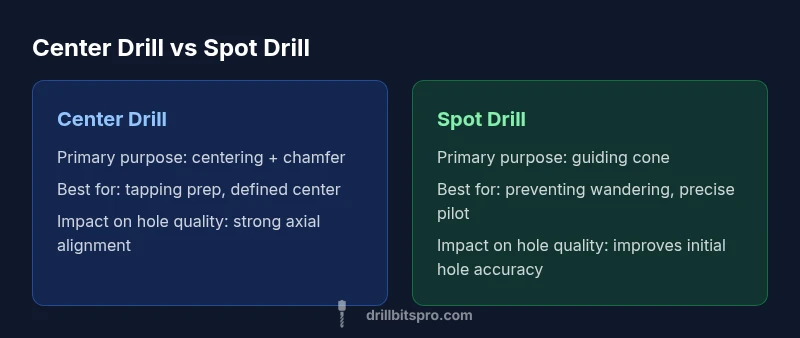
| Primary purpose | Center drilling for centering and chamfering at hole entrance | Spot drilling for creating a precise guiding cone to prevent wandering |
| Best applications | Metalworking requiring a true center and chamfer prior to tapping or drilling | Materials needing a precise pilot hole with reduced wander (steel, aluminum, hard plastics) |
| Hole quality impact | Produces a defined center and chamfer, aiding accuracy | Produces accurate pilot holes and guides subsequent drilling, reducing wandering |
| Common sizes | Typically longer, multi-stage with a 90° pilot | Shorter, conical tip designed for spotting before drilling |
| Cost range | $5-$25 per drill (basic sets) | $5-$20 per drill (basic spotting drills) |
What's Good
- Improved hole accuracy when used for proper centering
- Helps prevent drill wander and misalignment
- Creates a chamfer that simplifies tapping and countersinking
- Improves repeatability on repeated parts
- Reduces tooling wear by guiding subsequent drilling
Negatives
- Requires additional tool change in workflow
- Not suitable as a universal replacement for all drilling tasks
- Center drills can wear faster if misused or overloaded
- Spot drills may not locate center if misaligned
Center drill is best for centering and chamfering before tapping or deep drilling; spot drill excels at guiding the subsequent drill to prevent wandering.
If your project requires a defined center and clean entry edge, center drills are the safer choice. For high-precision pilot holes where wandering must be minimized, spot drills shine. In many workflows, using both in sequence offers the best of both worlds.
Got Questions?
What is the main difference between a center drill and a spot drill?
Center drills create a true center and chamfer for tapping or finishing, while spot drills produce a precise guiding cone to prevent wandering during the initial drill. The choice depends on whether you need centering accuracy or a clean pilot hole.
Center drills shape the entry for tapping or finishing, while spot drills guide the drill to prevent wandering.
When should I use a center drill first in metalworking?
Use a center drill when you need a defined center and chamfer for tapping or precise alignment before deeper drilling. This reduces misalignment and improves thread quality over long holes.
Center drills help you start a hole cleanly for tapping or deep drilling.
Are spot drills useful for wood drilling?
Spot drills are primarily used in metalworking to prevent wandering. For wood, you typically rely on wood-specific pilot holes or brad-point bits, though in some metal-to-wood transitions, a spot drill might be used carefully.
Spot drills mainly help with metal drilling precision; wood work often uses different pilots.
What sizes do I need for center and spot drills?
Sizes depend on your hole diameter and the tools you already own. Start with common center drill and spot drill sizes that match your drill bit set, then add sizes that cover your typical hole ranges.
Choose sizes that match your usual hole diameters and drill bits.
Can I sharpen center or spot drills, or should I replace them?
Center and spot drills can be sharpened in some setups, but many are economical and best replaced when worn. Follow manufacturer guidance and avoid aggressive sharpening that changes the tip geometry.
You can sharpen some drills, but often replacement preserves geometry and accuracy.
Top Takeaways
- Define your goal: centering vs guiding
- Choose the right tip geometry for the material
- Plan the workflow to minimize tool changes
- Test on scrap before production runs