Different Type Drill Bits: A Practical Guide
Explore different type drill bits and how to pick the right one for wood, metal, and masonry. Drill Bits Pro analyzes common bit types, their uses, and pro tips to improve hole quality and tool life.


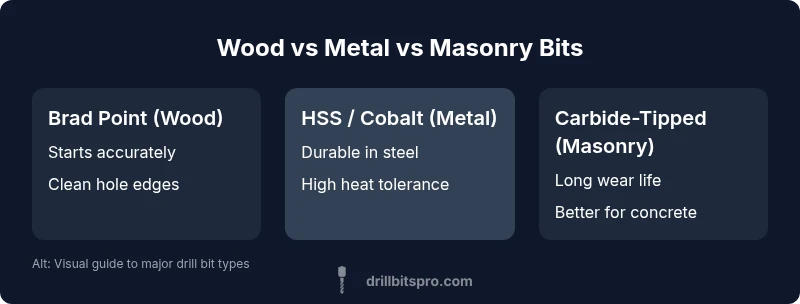
Choosing the right drill bits matters for clean holes and long tool life. In short, wood bits (Brad point or twist), metal bits (high-speed steel or cobalt), and masonry bits (carbide-tipped) each excel in different materials and drilling conditions. This article compares common types, their best uses, and how to pick the right bit for your project.
What are drill bits, and why does type matter?
A drill bit is more than a sharp piece of metal. The geometry, material, and shank design determine how well it starts a hole, how clean the edge will be, and how long the bit lasts under load. When you encounter different materials—wood, metal, masonry—the choice of bit becomes a pivotal factor in success. In practice, the phrase "different type drill bits" captures the broad range from wood-specific bits to carbide-tipped masonry bits. For DIYers and professionals, understanding material compatibility, flute geometry, and wear resistance helps you avoid common pitfalls like wandering, chatter, or smoking blades. In this guide from Drill Bits Pro, we break down the major families and provide practical decision criteria for everyday projects.
Woodworking bits: Brad Point, Twist, Spade, and Forstner
Woodworking spans a spectrum from delicate cabinetry to rough carpentry. Brad point bits are engineered to start holes precisely with a center point and spurs that reduce wandering—excellent for softwood and hardwood alike. Twist drills are versatile and affordable, ideal for general-purpose wood and light metal work, but they can wander without a center point. Spade bits cut quickly in thick wood but can leave ragged edges; they excel in bulk tasks where speed matters. Forstner bits create clean, flat-bottom holes perfect for decorative inlays or hardware installation. When selecting wood bits, match the bit’s flute design and point geometry to the wood type and hole goal, then pair with a sharp, properly fed feed rate.
Metalworking bits: HSS, cobalt, and carbide-tipped options
Metal drilling emphasizes strength and heat resistance. High-speed steel (HSS) bits work well for soft metals and light-duty steel but can dull quickly on harder alloys. Cobalt-infused HSS bits extend life on tougher metals like stainless steel and alloy steels. Carbide-tipped bits are the workhorses for ongoing metal drilling and high-temp applications, delivering superior wear resistance at the cost of higher price. Choose bit geometry based on material hardness, desired hole size, and your drill’s power. If you’re using a handheld drill or drill press, ensure the shank and flute geometry align with your chuck size and the material’s rigidity to minimize deflection.
Masonry and concrete bits: Carbide-tipped and SDS compatibility
Masonry bits are designed to cut through stone, concrete, and brick. Carbide-tipped bits stay sharp longer in hard aggregate materials, making them a good long-term choice for frequent masonry work. For hammer or rotary hammer drills, SDS or SDS-Plus/Max shanks can improve energy transfer and reduce bit wobble, but check your tool compatibility. When drilling ceramic tile, a masonry bit with a carbide tip or a diamond-tipped variation is common. Always start with a small pilot hole and progress to the final size with steady, moderate pressure to avoid cracking.
Specialty bits and why they matter
Beyond basic options, specialized bits address niche tasks. Step drill bits widen holes gradually for sheet metal and thin materials with controlled enlargement and smooth edges. Hole saws create large holes for conduit or piping and are often paired with a pilot bit to minimize wandering. Countersink bits produce clean countersunk recesses for screw heads, and plug cutters reproduce wooden plugs for seamless repairs. Coupled with correct speed and lubrication, specialty bits reduce repeated drill passes and improve overall work quality.
Coatings, shanks, and how they affect performance
Bit coatings such as titanium nitride (TiN) or aluminum nitride (TiAlN) reduce wear and heat buildup, especially in metal drilling. Coatings are beneficial where friction is high but do not fix fundamental geometry issues. Shank design (round, hex, or spline) influences chuck compatibility and torque transfer. When possible, use the shortest practical shank length and a properly aligned chuck to minimize runout. Remember that coatings wear off over time, so inspect bits and replace when performance deteriorates. Always use the correct drill speed and apply steady pressure to protect both bit and workpiece.
How to choose by material and task
Start by identifying the workpiece material and the desired hole characteristics. For wood: prioritize Brad Point for accuracy or Forstner for flat-bottom holes. For general-purpose wood/metal projects, a high-quality Twist bit is a good baseline. For metal: select HSS or cobalt for hard alloys, or carbide-tipped for frequent cutting of tough metals. For masonry: carbide-tipped masonry bits with a hammer drill are essential. Evaluate your drill’s power, chuck size, and the availability of a compatible shank. Finally, consider a basic kit that bundles wood, metal, and masonry bits to simplify procurement and ensure you’re prepared for common tasks.
Drill bit sizes, sets, and choosing the right kit
Bit size choices come in millimeters and fractional inches. For most homeowners, a starter set including 1/16
1/8
3/16
1/4
3/8
1/2
8 mm, 10 mm, and 12 mm covers typical sizes. Sets with both wood and metal bits help you cover a wide range without separate purchases. When shopping, look for labeled bit types, a durable coating, and a robust case for organization. Avoid low-quality sets with inconsistent bit diameters or magnets that fail to hold bits securely. A well-chosen set saves time and reduces the risk of using the wrong bit for a job.
Care, sharpening, and prolonging bit life
Keep bits sharp by avoiding overheating and excessive pressure. For HSS bits, use proper lubrication when drilling metal to minimize heat buildup. Sharpening can extend life, but determine whether a bit is salvageable—carbide-tipped bits are not field-sharpenable. Inspect cutting edges for nicks, and replace bits showing significant wear. Store bits in a dry, organized case to prevent corrosion and misplacement. Regularly clean chips and debris from flutes to maintain efficient cutting and reduce binding.
Common mistakes and how to avoid them
Common errors include using the wrong bit for the material, drilling at excessive speeds, and applying too much pressure. Wandering holes and chipped workpieces are frequent outcomes of improper starting points and dull bits. Avoid these by selecting the correct bit by material, starting the hole with a center point, using a backing board for drilling, and letting the bit do the work with steady, even feed. If you encounter a sticky bit, pause, withdraw slowly, and deburr edges before continuing.
Budgeting and value: investing in a practical kit
A balanced kit reduces project bottlenecks and improves efficiency. Consider a core bundle with wood, metal, and masonry bits, plus a couple of specialty bits for unexpected tasks. Evaluate lifetime value rather than upfront price: higher-quality bits typically last longer, resist dulling, and yield cleaner holes with less rework. For frequent hobbyists and professionals, a mid-range to premium assortment can deliver better long-term value, especially when paired with tool maintenance routines.
Safety and best practices
Always wear eye protection and secure the workpiece with clamps. Use the correct bit for the material, verify the drill speed, and maintain a firm grip to avoid kickback. When drilling deep holes, consider backing material to prevent blowout and wear on the bit edges. Practice safe handling and storage, and never attempt to sharpen carbide-tipped bits in the field. With these practices, you minimize risk while maximizing hole quality and tool life.
Feature Comparison
| Feature | Brad Point Bit (Wood) | Twist Drill Bit (General Purpose) | Masonry Bit | Forstner Bit (Wood) |
|---|---|---|---|---|
| Best For | Precise pilot holes in soft/hardwood | General-purpose drilling in wood/metal | Concrete, brick, stone | Flat-bottom, clean holes in wood |
| Material | HSS or carbide-tipped (wood bits often HSS) | HSS / cobalt for metals; some carbide-tipped | Carbide-tipped or carbide-enriched | HSS or high-grade steel |
| Shank Type | Round HSS | Round HSS or hex in some sets | Round HSS; some SDS variants exist for hammer drills | Round HSS |
| Hole Type | Pilot and through holes with clean edges | Through holes in wood or metal | Through or partial-depth holes in masonry | Flat-bottom holes in soft/hardwood |
| Price Range | Moderate | Low to moderate | Moderate to high (depending on carbide content) | Moderate |
What's Good
- Clear guidance on material-specific bit types
- Helps reduce mistakes and rework
- Improves hole quality and tool longevity
- Supports smarter purchasing decisions
Negatives
- Specialty bits can be costly upfront
- More options mean more decision fatigue
- Coatings wear over time and need replacement
A mixed kit covering wood, metal, and masonry is the most versatile choice
For most projects, start with a core wood, metal, and masonry set. This approach minimizes missteps, delivers reliable holes, and reduces tool wear. Add specialty bits as needed for niche tasks.
Got Questions?
What is the difference between Brad Point and Twist drill bits?
Brad Point bits have a center point and spurs to start holes accurately in wood, while twist bits are general purpose and versatile for wood and metal. Brad Point minimizes wandering and tear-out, whereas Twist bits are more economical and widely available.
Brad Point bits start holes accurately in wood, while Twist bits are the general-purpose option for wood and metal.
Can I use metal bits in wood?
Yes, you can drill wood with metal bits, but they may wander and dull more quickly than wood-specific bits. Wood bits typically provide cleaner starts and edges, so use the right bit when possible.
You can use metal bits in wood, but wood-specific bits usually give better starts and cleaner edges.
What is the best bit for tile?
For ceramic tile, a carbide-tipped masonry bit or a diamond-tipped bit is common. Start slow, use light pressure, and keep the bit cool to prevent cracking the tile.
Use a carbide-tipped masonry or diamond-tipped bit for tile, with slow speed and light pressure.
Do coatings help, like TiN or TiAlN?
Coatings reduce wear and heat buildup, improving life in high-friction applications. They are beneficial but do not substitute for proper bit geometry or correct material choice.
Coatings reduce wear in high-friction use, but don’t replace good bit choice.
How do I sharpen drill bits?
Sharpening is feasible for many HSS bits using a bench grinder or a dedicated sharpener. Carbide-tipped bits are not field-sharpenable. Inspect edges for dullness or chips and replace as needed.
You can sharpen most HSS bits with a grinder; carbide-tipped bits usually aren’t sharpened in the field.
What’s the difference between SDS and standard bits?
SDS bits are designed for hammer drills, especially masonry, for better energy transfer and reduced bit wobble. Standard bits fit regular drill chucks and work well for wood and metal, but may not tolerate hammer action.
SDS bits are for hammer drills; standard bits fit regular drills and aren’t optimized for hammering.
Top Takeaways
- Identify your material first to narrow bit type
- Prioritize proper bit geometry for clean holes
- Invest in a balanced wood/metal/masonry kit
- Choose carbide-tipped for frequent masonry work
- Maintain bits and store them properly