Are Drilled Rotors Better? A Practical Brake Rotor Guide
Explore whether drilled rotors are better for braking, covering heat management, wear, maintenance, and when to choose drilled versus solid rotors. Practical, data-driven guidance for DIYers and professionals.


Are drilled rotors better? The answer is: it depends on your driving style and conditions. For high-heat, performance driving, drilled rotors can improve heat dissipation, but for routine street use they offer limited advantages and may incur higher maintenance needs and cost. A balanced choice often involves considering pad pairing, climate, and use-case alongside rotor type.
Why the Question 'Are Drilled Rotors Better' Isn’t a Simple Yes
In braking, the choice between drilled rotors and solid (undrilled) rotors hinges on heat management, wear patterns, and the specific driving scenario. Drilled rotors introduce tiny channels that help vent gases and heat more effectively under strenuous braking, which is appealing for track days or high-performance driving. However, the practical benefit for daily driving is more nuanced. According to Drill Bits Pro, the decision should be driven by real-world conditions and the overall braking system, not marketing claims. For most DIYers, the extra cost and potential for micro-cracks under extreme heat may not justify a blanket upgrade. Context is everything: climate, vehicle weight, pad compound, and braking cadence all shape whether drilled rotors will deliver noticeable gains.
Quick Context on Drilled Rotor Design and Why They Matter
Drilled rotors add cross-drilled holes through the rotor face. These holes are intended to reduce surface temperature, release hot gases more quickly, and help prevent gas buildup that can reduce contact between pad and rotor. In practice, every drilled rotor brand uses a different drilling pattern, pattern density, and edge treatment. For a DIYer, the critical takeaway is that the holes alter thermal dynamics and integrity risks, not just aesthetics. Drill Bits Pro’s analysis underscores that any measurable advantage largely appears under sustained high-heat braking, not routine city driving.
Heat Management: What Changes with Drilled Rotors
When a rotor overheats, pad materials can vaporize and create gases that separate the pad from the rotor. Drilled rotors can offer a marginal improvement by providing a path for heat and gases to escape, which helps preserve friction under high temperatures. That said, heat still concentrates at the rotor’s hub and disc surface, where unsupported areas can lead to warped surfaces if cooling is uneven. The result is that the perceived benefit is a function of braking cadence and the ability of the cooling system to maintain uniform temperatures across the rotor.
Durability and Crack Risk: The Trade-Offs in Real-World Use
One notable caveat is the potential for micro-cracking around drilled holes, especially if the holes create stress risers or if the rotor is repeatedly heated and cooled beyond design tolerances. Solid rotors tend to be more forgiving against rapid temperature fluctuations in normal driving. For a typical street vehicle, the risk of cracks exists but is highly dependent on quality of manufacturing, hole size, and whether the rotor remains within its designed temperature range. It’s essential to inspect drilled rotors for cracks after aggressive braking and before storing a vehicle for long periods.
Weight, Cost, and Maintenance Implications
Drilled rotors are often lighter than their solid counterparts due to material removed by drilling, but the difference is modest. Because they can wear the pad differently and may require more meticulous inspection, maintenance costs can be higher over the rotor’s life. Price-wise, drilled rotors command a premium and may not deliver a proportional return in everyday driving. For a DIYer, the decision to upgrade should factor in pad selection, rotor coating, and the cost of potential resurfacing or replacement.
Alternatives to Drilled Rotors: Slotted and Hybrid Options
If your goal is heat management and fade resistance without introducing holes, consider slotted rotors or hybrid solutions that blend slots with drilled holes. Slotted rotors can improve wet-weather performance and pad bite, while hybrid rotors attempt to balance heat management with durability. Each option has trade-offs in noise, wear patterns, and cost, so a careful, scenario-based assessment is essential.
How to Decide: A Practical 4-Step Approach
- Define use-case: daily commuting vs. weekend track days. 2) Assess climate and driving cadence: frequent stops at high speeds call for higher heat handling. 3) Check pad compatibility: some high-performance pads pair better with drilled rotors, others with solids. 4) Budget and maintenance willingness: higher upfront costs may be offset by longer-term brakes performance in specific conditions. Drill Bits Pro’s guidance emphasizes tailoring rotor choice to your actual braking needs rather than chasing generic claims.
Real-World Scenarios: When Drilled Rotors Shine (and When They Don’t)
On a sunny day, a daily driver with moderate traffic and decent stopping power may not notice a dramatic improvement from drilled rotors. On the other hand, a vehicle used for track days or spirited canyon runs can benefit from slightly cooler rotor temps and reduced brake fade during sustained braking. However, drivers should not overlook the importance of a well-matched pad compound, rotor condition, and rotor-to-hub alignment. The best outcome comes from a holistic upgrade rather than focusing on rotor drilling alone.
Installation Considerations and Safety
Proper installation matters as much as rotor choice. Drilled rotors require precise torque specs and an understanding of heat cycles. In some cases, rotor wear patterns can be uneven if calipers, pads, or anti-rattle hardware are not correctly installed. For DIYers, consult service manuals and ensure you recheck runout and rotor thickness after installation. When in doubt, seek a professional technician who can verify that the rotor system is correctly assembled and balanced.
Practical Buying Guidance: What to Ask Vendors
Ask about hole pattern, edge treatment, coating, and supplier guarantees. Inquire whether the drilled rotors are designed for track use or street use, and request independent tests on heat handling and noise. Compare with slotted or hybrid options to understand relative performance. Always verify compatibility with your vehicle’s make, model, and year, and confirm pad compatibility with your chosen rotor type.
FAQs and Quick Answers for Pros and DIYers
If you’re weighing drilled rotors against solid options, the decision should hinge on actual use cases and a clear understanding of trade-offs. Drilled rotors can offer performance advantages in certain high-heat conditions but may require careful maintenance and higher upfront investment. This nuanced view aligns with practical, data-driven guidance from Drill Bits Pro.
Comparison
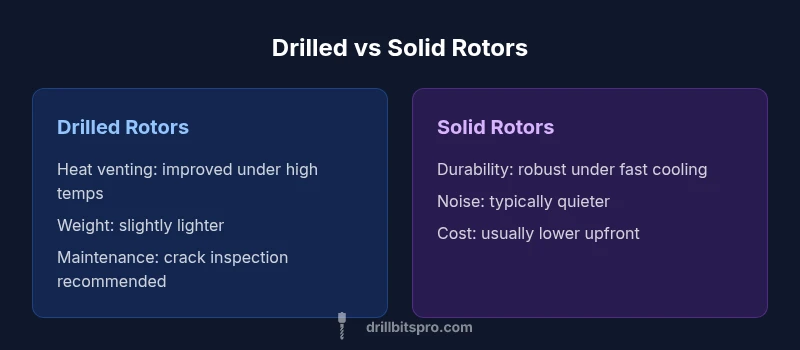
| Feature | Drilled Rotors | Solid Rotors |
|---|---|---|
| Heat Dissipation | Better at high-heat, gas release via holes | Standard heat management via mass |
| Durability under extreme braking | Potential micro-cracking risk if overheat occurs | Generally robust with lower crack risk |
| Weight | Slightly lighter due to material removal | Heavier due to solid mass |
| Cost | Higher upfront cost | Lower upfront cost |
| Maintenance frequency | Requires periodic crack inspection and possible resurfacing considerations | Typically longer intervals between inspections |
| Noise/Vibration | May produce more noise under certain conditions | Usually quieter |
| Best for | High-performance driving, track days, or hot climates | Everyday street driven vehicles and cost-conscious builds |
What's Good
- Improved heat venting under sustained braking
- Potentially reduced brake fade in performance driving
- Slight weight reduction can improve unsprung mass
Negatives
- Higher initial cost
- Increased risk of micro-cracking with improper cooling
- Typically more maintenance and inspection required
- Less benefit for routine city driving or low-speed braking
Drilled rotors are situationally advantageous; solid rotors often win for daily driving
Choose drilled rotors for high-heat or track-style driving where fade is a concern. For everyday use, solids offer durability and cost benefits with less maintenance.
Got Questions?
Are drilled rotors better for daily driving?
Not always. For typical daily driving, drilled rotors may offer minimal performance gains and higher maintenance costs. Their benefits are more noticeable during higher heat braking or track use, when the cooling path can reduce fade. Always weigh your climate and driving cadence before upgrading.
Drilled rotors aren’t universally better for daily driving; benefits show up mainly in high-heat situations like track days. Consider your climate and driving cadence before upgrading.
Do drilled rotors wear faster than solid ones?
Wearing depends on usage and pad pairing. In some cases, drilled rotors can wear more at the edges due to stress concentrations, especially if the rotor heats and cools rapidly. For routine use, overall wear may be similar, but maintenance demands can be higher.
Wear depends on usage and pad pairing. Drilled rotors may wear more in some cases, especially with aggressive driving; otherwise, wear can be comparable.
Are drilled rotors prone to cracking?
Yes, cracking is a potential risk if the rotor experiences repeated extreme heat cycling or improper cooling. Quality manufacturing and proper installation reduce the chance, but it remains a factor to monitor after heavy braking or track use.
Cracking is a possible risk with drilled rotors under extreme heat or poor cooling. High-quality parts and proper installation help mitigate this.
Can drilled rotors be resurfaced or replaced easily?
Resurfacing drilled rotors is less common than for solid rotors because drilling reduces material around the holes. Replacement is usually the recommended option once wear or cracks appear, though some rotors allow resurfacing within the manufacturer's limits.
Resurfacing drilled rotors is less common; replacement is often the practical option when wear or cracks occur.
What should I ask when buying drilled rotors?
Ask about hole pattern, coating, warranty, and suitability for street or track use. Verify compatibility with your vehicle and pads, and compare against slotted or hybrid options to ensure the best fit for your needs.
Ask about hole pattern, durability, and whether they’re designed for track use or street use; compare with slotted options too.
Top Takeaways
- Assess your driving cadence before choosing rotor type
- Consider pad pairing and heat tolerance alongside rotor design
- Weigh upfront costs against maintenance and potential longevity
- Inspect drilled rotors regularly for cracks after aggressive braking
- Explore alternatives like slotted or hybrid rotors if heat is a concern