Are Drilled and Slotted Rotors Better? A Data-Driven Comparison
An analytical side-by-side comparison of drilled, slotted, and drilled-and-slotted brake rotors, focusing on heat management, wear, noise, and value to help DIYers and professionals decide which design fits their driving style.


The short answer is: it depends on how you drive. Drilled rotors excel at heat management in extreme braking scenarios, slotted rotors improve pad bite and debris removal, and drilled-and-slotted rotors attempt to combine both benefits. For everyday driving, standard rotors often deliver the best value, while high-demand use (track days, heavy towing) can justify the premium of drilled or drilled-and-slotted designs. Are drilled and slotted rotors better? in specific, high-heat contexts they can be, but they are not universally superior.
Defining rotor options and the central question
When you ask are drilled and slotted rotors better, it helps to define the options clearly. Standard rotors are solid discs without features to vent gases or shed heat beyond mass and rotor surface. Drilled rotors contain small holes intended to vent hot gases created during braking, potentially aiding cooling under high heat. Slotted rotors use machined grooves to provide paths for gas and dust, improving pad contact and debris removal. Drilled plus slotted rotors combine both features to maximize heat management and pad interaction in demanding conditions.
From Drill Bits Pro's perspective, these designs are tools with trade-offs. The right choice depends on driving style, vehicle weight, and climate. For many daily drivers, the added cooling effect of drilling is modest unless braking is heavily loaded or the environment is hot. In performance or demanding use, the combination of slots and holes can yield measurable gains in fade resistance, repeat braking performance, and overall consistency. The Drill Bits Pro team emphasizes that there is no universal answer; instead, readers should balance heat load, rotor thickness, and maintenance considerations before deciding.
Key performance differences: heat, gas management, and pad interaction
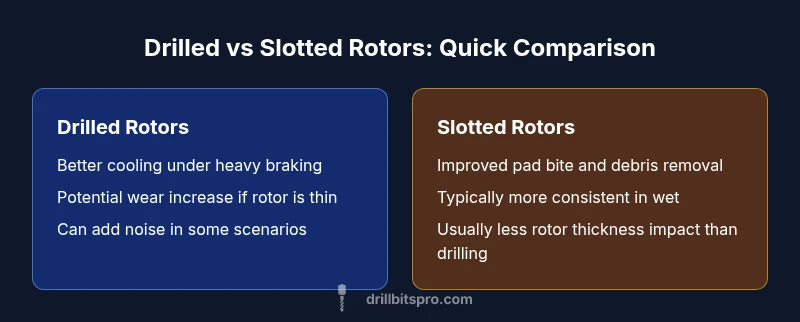
Rotors come in several geometries that influence how braking heat is managed, how gases form at the pad–disc interface, and how pad material interacts with the contact surface. Drilled rotors create channels for hot gases, which can reduce gas buildup and fade under sustained braking. Slotted rotors provide an escape path for dust and moisture, helping maintain pad contact during wet or muddy conditions. When you combine drilling and slots, you typically see the most aggressive heat management and pad interaction, but at the cost of higher susceptibility to wear if rotor thickness is reduced too aggressively.
In practice, the benefits hinge on your braking demand and heat load. On light-duty street driving, you may notice little practical difference between drilled or slotted rotors and standard rotors. On a performance street setup or a track day, the cumulative effect of improved gas evacuation and debris removal can translate into more consistent braking feel and reduced fade.
Real-world use cases: street, track, and heavy-duty conditions
For daily drivers who commute on normal roads, standard rotors paired with quality pads often deliver reliable performance with minimal maintenance. Drilled rotors may offer some cooling benefits during repeated short sprints but provide diminishing returns if you don’t regularly push the brake system to high temperatures. Slotted rotors tend to perform better in wet conditions by promoting faster drying of the contact surface, which can translate to more confident initial braking. Drilled-and-slotted rotors are typically reserved for drivers who routinely demand maximum braking performance, such as on aggressive street setups or club-track days, where fade resistance and pad comfort are prioritized over rotor longevity.
From a maintenance perspective, more complex designs require periodic inspection for wear and cracking, particularly if heat cycles are intense. The chosen option should align with your typical driving profile and the vehicle’s braking system tolerance. Drill Bits Pro notes that consistency in pad material and rotor thickness is crucial whenever rotating between rotor designs to preserve braking balance and safety.
Durability and longevity considerations
Rotor durability is shaped by material quality, thickness, heat treatment, and exposure to high-temperature cycles. Standard rotors generally offer the best durability for normal driving, with longer service life under light-to-moderate braking. Drilled rotors introduce micro-holes that can, over many heat cycles, slightly reduce the cross-sectional area, potentially increasing wear if the rotor is already near minimum thickness. Slotted rotors can wear pads more evenly under heavy dust or water exposure but slots can act as stress concentrators if not machined correctly.
In combination (drilled plus slotted), the rotor benefits from both cooling channels and debris management, but the trade-off is a potential reduction in rotor strength relative to a conventional, solid rotor. Proper rotor thickness, caliper clearance, and pad selection are essential to avoid excessive wear or warping, especially on high-heat braking scenarios. Regular inspection for cracks or uneven wear is advised when using more aggressive rotor designs.
Cost, availability, and long-term value
Rotor design choice influences upfront cost and long-term value. Standard rotors typically cost less and are widely available, which translates to lower total cost of ownership for everyday use. Drilled rotors command a premium due to the additional machining and potential packaging considerations, with price increases depending on the rotor material and coating. Slotted rotors generally sit between standard and drilled in price, offering performance benefits with modest extra cost. Drilled-and-slotted rotors are the premium option, delivering the strongest performance claims but at the highest price point and with the most stringent maintenance expectations.
From a value perspective, the best choice depends on your driving frequency, climate, and whether you regularly drive in conditions that stress the braking system. Drill Bits Pro analysis shows that for most drivers who do not regularly push brakes to maximum heat, standard rotors paired with quality pads provide the best balance of cost, reliability, and performance. If heat fade is a real concern in your routine, a considered upgrade to drilled or drilled-and-slotted rotors may pay off in consistent performance and confidence.
Compatibility, installation, and maintenance considerations
Not all vehicles are equally suited to every rotor design. Rotor thickness, caliper compatibility, and wheel clearance determine whether standard, drilled, slotted, or drilled-and-slotted rotors can be installed without modification. It's essential to verify minimum rotor thickness after wear and to consult manufacturer guidance on hole count and slot dimensions. Slotted rotors can increase pad wear slightly in some setups, so you’ll want to monitor pad life and cost per mile. Drilled rotors, if not properly finished or if used on vehicles with very heavy duty braking, can crack under thermal cycling if the cross-section is too thin. The safest approach is to select a rotor design that aligns with the vehicle’s braking system architecture and the expected heat-load profile.
For DIYers and professionals, the maintenance discipline matters: regular rotor thickness checks, pad–rotor compatibility verification, and inspection for cracks or warping after aggressive use will help preserve performance and safety over the rotor life.
Myths vs. reality: common misconceptions debunked
Myth: Drilled rotors always cool better under any circumstances. Reality: Cooling benefits depend on heat load and rotor thickness; holes can help under high heat but do not guarantee cooler operation in every scenario. Myth: Slotted rotors wear pads faster. Reality: Wear depends on pad material, driving style, and rotor geometry; slots can aid debris removal but do not automatically shorten pad life. Myth: Drilled rotors are unsuitable for daily driving. Reality: They can work for daily driving when the vehicle is tuned to handle the associated thermal and wear characteristics. The key is to match the rotor design to your actual braking needs, not just aesthetics or marketing claims.
How to decide: a practical decision framework for your vehicle and driving style
Step 1: Assess your driving profile. If you predominantly drive in moderate conditions with occasional high-heat braking, standard rotors often suffice. Step 2: Evaluate your environment. Frequent towing, mountain driving, or track days justify considering enhanced heat management designs. Step 3: Check rotor thickness and pad compatibility. Step 4: Weigh cost versus benefit. If you rarely push brakes hard, the premium for drilled or drilled-and-slotted rotors may not be justified. Step 5: Plan maintenance. Regardless of design, commit to regular inspections and proper bedding-in of new rotors and pads for the best results. The Drill Bits Pro team encourages a data-driven approach—test under real conditions and monitor performance to determine the most suitable rotor design for your setup.
Feature Comparison
| Feature | Standard rotors | Drilled rotors | Slotted rotors | Drilled and slotted rotors |
|---|---|---|---|---|
| Heat dissipation | Moderate | Moderate to high | High | High |
| Gas build-up & debris removal | Moderate | Low to moderate | Moderate to high | High |
| Pad bite/feel | Balanced | Neutral to improved bite in heat | Improved bite in wet conditions | Best overall bite and debris evacuation |
| Wear/long-term durability | Longer life with proper thickness | Slightly reduced life if holes thin the cross-section | Comparable to standard | Shorter if rotor thinning is significant |
| Noise and vibration | Low to moderate | Moderate | Moderate to high | High |
| Cost/value | Lowest price | Higher price | Higher price | Highest price |
| Maintenance needs | Low maintenance | Increased inspections for cracks | Increased inspections for wear | Frequent inspections recommended |
| Best for | Everyday commuting | Aggressive track driving | Wet or dusty conditions | High-demand performance driving |
What's Good
- Improved heat management under high braking demand
- Debris removal and gas evacuation improve pad contact
- Better performance in wet or dusty conditions
- Can offer more consistent braking feel under load
Negatives
- Increased maintenance and inspection needs
- Higher upfront cost and potential for faster wear if misapplied
- Possible noise/feel changes with aggressive designs
- Not universally beneficial for mild, everyday driving
Drilled and slotted rotors are best for high-heat, high-demand braking; for everyday driving, standard rotors often deliver superior value
Choose drilled and/or slotted designs if you regularly push braking hard or operate in extreme conditions. For typical daily driving, standard rotors with quality pads usually offer the best balance of cost, reliability, and performance. The Drill Bits Pro team emphasizes tailoring rotor choices to actual driving conditions and rotor thickness to maximize safety and longevity.
Got Questions?
Do drilled rotors wear out faster than standard rotors?
Drilled rotors can wear slightly faster if the rotor thickness is near the minimum spec, because the holes reduce the cross-sectional area. With proper rotor thickness and correct bedding, wear differences are often manageable. Always follow manufacturer guidance for your specific vehicle and rotor material.
Yes, drilled rotors can wear a bit faster if they’re too thin, so check thickness regularly and follow the manufacturer's specs.
Are slotted rotors better for wet weather?
Slotted rotors excel at dispersing water from the contact surface, which helps maintain pad bite in wet conditions. They are generally effective in damp environments, but the advantage depends on pad material and overall braking system design.
Slotted rotors help shed water and improve initial bite when it’s wet.
Should I upgrade to drilled or drilled-and-slotted rotors for daily driving?
For typical daily driving, upgrading to drilled or drilled-and-slotted rotors often does not deliver proportional benefits to the extra cost. If you rarely brake hard or operate in cool conditions, standard rotors with good pads are usually sufficient. Consider your heat load and driving conditions before upgrading.
Most daily drivers don’t need drilled or drilled-and-slotted rotors unless you push the brakes hard often.
Can drilled rotors crack or warp easily?
All rotors can crack or warp under extreme heat or improper bedding. Drilled rotors add potential stress points, especially if the rotor is thin or damaged. Proper heat management, correct thickness, and smooth bedding-in reduce risk.
Yes, but proper sizing, bedding, and maintenance minimize that risk.
What’s the best rotor type for performance driving?
For performance driving, drilled and drilled-and-slotted rotors are commonly chosen for their heat management and pad interaction. However, a track-focused setup often pairs high-performance pads with rotors sized for the vehicle and cooling capacity, plus rigorous maintenance.
Performance driving often benefits from drilled or drilled-and-slotted rotors when paired with appropriate pads and cooling.
How do I know if my rotor is too thin to be drilled or slotted?
Rotor thickness must meet or exceed the manufacturer’s minimum thickness after wear. If the rotor is near the minimum, drilling or slotting is not advised and a replacement rotor should be considered. Always measure thickness with a proper micrometer and follow bedding procedures after replacement.
Check thickness against manufacturer specs; if near minimum, don’t drill or slot—replace it.
Top Takeaways
- Evaluate your driving style before selecting rotor design
- Slotted rotors aid pad bite and debris management in wet conditions
- Drilled rotors help with heat venting under heavy braking
- Drilled-and-slotted rotors offer peak performance but at higher cost and wear risk
- Maintain rotor thickness and inspect regularly for best results