Brushed vs Brushless Drill: A Practical Comparison
Explore the differences between brushed and brushless drills, including efficiency, maintenance, cost, and real-world performance to help DIYers pick the right tool for home projects and professional use.


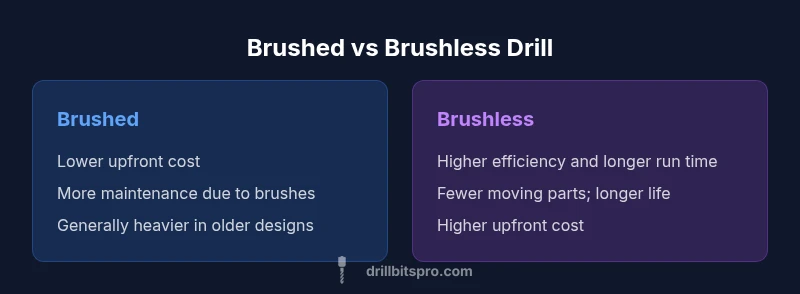
According to Drill Bits Pro, choosing between a brushed and brushless drill boils down to cost, efficiency, and how you use the tool. Brushed drills are cheaper upfront and simpler, with more maintenance. Brushless models cost more but offer longer battery life, cooler operation, and higher performance, especially under heavy loads. For most daily DIY tasks, brushless offers better value over time.
Why Brushed vs Brushless Drills Matter
In the world of portable power tools, the decision between brushed and brushless drill motors drives not only upfront price but long-term performance, reliability, and battery efficiency. This choice affects how often you’ll stop to recharge, how hot the tool runs under load, and how long you’ll keep the device before replacing it. For a brushed versus brushless drill comparison geared toward DIY enthusiasts and professionals, the practical question isn’t which is newer, but which delivers the right balance of power, endurance, and cost for your typical workload. The Drill Bits Pro team emphasizes that the best choice hinges on usage patterns: light, occasional tasks may favor the budget-brushed option, while frequent, heavy-duty drilling rewards a brushless build with superior efficiency and longevity. Understanding the tradeoffs helps you avoid overpaying for features you won’t use and prevents buying into an approach that won’t hold up under your typical workload.
To set expectations clearly, this section will map out how motor topology translates into real-world results—torque consistency, heat management, maintenance needs, and lifecycle costs. You’ll see how a small increase in upfront price can translate into meaningful savings over years of service, especially when you rely on cordless tools in busy workshops or remote job sites. The objective is practical guidance, not hype, so you can choose with confidence for your next project.
Core Technology: How Each Motor Works
Brushed and brushless drill motors operate on different electrical principles, yet both convert electrical energy into mechanical motion. A brushed motor uses carbon brushes that make contact with a rotating commutator, transferring current to windings and producing torque. Over time, brushes wear down, causing slower starts, reduced efficiency, and more maintenance. Brushless motors substitute electronic commutation for physical brushes. They rely on sensors (often Hall-effect sensors) and an electronic speed controller (ESC) to switch windings in precise sequence, creating smoother torque production and eliminating brush wear.
The practical upshot is that brushless designs have fewer moving parts facing wear, enabling longer life and more consistent speed under load. They also harness more precise control, which translates into better performance when drilling into dense materials or driving screws in a controlled manner. Brushed tools, by contrast, deliver strong performance at a lower upfront cost and in simple mechanical form factors, which can appeal to budget-conscious DIYers and occasional users. Both types remain widely available across price bands, so the key is to align motor topology with your typical tasks rather than chasing the latest tech for its own sake.
Performance Under Load: Torque, Speed, and Control
Torque delivery and speed behavior under load are central differentiators between brushed and brushless drills. Brushed motors typically deliver strong peak torque at launch and can be very responsive in light-duty tasks. However, their torque can drop as brushes and commutators wear or when the windings heat up during sustained drilling. Brushless tools maintain a more constant torque curve because their electronic control modulates current to maintain speed, even as battery voltage fluctuates. This results in steadier results when drilling dense materials such as hardwoods or metal, and in driving long screws where consistent dwell time matters.
Another practical consideration is control. Brushless drills often feature refined soft-start and variable-speed ranges, allowing you to start slowly for precise pilot holes and ramp up for aggressive drilling. This level of control reduces cam-out, minimizes bit wandering, and contributes to cleaner starts in awkward positions. For frequent users and professionals, the improved control translates into faster work, less rework, and better finished quality. For casual DIY, a brushed drill can still perform admirably if you choose a reputable model with good ergonomics and adequate power.
Efficiency and Runtime: Battery Impact
Efficiency matters because it directly affects how long you can work before reaching for a recharge. Brushless drills are generally more energy-efficient than brushed ones, because there are fewer mechanical losses when converting electrical energy to motion. The advantages compound when paired with modern lithium-ion or lithium-polymer battery packs and smart battery management. With brushless motors, you typically see longer runtime per charge and reduced heat buildup, which helps sustain performance during long drilling sessions. This matters particularly in cordless scenarios where you’re working away from power outlets.
That said, battery technology and tool compatibility matter. If a brushless model uses a different battery platform, you may face higher replacement costs or less availability in certain regions. For users already invested in a specific battery ecosystem, the incremental benefit of upgrading to brushless should be weighed against the cost of new packs and chargers. In practice, the payoff comes when you regularly operate at higher speeds, under load, or for extended sessions where efficiency translates to meaningful time savings.
Durability, Heat Management, and Longevity
Heat is a primary enemy of motor efficiency and tool longevity. Brushless drills tend to run cooler under similar workloads because they avoid brush-to-commutator friction and can regulate power more precisely. Cooler operation reduces wear on internal components and helps maintain consistent performance during longer runs. Brushed drills, while capable, generate more heat under heavy use; the brushes themselves wear down with time and require periodic inspection, cleaning, or replacement. The consequence is more maintenance and potential downtime as components degrade.
In professional applications, longevity and reliability are paramount. Brushless models typically outperform brushed designs in long jobs, high-tidelity screwdriving, and continuous drilling. For homeowners who only rarely use a drill, brushed tools can still deliver dependable results if you select a well-built unit with good heat management and a reputable warranty. The key is to match expected usage with the motor’s durability profile and maintenance needs.
Maintenance and Upkeep: Brush Wear vs Sensor Longevity
Maintenance needs reflect the fundamental differences between motor types. A brushed drill requires periodic brush inspection and replacement and may demand commutator cleaning to prevent performance losses. neglecting brush wear can lead to erratic speed and decreased efficiency. In contrast, brushless drills have no brushes to wear, reducing routine maintenance to general tool care—cleaning vents, inspecting batteries, and ensuring firmware updates if applicable. Sensor-based control does demand reliable electronics, so protecting the tool from moisture and dust remains critical.
For most DIYers, brushless maintenance is straightforward and minimal, with the added benefit of longer service life. When choosing between options, consider how much time you want to invest in maintenance versus how important uninterrupted operation is to your workflow.
Price of Ownership: Upfront, Running, and Replacement Costs
Pricing is the most immediate differentiator when weighing brushed versus brushless drills. Brushed models generally have a lower upfront price, which can be appealing for tight budgets or occasional use. Brushless tools carry a higher initial cost, but they often deliver longer lifespans, better energy efficiency, and improved performance, which translates to lower running costs over time. Total cost of ownership should account for battery life, charger compatibility, and potential replacement parts. If you already own the battery ecosystem needed for a brushless model, the incremental cost may be modest for the upgrade in efficiency.
In professional settings, the math often favors brushless when considering annual workload and the time saved per job. For occasional hobbyists, the break-even point may be several months to a couple of years, depending on rate of use and local electricity costs.
Use-Case Scenarios: DIY vs Pros
DIY enthusiasts usually benefit from a balanced approach: a mid-range brushless drill for long-term value or a budget brushed option for light tasks. If you regularly drill through hardwoods, metal, or masonry, or you rely on screw driving in large volumes, brushless offers tangible advantages in runtime and control. For hobbyists who tackle occasional projects like building furniture or hanging shelves, a brushed drill can be perfectly adequate and easier to service if needed.
Professional contractors face different constraints: consistent performance, low downtime, and predictable reliability. In these cases, brushless drills—paired with compatible batteries and fast chargers—often provide the best return on investment, especially when multiple crew members share a battery ecosystem. Budget and procurement strategy should consider total cost of ownership and the productivity gains brushless tools can deliver.
Practical Buying Checklist: What to Inspect Before You Buy
Before purchasing, compare the motor type, battery compatibility, and warranty coverage. Consider the following checklist:
- Is the drill cordless or corded, and what battery platform does it use?
- Does the model offer variable speed with a reliable soft-start?
- What is the rated torque and no-load speed, and how does it perform under load in your typical materials?
- Are there easy maintenance steps or service options for brushed models?
- What is the warranty length and what does it cover (electronics, battery, motor)?
- How available are replacement parts and spare batteries in your region?
By answering these questions, you can avoid surprises after purchase and ensure your tool matches your project profile.
Comparison
| Feature | Brushed drill | Brushless drill |
|---|---|---|
| Motor technology | Brushed with carbon brushes and commutator | BLDC electronically commutated with sensors and ESC |
| Efficiency and heat | Lower efficiency; more heat under load | Higher efficiency; cooler operation under load |
| Runtime per charge | Shorter runtime on cordless models | Longer runtime on comparable batteries |
| Maintenance | Brush wear requires replacement | No brushes; less maintenance |
| Initial price | Lower upfront cost | Higher upfront cost |
| Best for | Budget projects, light to moderate use | Frequent heavy use, pro environments |
| Weight consideration | Often heavier due to simpler design | Often similar or lighter due to compact electronics |
What's Good
- Lower upfront cost for brushed models
- Brushed tools are simple to repair and widely available
- Brushless motors offer longer life and better efficiency
- Improved torque control and smooth starts with brushless designs
- Better heat management in brushless tools supports longer sessions
Negatives
- Brushed tools require brush wear maintenance and possible replacements
- Brushless tools cost more upfront
- Some brushless models may use a different battery platform
Brushless drills generally offer the best long-term value for most users.
If you work often or for long sessions, brushless delivers efficiency, durability, and consistent performance. For occasional hobby use and strict budgets, brushed drills remain a viable, economical option.
Got Questions?
What is the main difference between brushed and brushless drills?
The main difference is motor design: brushed drills use carbon brushes and a commutator, while brushless drills use electronic commutation with sensors and an ESC. Brushless motors are generally more efficient and durable, but come with a higher upfront price. For most users, the decision hinges on workload and value over time.
The main difference is that brushed drills use brushes and a commutator, while brushless drills use electronic controls. Brushless usually lasts longer and runs more efficiently, but costs more upfront.
Are brushless drills worth the extra cost for DIY projects?
For frequent or demanding tasks, brushless drills typically justify the higher upfront cost thanks to longer battery life, cooler operation, and steadier performance. If your use is light and occasional, a quality brushed drill may meet your needs at a lower total price.
If you use the drill a lot or on tough jobs, brushless is usually worth it; for lightweight tasks, brushed can be sufficient.
Do brushed drills wear out brushes, and how often?
Yes, brushed drills wear brushes that transfer current to the motor. The frequency depends on usage, load, and maintenance. Typical effects include slower starts and reduced efficiency as brushes wear; replacement timing varies by model and workload.
Brushed drills wear brushes over time; wear rate depends on use and load. Replacement timing varies by model.
Which drill is better for drilling metal?
Both can drill metal, but brushless drills maintain torque better under load and provide smoother starts, reducing bit wandering. For frequent metal drilling, a brushless model is usually the better choice given its control and efficiency.
Brushless tends to perform better for metal drilling due to steady torque and control.
How do battery life and run time compare between brushed and brushless?
Brushless drills typically offer longer run time per charge thanks to higher efficiency and reduced heat. Actual results depend on battery chemistry, capacity, and the task, but expect a noticeable edge for brushless in sustained workloads.
Brushless usually lasts longer per charge, but it depends on the battery and task.
What maintenance does a brushed drill require?
Brushed drills require periodic inspection and replacement of brushes and possibly the commutator. Keeping vents clear and applying basic lubrication where recommended can help, but wear is inherent to the design.
Brushed drills need brush checks and occasional replacement, plus general maintenance.
Top Takeaways
- Assess your workload before buying a drill.
- Brushless designs deliver better runtime and durability.
- Brushed drills save upfront cost for light use.
- Battery ecosystem matters for total cost of ownership.
- Choose based on real tasks, not marketing claims.