Brushless Drill vs Non-Brushless: A Practical 2026 Comparison
A thorough, objective comparison of brushless drill vs non brushless models, covering efficiency, torque, heat, maintenance, price, and ecosystem for DIYers and pros in 2026.


In most scenarios, a brushless drill vs non brushless tends to deliver better efficiency, longer battery life, and smoother torque, but at a higher upfront cost. The Drill Bits Pro team weighs the trade-offs for DIYers and professionals, highlighting where each style shines and when the extra cost pays off.
What is the brushless drill vs brushed (non brushless)?
When you compare brushless drill vs non brushless models, the fundamental difference lies in the motor design and how it is controlled. A brushed drill uses carbon brushes and a mechanical commutator to switch current in the windings, which creates wear and energy loss over time. A brushless drill uses an electronic controller (often called a BLDC controller) to switch the current in the rotor windings without physical brushes. The result is fewer wear parts, more precise speed control, and generally higher efficiency. For the user, the practical takeaway is clear: brushless models tend to run cooler, deliver more consistent torque under load, and maximize battery life, while brushed models can be more affordable upfront and simpler in some cases. Throughout this article we compare brushless drill vs non brushless in terms of performance, cost, and long-term value, with examples from common DIY tasks and professional use.
According to Drill Bits Pro, the decision between brushless drill vs non brushless should be anchored in how you intend to use the tool. If you work on frequent, demanding jobs, the efficiency and longevity of a brushless drill often justify the higher price. For occasional tasks or tight budgets, a reliable brushed drill can still handle most home projects without breaking the bank. The key is to align capabilities with your workload and ecosystem, not just the headline specs.
How the two motor types differ in construction and control
- Brushed motors rely on carbon brushes that wear with use, leading to performance drift and eventually the need for brush replacement or motor service.
- Brushless motors replace brushes with electronic speed control, enabling precise, programmable torque curves and smoother starts.
- Electrically, brushless systems can run the motor more efficiently because there is less energy lost to brush friction and heat, which often translates to longer runtimes per battery charge.
- The controller in a brushless drill can also support advanced features like variable speed profiles, impact/toggle modes, and soft-start, which improve control in a variety of materials.
From a user perspective, this translates into more consistent performance and less maintenance for brushless designs, especially under heavy loads. However, not all brushless tools are created equal—your experience will depend on the quality of the electronics, magnets, bearings, and wiring in the kit.
For the non technical reader: think of brushless as an efficiency upgrade with smarter control, while brushed is the traditional, budget-friendly baseline. The choice hinges on use-case, budget, and willingness to invest in ecosystem compatibility.
Real-world implications: when brushless matters and when it doesn’t
- For high-torque tasks like drilling through hardwood or dense metals, a brushless drill maintains torque more reliably as battery voltage sags.
- In frequent-use scenarios (e.g., contractor work), brushless tools tend to avoid heat buildup and throttling that can plague brushed designs after repeated heavy-duty cycles.
- If your work rarely pushes the tool to its limits, a good brushed drill still offers solid performance and often lower upfront cost.
- Batteries and chargers within the same brand ecosystem influence long-term value; choosing a brushless model within a compatible system can expand future kit options without wasting investment.
This section demonstrates that the brushless drill vs non brushless decision often comes down to workload intensity and system compatibility, not just a single spec like rpm or max torque.
Durability, heat management, and maintenance
- Brushless designs reduce wear-prone parts and can run cooler under sustained load, which helps protect internal components and extend usable life.
- Brushed motors inherently experience brush and commutator wear; over time this can degrade performance and require maintenance or part replacement.
- Heat management is a common differentiator: brushless tools often throttle less aggressively under heat, maintaining steadier output during longer sessions.
- Maintenance considerations apply: brushed drills may need brush replacements or motor servicing, while brushless tools primarily need battery and electronics health checks.
In practical terms, durability and maintenance favor brushless models in professional workloads, but reliability depends on build quality, cooling design, and how well the tool is matched to the task.
The Drill Bits Pro team notes that opting for a reputable brand with proven brushless electronics often yields better long-term satisfaction than chasing the lowest initial price.
Battery ecosystem and charging considerations
- Brushless drills are frequently sold within modern, platform-based ecosystems that share batteries, chargers, and accessories across multiple tools.
- A brushed drill can still be part of a robust system, but the potential for better value comes when you stay within a cohesive line that covers drills, impact drivers, and saws.
- Battery capacity, voltage, and chemistry influence runtime more than brushless vs brushed alone; a high-capacity pack on a brushed tool may rival a lower-capacity pack on a brushless one in certain scenarios.
- Charging speed and dual-bay chargers can reduce downtime, especially in professional environments where multiple batteries are in rotation.
In summary, the total cost of ownership often hinges on the ecosystem you adopt and how efficiently you can reuse batteries across tools. Brushless kits within a coherent system tend to maximize value over time.
Weight, ergonomics, and user comfort
- Brushless drills frequently trade a modest increase in weight for improved internal efficiency and better heat distribution; many users report more balanced handling due to the lack of oversized brushes and selectors.
- Brushed drills can be lighter in some designs and may feel snappier in lightweight, low-torque tasks.
- For extended sessions, ergonomics matter as much as raw power; a well-balanced tool reduces fatigue and improves precision, especially when drilling overhead or in tight spaces.
- Handle design, grip texture, and overall tool ergonomics influence user satisfaction, regardless of motor type.
In practice, choose a brushless model if you value smoother operation and reduced fatigue over minimal weight. If you prioritize one-handed control in occasional tasks, a comfortable brushed design from a reputable maker may suffice.
Cost of ownership and warranty considerations
- Brushless drills typically command a higher upfront price, but many users justify the premium with longer runtime, less maintenance, and better performance under load.
- Warranty terms can vary by brand and model; professional-grade brushless tools often come with longer warranties or comprehensive service packages, which can offset higher initial costs over time.
- Battery life and availability of replacement cells can impact long-term costs; ensure you understand the warranty coverage for both motor/electronics and batteries.
- When evaluating total cost, consider not only purchase price but also accessory compatibility, kit contents (batteries, chargers, bits), and potential resale value.
Ultimately, the best value is achieved by balancing upfront price with expected workload, spare parts costs, and the familiarity your team has with a given ecosystem. Drill Bits Pro notes that careful planning yields a lower total cost of ownership for brushless tools in demanding workflows.
Real-world task performance: wood, metal, and masonry
- Wood: Brushless drills maintain steady torque and smooth starts, yielding cleaner holes and longer bit life, particularly with larger-diameter bits.
- Metal: Consistent speed control and heat management reduce tool chatter and extend bit life when drilling through steel or aluminum.
- Masonry: Hammer actions in brushless tools canse manage load better, though masonry drilling heavily depends on the correct bit type and quality of the hammer mechanism rather than motor type alone.
- Accessories: The drill bit choice, clutch settings, and pilot hole strategy often have a bigger immediate impact than brushless vs brushed once you match the tool to the task.
In everyday usage, most DIYers notice tangible benefits from brushless models in high-speed or heavy-load tasks, while brushed models still do well for lighter jobs. The key is to pair the motor type with appropriate bits and feeds for the material.
DIY vs professional use: which is best?
- DIY enthusiasts: A well-chosen brushed or brushless model can cover a wide range of projects; if you predict occasional heavy-duty use or plan to expand your tool lineup, investing in a brushless platform can future-proof your workshop.
- Professionals: The durability, efficiency, and system-wide compatibility of brushless tools typically translate to lower downtime and higher productivity in demanding environments.
- Budget-aware users: If initial cost is the primary constraint and workloads are light-to-moderate, a solid brushed tool from a reputable brand will likely deliver satisfactory results.
- Decision framework: Start with workload frequency, material mix, and power needs, then evaluate ecosystem, warranty, and future expansion possibilities before committing to brushless or brushed.
The takeaway is pragmatic: brushless isn’t a universal upgrade, but for sustained, repetitive work or a growing tool kit, brushless often delivers better overall value.
Common myths and clarifications
- Myth: Brushless = always stronger and faster. Reality: Brushless improves efficiency and control, but peak speed and torque depend on gearing, battery voltage, and design quality.
- Myth: Brushed tools are outdated and unreliable. Reality: Many brushed drills perform reliably in light-to-moderate tasks, with lower upfront costs.
- Myth: You must upgrade all tools to brushless to see benefits. Reality: Upgrading selectively where workloads demand high efficiency or longer runtimes often yields the best ROI.
- Myth: Battery life is the same across brushless and brushed. Reality: battery performance is a function of motor efficiency, control electronics, and the battery chemistry and capacity you choose.
Dispel these myths by testing in real tasks and comparing tools within a cohesive ecosystem. Drill Bits Pro encourages hands-on evaluation rather than relying solely on spec sheets.
How to choose: a practical decision framework
- Define your workload: frequency, materials, and required hole sizes.
- Set a budget that aligns with expected usage; include batteries and chargers in the plan.
- Check the ecosystem: can you share batteries across drills and other tools? Is service readily available?
- Assess warranties and service options; prioritize models with robust support.
- Test with a few tasks if possible: hole quality, startup torque, and heat buildup matter more than flashy numbers.
Use this framework to decide whether brushless is worth the investment for you or if a well-chosen brushed drill already meets your needs.
Specs to inspect when buying
- Voltage and class: 12V–20V platforms are common; higher voltage tools typically offer more torque and faster drilling in tough materials.
- Max RPM and torque ratings: Look for real-world torque data and a broad RPM range; soft-start and clutch settings improve control.
- Gear configuration: Two-speed gearboxes and hammer modes add versatility for different materials.
- Battery compatibility: Confirm that the model fits your existing batteries or future kit plans.
- Durability indicators: Check IP ratings, build quality, and ergonomics for long-term use.
- Warranty terms: Note what is covered and for how long, including batteries and chargers.
- Overall value: Consider the kit contents, service availability, and potential resale value when evaluating a brushless vs non-brushless option.
Comparison
| Feature | Brushless drill | Brushed drill |
|---|---|---|
| Motor type | brushless DC motor | brushed DC motor |
| Efficiency & runtime | higher efficiency; longer runtime per charge | lower efficiency; shorter runtime per charge |
| Torque control | advanced electronic control; smoother starts | basic control; mechanical limits |
| Heat management | better heat management under load | more heat buildup under load |
| Initial price range | higher upfront price | lower upfront price |
| Battery ecosystem | often broader compatibility within a brand line | ecosystem more dependent on specific brand |
| Durability & service | fewer wear parts; longer potential life | brush wear can require maintenance or replacement |
What's Good
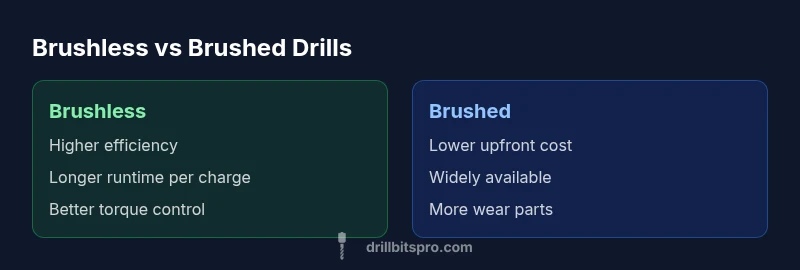
- Higher efficiency and longer runtime per charge
- Better torque control and smoother operation
- Fewer wear parts due to absence of brushes
- Improved heat management under heavy use
- Strong ecosystem support within modern tool lines
Negatives
- Higher upfront cost
- Battery costs can be significant if upgrading
- Electronics can complicate repairs in older models
- Quality varies; not all brushless tools outperform brushed equivalents
Brushless drills generally win for longevity and efficiency; brushed drills remain viable for casual users and tight budgets
If you work frequently or require longer runtimes, a brushless model is worth the premium. For occasional tasks, a quality brushed drill can meet needs at a lower upfront cost.
Got Questions?
What is a brushless drill and how does it differ from a brushed drill?
A brushless drill uses electronic speed control to drive a brushless motor, offering improved efficiency, torque control, and durability. A brushed drill relies on physical carbon brushes that wear over time, requiring maintenance. The key difference is electronic control versus mechanical switching, which generally makes brushless more efficient and quiet.
A brushless drill uses smart electronics for smoother operation and longer runtime, while a brushed drill uses brushes that wear with use. That difference is why brushless tools often last longer between charges.
Are brushless drills worth the extra upfront cost?
For frequent, professional, or high-demand use, the efficiency and durability of brushless drills can justify the higher price. For casual DIY tasks, a solid brushed tool might be adequate and more economical in the short term.
If you work a lot or need consistent performance, brushless is likely worth it; otherwise, a good brushed drill can do the job.
Do brushed drills have longer battery life in practice?
Battery life depends more on how the tool is used and the battery capacity than on motor type alone. Brushless motors generally use energy more efficiently, but a low-capacity battery paired with a brushless tool may still run out quickly.
Brushless tools tend to run longer per charge, but battery size and usage matter just as much.
Can I convert a brushed drill to brushless?
Conversion isn’t practical; brushless conversion typically requires a new motor and electronics package. It’s usually easiest and most cost-effective to buy a purpose-built brushless drill.
Conversion isn’t practical—get a brushless drill designed for your needs.
Which is better for masonry drilling: brushless or brushed?
For masonry, the hammer action and clutch system matter as much as motor type. A brushless hammer drill with a high-quality bit often performs better under load and heat, though a reliable brushed hammer drill can still be effective in lighter tasks.
In masonry, a brushless hammer drill with a good bit usually performs better, but a solid brushed hammer drill can work for lighter work.
What should I look for when buying a brushless drill?
Look for battery compatibility across your toolkit, a robust warranty, real-world torque and RPM ranges, and a comfortable, well-balanced design. Also check heat management, gearing options, and availability of accessories.
Prioritize ecosystem, warranty, torque control, and comfort when buying a brushless drill.
Top Takeaways
- Evaluate workload first to justify brushless upgrades
- Consider total ownership cost, not just sticker price
- Choose a shared battery ecosystem for future expansion
- Prioritize quality warranty and service options
- Test performance on your common materials when possible