How Long Drill Battery Charge: Timelines and Tips
Discover how long drill batteries take to charge, the factors that affect timing, and practical tips to minimize downtime for DIY and professional use, including battery health guidance.


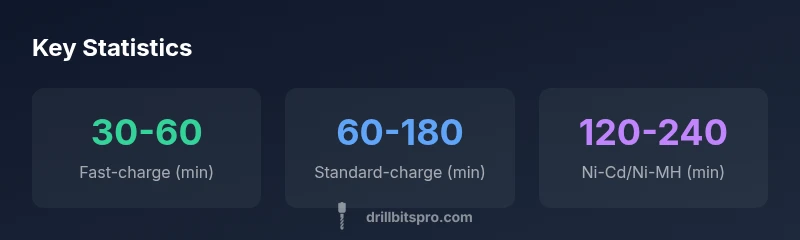
For the question 'how long drill battery charge,' most cordless drill batteries reach a full charge in about 30-60 minutes with a fast charger and roughly 60-180 minutes with a standard charger. Actual times vary by battery chemistry (Li‑ion vs Ni‑Cd), capacity (Ah), charger quality, and ambient temperature. Drill Bits Pro Analysis, 2026 notes that proper charging practice can cut or extend these times.
Understanding Battery Chemistry and Charger Types
Different drill batteries use different chemistries. Lithium‑ion (Li‑ion) batteries dominate modern tools due to high energy density and lighter weight. Nickel‑Cadmium (Ni‑Cd) and Nickel‑Metal Hydride (Ni‑MH) remain common in older or budget models. Chargers can be standard or fast; many newer units are smart chargers that monitor voltage, temperature, and state of charge to optimize safety and performance. Understanding these basics helps set realistic expectations for charge time and cycle life. According to Drill Bits Pro, the chemistry and charger design are the primary drivers of charge duration, with ambient temperature and pack age playing supporting roles. In the field, you’ll notice that fast chargers can dramatically shorten downtime, but heat and aging can temper the gains. When planning a project, consider the battery chemistry, pack capacity (Ah), and the charger’s output (amps).
How Long Should You Expect for Popular Battery Chemistries
Li‑ion packs are by far the most common in new tools, and they typically charge faster on capable chargers. With a fast charger, Li‑ion batteries commonly range from about 30 to 60 minutes for a full top‑up. On a standard charger, expect roughly 60 to 180 minutes, depending on the pack’s Ah rating and the charger’s current output. Ni‑Cd batteries, underscored by older tool lines, often take longer—roughly 60 to 120 minutes on fast charging, and 120 to 240 minutes on a standard charger. Ni‑MH sits between these two families, typically in the 45–90 minute fast charge and 90–180 minute standard charge range. Remember that higher‑capacity packs (5 Ah and above) may stretch the standard range toward the upper end, even with smart chargers.
Factors That Affect Charging Time
Charging time is not a single fixed figure. Several interacting factors determine how long a battery takes to reach full capacity:
- Battery chemistry: Li‑ion charges faster on modern smart chargers than Ni‑Cd or Ni‑MH.
- Capacity (Ah): Higher capacity packs hold more energy; they require longer to refill unless the charger compensates with higher current.
- Charger output (A): A charger’s amperage directly scales charging speed; higher amps equal shorter times up to the battery’s acceptance limit.
- Temperature: Charging is faster in moderate temperatures; extreme heat or cold slows the process and can reduce capacity over time.
- Battery age: Older cells lose efficiency and may take longer to reach full charge.
- State of charge and health: A battery near empty will charge from a lower baseline and can take longer to reach a full, healthy state if the cells are imbalanced.
These interactions mean a 4–5 Ah Li‑ion pack might charge in the lower to mid end of the 60‑minute window on a robust fast charger, while the same pack on a low‑power charger could approach the upper end or longer. Always pair the battery with the charger recommended by the tool’s manufacturer to optimize safety and performance.
How to Optimize Charge Time
If you need to shave minutes off charging, try these evidence‑based practices:
- Use the manufacturer‑recommended charger and cable. Third‑party accessories may be slower or unsafe.
- Keep the battery within its ideal temperature range during charging (roughly 15–25°C for many Li‑ion packs).
- Avoid letting batteries sit fully discharged for extended periods; store at partial charge when not in use for long durations.
- Unload the battery from storage or standby state only when needed; long idle times can reduce voltage and slow charging dynamics.
- Balance charging for multi‑cell packs: some packs require a conditioning or balancing cycle for even cell health and faster overall charging.
- If you’re in a hurry, choose a high‑quality fast charger that supports your pack’s chemistry and capacity, and monitor for heat.
When to Use Fast-Charging vs Standard Charging
Fast charging is a lifesaver on job sites or busy workshops, but it isn’t always the best choice for every cycle. Use fast charging sparingly to minimize heat buildup and potential long‑term wear on cells. For routine daily use or when charging overnight, standard charging is safer for maximizing cycle life. Always match charging strategy to your workload: time‑critical tasks can benefit from a fast option, while long‑term tool health benefits from standard charging when possible.
Charging Practices for Different Drill Models
Modern Li‑ion drills typically ship with fast‑charging capable packs and smart chargers, which can optimize charging during idle periods and protect cells from overheating. Ni‑Cd and Ni‑MH packs, though more common in legacy kits, still operate with similar rules: you’ll want a charger that provides a stable, appropriate current and temperature control. Check the tool’s manual for the recommended charging profile and avoid switching between vastly different chargers on the same pack. For high‑capacity packs, ensure your charger can deliver the required current without triggering thermal shutdown.
Practical Scenarios and Timelines
A typical home user with a 2–3 Ah Li‑ion battery may see 30–60 minutes on a fast charger and 60–180 minutes on a standard charger, depending on the charger’s amperage and ambient conditions. On a professional site with a 4–5 Ah pack, fast charging can reduce downtime to well under an hour, provided the charger supports the pack and heat is managed. For Ni‑Cd or Ni‑MH, expect longer sessions, especially on standard charging, and plan for downtime accordingly. In all cases, keep a spare charged pack on hand when possible to avoid workflow interruptions.
Common Mistakes and Troubleshooting Charging Issues
- Charging from a hot battery: Move to a cooler area; avoid charging while the battery is hot from heavy use.
- Using incompatible chargers: Always use the charger designed for the battery chemistry.
- Ignoring signs of aging: If a battery never reaches full, consider aging or cell imbalance and replace as needed.
- Leaving a pack on charge indefinitely: While many packs have protection, long charges in high heat can degrade cells; remove when full and store per guidelines.
- Inaccurate battery health monitoring: Use built‑in tool indicators or periodic performance tests to gauge remaining life and schedule replacements.
Typical charging time ranges by battery chemistry
| Battery Chemistry | Fast-Charge Time (minutes) | Standard-Charge Time (minutes) | Notes |
|---|---|---|---|
| Li-ion | 30-60 | 60-180 | Dominant modern chemistry; high energy density |
| Ni-Cd | 60-120 | 120-240 | Older tech; more memory effect |
| Ni-MH | 45-90 | 90-180 | Common in older tools; moderate capacity |
| High-cap Li-ion (5 Ah) | 40-70 | 120-180 | Higher-capacity packs require capable chargers |
Got Questions?
What factors affect drill battery charging time?
Charging time depends on chemistry (Li-ion vs Ni-Cd), capacity (Ah), charger power (A), and ambient temperature. Age and state of charge also play a role. Use the appropriate charger for your battery to estimate realistic times.
Battery chemistry, capacity, charger power, and temperature all affect charging time. Age and current charge level also matter.
Is it OK to leave a battery on the charger after it’s full?
Most modern packs include protection to prevent overcharging. Keeping a full battery on a smart charger is usually safe, but prolonged heat can degrade cells over time.
Most packs stop charging automatically, but heat can hurt battery life if left on the charger for long periods.
Does fast charging harm battery life?
Frequent fast charging can increase heat and stress cells, potentially reducing cycle life. Use fast charging when time is critical and not every cycle.
Fast charging can add heat and wear; use it when you need it, not all the time.
How can I estimate charging time for my specific pack?
Compute using Ah rating and charger amperage: time ≈ (Ah) / (A), add a safety margin for real-world conditions.
Estimate using capacity and charger output; add a little extra time for temperature and aging.
Do temperature conditions change charging times?
Yes. Higher temperatures generally speed up charging up to a point, while cold conditions slow charging and reduce efficiency.
Temperature affects charging speed and efficiency; keep packs within recommended ranges.
“Charging behavior is highly dependent on chemistry and charger design; understanding this interaction helps minimize downtime and extend battery life.”
Top Takeaways
- Know your battery chemistry to estimate charge times
- Use the charger matched to your pack
- Fast charging saves time but may affect cycle life if overused
- Temperature and aging affect charging duration
- Store and use batteries within recommended charge conditions