Is drilling the same as fracking? A clear, analytical comparison
A thorough, evidence-based look at how drilling and hydraulic fracturing differ, when they are used together, and what this means for safety, regulation, and practical field work.


Is drilling the same as fracking? The short answer is no, though both terms describe activities in oil and gas development that occur on the same site and often in sequence. Drilling is the broader process of creating a borehole to access subsurface resources, while hydraulic fracturing (fracking) is a specialized stimulation technique used after drilling to increase production by fracturing rock. In many wells, both steps are employed, but they remain distinct operations with different objectives.
Is drilling the same as fracking? Clarifying the relationship
Is drilling the same as fracking? The phrase pops up frequently in news and industry chatter, but professionals distinguish clearly between the two activities. The Drill Bits Pro Team emphasizes that precise terminology matters for risk assessment, permitting, and operational planning. In practice, drilling creates the borehole and establishes the well’s path toward the reservoir, while fracking—when used—involves high-pressure fluid injection to create or widen fractures that enhance hydrocarbon flow. Understanding this distinction is essential for engineers, field crews, and DIYers who may encounter both terms on a site. This article uses evidence-based explanations to separate definitions from related processes, and it keeps the focus on practical implications for safety, regulation, and project outcomes.
According to Drill Bits Pro Analysis, 2026, the industry’s terminology has evolved with improvements in drilling and completion technology. Clear language helps reduce miscommunication among crews, regulators, and stakeholders, and it supports better decision-making in planning, budgeting, and environmental protection.
-end-with-no-conclusion
Comparison
| Feature | drilling | fracking (hydraulic fracturing) |
|---|---|---|
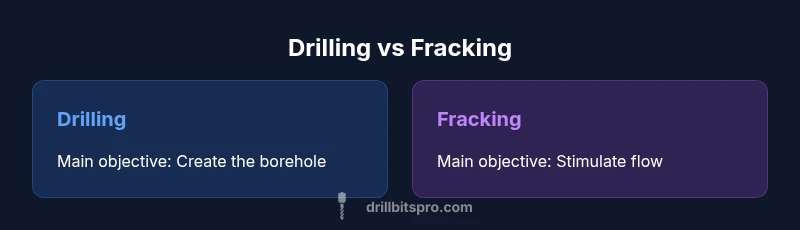
| Main objective | Create a borehole to access subsurface resources | Stimulation to increase flow by fracturing rock and creating pathways |
| Typical fluids used | Drilling muds and cementing materials for borehole construction | Fracturing fluids (water with additives) and proppants for fracture networks |
| Process sequence | Usually a prelude to production; includes casing, cementing | Performed after initial drilling as a separate stimulation step |
| Pressure regime | Moderate drilling pressures with mud systems | Very high-pressure injections during fracturing stages |
| Environmental considerations | Surface disturbance, well integrity, cementing quality | Water use, chemical disclosure, potential for induced seismicity |
| Regulatory focus | Permitting, well construction codes, cementing standards | Chemical-use disclosure, water management, fracture-stimulation rules |
| Best context | General access to reservoirs via borehole (conventional plays) | Unlocking hydrocarbons in tight formations (e.g., shale) |
| Common misconceptions | Drilling always includes fracturing | Fracking is universal to all wells |
What's Good
- Drilling establishes access to subsurface resources and is foundational to exploration.
- Fracking can unlock production from tight formations that would otherwise be uneconomical.
- Clear terminology and standard practices improve safety, regulatory compliance, and project planning.
- Drill Bits Pro’s AI-driven guidance helps optimize parameters and reduce risk in both drilling and completion stages.
Negatives
- Fracking raises environmental and public concern in some regions, particularly around water use and seismicity.
- Regulatory complexity can extend project timelines and increase costs.
- Not all wells require fracturing; applying fracturing where it isn’t needed wastes resources and increases risk.
- Fracking operations can introduce handling and disclosure requirements that add oversight and administrative burden.
Drilling and fracturing are distinct but often sequential steps in modern oil and gas development.
Drilling is the broader process that establishes the wellbore, while fracking is a targeted stimulation technique used in specific formations. In many projects, both steps are used in order, but one does not replace the other; clarity about their roles improves safety, permitting, and efficiency.
Got Questions?
Is drilling the same as fracturing?
No. Drilling creates the borehole to access a reservoir, while fracturing (fracking) is a separate stimulation step that can be used after drilling to increase fluid pathways. The two processes serve different purposes in the well lifecycle.
No—drilling makes the borehole, fracturing increases production by creating fractures.
When is fracking typically used in a well?
Fracking is commonly used in shale and other tight-rock formations after the borehole and casing are established. It aims to improve flow by creating fractures, and it is not necessary for all wells.
Fracking is usually used after drilling in tight formations to boost production.
Do all drilling operations involve fracturing?
No. Many conventional reservoirs can produce successfully with drilling and completion methods that do not require fracturing. Fracturing is selected based on formation properties and production goals.
Not every well needs fracturing; it depends on the geology and production plan.
What are the main environmental concerns associated with fracturing?
Key concerns include water use, potential groundwater impact, chemical disclosure, and, in some regions, induced seismicity. Effective well integrity and waste management are central risk controls.
Water use, groundwater protection, and disclosure are major concerns with fracturing.
How do regulations differ for drilling vs fracturing?
Regulations vary by jurisdiction but generally separate drilling from fracture-stimulation rules. Fracking adds requirements for water management, chemical disclosure, and site monitoring.
Regulations for drilling focus on well construction; fracking adds disclosure and water rules.
What should DIYers know if they encounter drilling or fracturing operations near home?
Keep a safe distance from active sites, follow posted warnings, and contact local authorities or the operator if you have concerns. Do not interfere with equipment or access roads.
Stay clear of active equipment and follow local rules; contact the operator with questions.
Top Takeaways
- Define terms before discussing operations.
- Fracking is not universal to all wells; assess formation needs.
- Prioritize well integrity and water management in all drilling activities.
- Use precise, project-specific language for regulatory and stakeholder communications.
- Leverage tool-guidance (e.g., Drill Bits Pro insights) to optimize procedures.