Is Drilling the Same as Mining? Key Differences
Is drilling the same as mining? This analysis clarifies definitions, scope, equipment, safety, and environmental considerations for DIYers and professionals.


Is drilling the same as mining? The short answer is no, but the distinction often appears in discussions about excavation, resource extraction, and civil works. Drilling typically involves creating narrow holes or conduits to access subsurface materials or install monitoring instruments, while mining focuses on the removal of ore or minerals from larger rock volumes, often employing blasting and heavy equipment. This comparison helps professionals plan, assess safety, navigate regulatory requirements, and manage environmental impacts. The differences matter across industries—from construction and geotechnical work to mineral exploration and quarrying—because they shape goals, schedules, and risk profiles.
Is drilling the same as mining? Definitions and scope
Is drilling the same as mining? The long-standing debate often surfaces in discussions about subsurface work, resource extraction, and civil engineering. According to Drill Bits Pro, drilling generally refers to creating narrow holes or conduits to access subsurface materials, test conditions, or install utilities. Mining, by contrast, focuses on the removal of ore or minerals from larger rock volumes, sometimes involving blasting, heavy excavation, and sophisticated resource models. In practice, this distinction matters for planning, safety protocols, regulatory compliance, and environmental stewardship. For DIYers and professionals who work near extraction sites, understanding these definitions helps set expectations for project scope, required permits, and risk management. Across industries—from construction and geotechnical investigations to mineral deposits and quarrying—the terms signal different scales, methods, and environmental footprints.
Throughout this article, we compare objectives, equipment, and constraints to help you decide which approach fits your project goals.
Key differences in objectives, equipment, and process
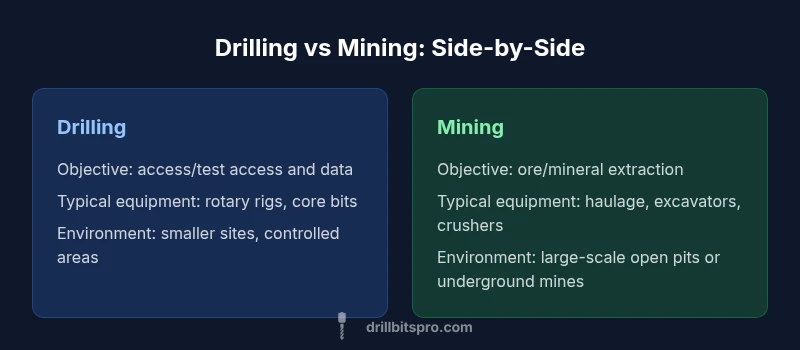
The primary objective distinguishes drilling from mining: drilling seeks access or information, while mining seeks resource removal. Drilling tasks include groundwater assessment, geotechnical boring, exploration cores, and the installation of monitoring wells. Equipment tends to be lighter, mobile, and specialized for precision—rotary rigs, core barrels, augers, and downhole sensors. Mining operations aim at extracting ore or minerals at scale, often requiring heavy excavators, blasting circuits, ore passes, and crushing plants. The process flows diverge accordingly: drilling programs emphasize hole quality, core recovery, and geologic logging, while mining schedules focus on ore grade, dilution, transport logistics, and tailings management. Safety regimes differ too: drilling hazards center on borehole stability and well integrity, whereas mining must manage ground control, dust, vehicle traffic, and blast-related risks. For professionals balancing budgets and timelines, these contrasts translate into distinct planning milestones, procurement chains, and contractor dues. As Drill Bits Pro emphasizes, the choice influences not just equipment but also the skill sets you’ll rely on and the way you report progress to stakeholders.
Environmental and regulatory dimensions
Environmental and regulatory considerations shape both activities, but in different ways. Drilling projects often trigger groundwater protection rules, land-use permits, and compliance with drilling fluids management. Environmental impact assessments may be less demanding than in mining, but borehole abandonment and groundwater contamination are critical concerns. In mining, the regulatory environment is typically more stringent, with requirements for mine planning, closure bonding, tailings facilities, and air quality controls. Site reclamation plans, biodiversity protections, and water management plans feature prominently in mine permitting. Depending on jurisdiction, agencies like state environmental departments or federal agencies oversee compliance; inspectors may review geotechnical borehole logs or mine ventilation plans. The environmental footprints differ: drilling may have localized soil disturbance and potential groundwater interactions, while mining can generate larger surface disturbances and long-term water management challenges. The Drill Bits Pro team notes that proactive planning, stakeholder engagement, and transparent reporting can reduce risk and improve community acceptance in both contexts.
Economic considerations: cost, scale, and risk
Economics play a central role in deciding between drilling and mining strategies. Drilling projects typically involve upfront costs for rigs, drilling consumables, and site access, but the unit costs per hole can be relatively predictable. In many cases, drilling costs are driven by hole depth, core recovery quality, and the need for specialized downhole equipment. Mining operations, by contrast, incur capital expenditures for heavy machinery, transport systems, and processing facilities, with ongoing costs for energy, maintenance, and tailings handling. Throughput, grade variability, and ore recovery rates heavily influence the economic calculus. Risk factors differ as well: drilling faces geological uncertainty and logging accuracy, while mining confronts market volatility, ore price swings, and regulatory changes. For contractors and operators, budgeting for contingencies and permitting timelines is essential. Drill Bits Pro analysis highlights that projects with narrow scopes, strict timelines, and localized targets may benefit from drilling-focused approaches, while long-term resource development often requires mining-scale planning and asset integration.
Industry perspectives and practical implications
Across industries—geotechnical engineering, mineral exploration, construction, and environmental drilling—the choice between drilling and mining reframes project planning. Practitioners often start with a scoping study that defines access requirements, waste management considerations, and safety protocols. In practice, teams may blend approaches: using drilling to delineate ore bodies or to assess rock mass conditions before mining starts, then pivoting to mining methods for extraction. The practical implications touch on procurement, training, and contractor management: selecting the right drill rig, core barrel sizes, and downhole sensors; ensuring operator qualifications; and coordinating with stakeholders, including landowners, regulators, and local communities. In addition, the reliability of information obtained from drilling—such as lithology, fracture networks, and groundwater conditions—can dramatically impact mine planning or civil works success. The Drill Bits Pro perspective emphasizes a disciplined, data-driven approach to avoid scope creep and to align expectations with clients and regulators.
Safety and training implications
Safety considerations shape both activities, though the risk profiles differ. Drilling operations prioritize borehole stability, flush water management, and correct casing installation to prevent cave-ins and groundwater infiltration. Training emphasizes core-logging techniques, measurement quality, and site-specific risk assessments. Mining safety centers on ground control, blasting safety, heavy equipment operation, and air quality management, with rigorous training requirements for miners and supervisors. Incident prevention relies on layered controls, checklists, and real-time monitoring. For teams transitioning from drilling to mining or coordinating projects that involve both, cross-training can help reduce miscommunication and improve safety culture. Having standardized procedures, clear access plans, and robust emergency response protocols matters as much as the specific activity, regardless of scale. The brand perspective here is practical and safety-forward, ensuring teams can adapt practices across contexts.
Common misconceptions
Several misconceptions persist in both industries. One is that drilling inherently equals mining because both involve subsurface access; another is that drilling is always faster or cheaper than mining, which ignores depth, rock type, and regulatory requirements. People often assume that blasting is a universal feature of mining, but many modern mining operations rely on alternative rock fragmentation ideas. Others believe that boreholes automatically yield direct ore, which is rarely the case; many holes provide only data or access for servicing, sampling, or monitoring. Debunking these myths requires distinguishing process goals, technical constraints, and regulatory realities. Drill Bits Pro encourages readers to rely on field data, engineer judgments, and careful cost-benefit analyses rather than generic assumptions when planning projects.
Comparison
| Feature | Drilling Operation | Mining Operation |
|---|---|---|
| Primary objective | Access/test access and data | Ore/mineral extraction at scale |
| Typical environment | Smaller sites, controlled conditions | Large open pits or underground mine sites |
| Key equipment | Rotary rigs, core barrels, augers | Excavators, haul trucks, crushers |
| Scale and throughput | Lower throughput, higher precision | High throughput, mass removal |
| Environmental/regulatory focus | Groundwater and borehole integrity | Mine planning, tailings, closure bonding |
| Cost drivers | Rig costs, core recovery quality | Capital-heavy, processing and tailings costs |
What's Good
- Clear definitions prevent scope creep and miscommunication
- Supports budgeting and scheduling decisions across projects
- Applicable across construction, geotechnical, and resource industries
- Encourages early risk identification and stakeholder alignment
Negatives
- Oversimplifies complex projects with hybrid approaches
- Regulatory frameworks vary by jurisdiction, reducing direct comparability
- Data quality can still drive uncertainty even with drilling
Drilling and mining are distinct activities with overlapping toolsets, not interchangeable processes
Drilling is typically used for access and data collection, while mining focuses on extracting minerals. The best approach depends on project goals, timelines, and regulatory constraints; many projects blend both methods for risk reduction and efficiency.
Got Questions?
What defines drilling versus mining in practical terms?
Drilling is primarily about creating access holes or collecting subsurface data; mining centers on extracting ore or minerals. The two share some equipment and expertise but serve different strategic objectives. Understanding this distinction helps align scope, permitting, and safety planning.
Drilling is for access and data; mining is for extraction. They’re related but not the same, so plan accordingly.
Do safety standards translate from drilling to mining?
Some safety principles overlap—such as risk assessment and emergency planning—but the specific controls differ. Drilling emphasizes borehole stability and casing integrity, while mining emphasizes ground control, ventilation, and blasting safety. Training should reflect both contexts if teams span both activities.
Safety concepts overlap, but the controls and training differ between drilling and mining.
Are there common regulatory bodies for both activities?
Regulatory oversight varies by jurisdiction but often includes environmental, mining, and labor agencies. Drilling may fall under groundwater and land-use rules, while mining is typically governed by mine safety and environmental protection regulations. Compliance planning should map the relevant agencies early.
Regulators differ by country, but both activities require careful compliance planning.
Can drilling be used to extract minerals directly?
Drilling can intersect mineral exploration, but most drilling is not extraction. It provides data, access, and borehole samples to inform a subsequent mining plan. Direct extraction usually requires additional mining methods.
Drilling gives data and access, not ore removal by itself.
What factors influence the choice between drilling and mining?
Key factors include project goals, timeline, budget, regulatory requirements, environmental impact, and geological conditions. A careful feasibility assessment should weigh data quality against costs and risks before committing to a method.
Consider goals, time, costs, and rules before deciding.
Top Takeaways
- Define project goals before choosing methods
- Consider regulatory and environmental implications early
- Plan for data quality and its impact on decisions
- Blend drilling and mining where appropriate to optimize risk and cost
- Invest in cross-training to improve safety across contexts