Which Drill for Concrete Wall: A Practical Guide
Learn how to choose the right drill for concrete walls, compare hammer drills, rotary hammers, and SDS options, and avoid common mistakes with practical, AI-informed guidance from Drill Bits Pro.


Concrete-wall drilling is best handled by a rotary hammer with a masonry bit for most dense walls, or a hammer drill with a masonry bit for lighter tasks. For larger holes or denser concrete, an SDS or rotary hammer with carbide bits is ideal. Drill Bits Pro recommends prioritizing performance, bit quality, and dust control.
Why choosing the right drill for concrete wall matters
Choosing the right drill for concrete wall isn't just about speed; it's about hole quality, tool longevity, and worker safety. DIY projects, renovations, and professional builds all hinge on selecting a tool that matches the wall's composition and the job's demands. When you start with the right equipment, you reduce rework, limit dust, and preserve wall integrity. For many readers, the question is which drill for concrete wall, and the best answer depends on density and hole diameter. According to Drill Bits Pro, the most reliable approach is to match the tool family to the job: a hammer drill for light-duty tasks and a rotary hammer or SDS setup for heavy-duty or frequent drilling. In practice, you evaluate wall material, anchors, and the required depth before picking a drill. Focus on bit quality, shank compatibility, and vibration control, then verify with a small pilot hole before committing to a full hole. This mindset ensures you select the right drill for concrete wall and avoid common pitfalls such as bit wandering, bit binding, or low-quality bits that wear quickly. The goal is predictable results and a clean hole that accepts the fastener securely.
Understanding concrete wall types and their drilling requirements
Concrete walls come in several varieties, and each type has distinct drilling requirements. Poured-in-place concrete, common in modern buildings, is dense and stiff, demanding higher impact energy and carbide-tipped bits for reliable penetration. Brick and cinder-block walls vary in density and porosity; you often deal with hollow sections where perforation must be controlled to avoid blow-outs. Reinforced concrete adds steel mesh that can dull bits quickly; you need bits with robust carbide tips and sometimes pre-pilot holes to reduce stress. Dry or wet drilling can also affect dust and bit wear: wet drilling helps manage dust and cooling on high-speed operations. In all cases, starting with the correct bit size and ensuring the bit is sharp are essential steps. When asked which drill for concrete wall in a multi-material project, you should prefer a tool that can drive through different densities without overheating. Corded models generally run longer and maintain peak power; cordless options offer convenience but may require larger batteries for sustained drilling. The key takeaway is to align your drill type not just with the wall, but with the whole system: anchors, fasteners, and safety gear.
Core drilling options: hammer drill, rotary hammer, SDS
The three main tool families you will encounter are hammer drills, rotary hammers, and SDS-equipped rotary hammers. Hammer drills use a piston-assisted hammer action, delivering bursts to the bit but typically with lower impact energy than a dedicated rotary hammer. They handle light- to medium-density concrete efficiently and work well for smaller holes. Rotary hammers use a piston mechanism that delivers larger blows, allowing faster penetration and cleaner holes in dense concrete; they are the preferred choice for 1/4 to 1-1/2 inch holes and for repeated work. SDS (Slotted Drive System) rotary hammers use specialized bits that slide within the chuck, delivering maximum power with minimal bit wobble and easy bit changes; SDS-Plus is common for light to mid-range tasks, while SDS-Max supports heavy-duty drilling. When selecting which drill for concrete wall, consider the wall density, target hole size, and whether you anticipate future work of a similar scope. For most professionals and serious DIYers, a compact rotary hammer with carbide bits offers speed and durability, while an ordinary hammer drill remains a practical option for small projects.
How to read drill bits and anchors for concrete
Bit types determine wear resistance and hole quality. Masonry bits for concrete have carbide tips and robust flutes; the bit diameter should match the anchor size. For larger holes, you may need a pilot hole or hole-saw in some configurations, but for most anchor installations, a single appropriate-size masonry bit is sufficient. Shank compatibility matters: many corded drills use hex or round shanks; SDS tools require SDS bits. Carbide tips last longer in dense concrete; high-lubricant grinding helps reduce heat. Depth stops and drill stops prevent over-penetration and ensure consistent hole depth. Anchors such as plastic plugs, sleeve anchors, and wedge anchors require precise hole diameters and clean edges. Always pre-check the wall material by drilling a test hole in a scrap area if possible. This approach helps ensure that the hole aligns with the fastener and reduces the need for re-drilling.
Step-by-step approach to drilling a concrete wall
- Define the task: identify hole size, depth, and anchor type. 2) Select the right drill family based on wall density. 3) Choose a sharp masonry bit of the correct diameter. 4) Mark the drill point and apply masking tape to prevent wandering. 5) Start with a small pilot hole at low speed to guide the larger hole. 6) Increase speed gradually, applying steady pressure. 7) Use a dust collection attachment or vacuum to manage debris. 8) Stop periodically to cool the bit and inspect wear. 9) Clean the hole edges before installing anchors and fasteners. 10) Verify the fit with the anchor and test for tightness before final installation.
Safety, dust control, and maintenance
When drilling concrete walls, PPE is non-negotiable: safety glasses, hearing protection, gloves, and a dust mask or respirator. Use a dust-collection attachment or vacuum and consider wet drilling to suppress dust and heat when appropriate. Maintain your drill by cleaning vents, lubricating moving parts, and replacing worn bits promptly. Inspect bits for carbide chipping or dull edges, and retire worn tools to avoid overheating and poor hole quality. Store bits in a dry, organized manner to prolong life. Regularly check the chuck or SDS mechanism for play and ensure proper bit seating before each use. Proper maintenance extends tool life and keeps performance predictable across projects.
Practical scenarios and recommended setups
- Light-duty task (small holes in brick): hammer drill with a 3/16–1/4 inch masonry bit. Corded models provide steady power. - Medium-density wall (dense concrete, 5/16–1/2 inch holes): rotary hammer with carbide bits. SDS-Plus or SDS-Max depending on bit size. - Heavy-duty or high-volume work (large holes or thick walls): SDS rotary hammer with larger carbide bits; use dust collection and extended runtime batteries for cordless models.
Common mistakes and how to avoid them
Common mistakes include using an undersized bit for the hole, starting at too high speed without a pilot, and neglecting dust control. Avoid wandering by marking the setback with tape and starting in a scrap area to establish a groove. Do not force a bit into non-compatible chucks; match the tool to the bit. Finally, skip rapid changes of direction to prevent bit binding and wall damage; take small, controlled steps for clean, accurate holes.
Feature Comparison
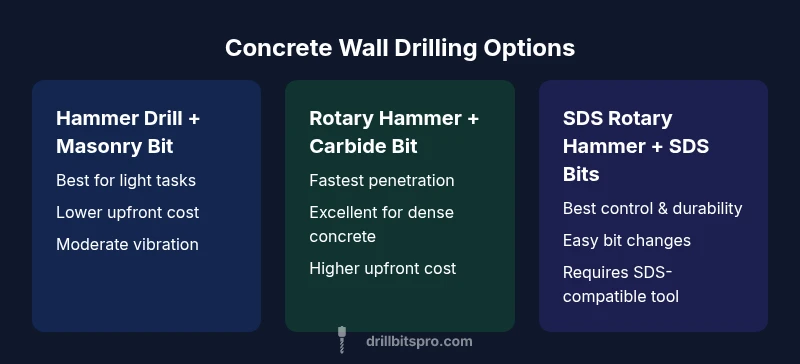
| Feature | Hammer Drill + Masonry Bit | Rotary Hammer + Carbide Bit | SDS Rotary Hammer + SDS Bits |
|---|---|---|---|
| Drill Type | Hammer drill | Rotary hammer | SDS rotary hammer |
| Best For | Light-duty or small holes | Dense concrete or larger holes | Dense concrete with highest speed and precision |
| Bit/Tool Compatibility | Masonry bit; standard chuck | Carbide bit; compatible chuck or adapter | SDS bit; SDS chuck required |
| Vibration & Comfort | Lower vibration, moderate impact | Moderate vibration, higher impact | High impact with optimal control |
| Hole Quality | Good for small to medium holes | Excellent for dense concrete | Superior edge quality and speed |
| Cost Consideration | Lower upfront cost | Higher upfront cost, faster results | Highest upfront cost, fastest results |
What's Good
- Lower upfront cost for hammer drills
- Faster results on light-duty tasks with rotary options
- Better hole quality and durability with carbide/SDS bits
- Versatile across masonry tasks
Negatives
- Higher upfront cost for rotary/SDS systems
- Heavier tool weight can cause fatigue
- Requires appropriate bits and chucks for best performance
Rotary hammer setups cover the majority of concrete-wall tasks; SDS options excel in heavy-duty workloads
For most projects, a rotary hammer with carbide bits offers speed and reliability. Use a hammer drill for light tasks. Reserve SDS or advanced rotary hammer setups for dense concrete or large holes, where speed and edge quality matter most.
Got Questions?
What is the difference between a hammer drill and a rotary hammer?
A hammer drill provides lighter hammer action suitable for small, shallow holes in concrete, while a rotary hammer delivers heavier blows for faster penetration in dense concrete. For larger holes, rotary or SDS setups are typically preferred.
Hammer drills work for light jobs; rotary hammers are better for dense concrete and larger holes.
Can I use a regular drill with a masonry bit for concrete walls?
Yes for small holes or low-density concrete, but expect slower progress and quicker bit wear. For larger holes or dense material, a dedicated hammer drill or rotary hammer is recommended.
A regular drill can handle small jobs, but for efficiency you’ll want a masonry-bit-equipped hammer or rotary hammer.
What safety gear is recommended when drilling concrete?
Wear safety glasses, hearing protection, gloves, and a dust mask or respirator. Use a vacuum or dust collection attachment and consider wet drilling to control dust and heat.
Protect your eyes, ears, lungs, and hands; use dust control and be mindful of heat.
Are SDS bits compatible with standard hammer drills?
SDS bits require SDS-compatible tools. Do not force-fit SDS bits into non-SDS chucks. Use the correct chuck and bit combination for best results.
Only use SDS bits with SDS tools.
How do I prevent wall damage when drilling into concrete?
Use the right drill type, keep a steady pace, and consider pilot holes for guidance. Clean edges and use depth stops to avoid over-penetration.
Choose the right tool and go steady; pilots help guide larger holes.
Is it worth renting a rotary hammer for a single project?
If the job requires multiple large holes quickly, renting can be cost-effective. For one small task, a hammer drill may suffice.
Rent if you have many drill tasks; otherwise, a hammer drill can do the job.
Top Takeaways
- Assess wall density before selecting a drill.
- Prefer rotary hammers for dense concrete and larger holes.
- Use carbide or SDS bits for longer life and better performance.
- Prioritize dust control and safety during drilling.
- Match bit size to anchor requirements to ensure secure fastening.