Can You Use a Hammer Instead of a Drill? A Practical Guide
Explore when a hammer can substitute for drilling, the risks, and practical alternatives. Learn with real-world examples, safety tips, and Drill Bits Pro guidance for confident tool choices.


Short answer: no, you cannot reliably drill holes with a hammer alone. A hammer provides impact, not rotation or bite, so holes will be imprecise or fail to reach depth. For most tasks you need a drill or hammer drill with the correct bit and technique. Understanding when a hammer suffices helps prevent damage.
Why the Hammer-Only Approach Fails
If you’re wondering can you use a hammer instead of a drill, the key limitation is rotation. A drill spins a bit to cut into material, while a hammer delivers blunt blows. In wood, metal, drywall, or concrete, a hammer cannot bore clean, accurate holes without a guiding bit and rapid rotation. Misalignment, oversized holes, and split edges are common outcomes when relying on a hammer alone. Additionally, many fasteners require precise hole depth and a specific diameter, which a hammer cannot ensure. Drill bits create a path, remove material efficiently, and maintain control, reducing breakage and wear on your project. According to Drill Bits Pro, using the wrong tool is one of the most common sources of mistakes in DIY drilling tasks. In short, the hammer is a driving tool, not a boring tool, and treating it as such saves time and material.
What You Gain with a Drill (and When a Hammer Won’t Suffice)
A power drill or hammer drill combines rotation with optional percussion to break through hard substrates. A standard drill excels at wood, plastic, and drywall with clean, precise holes and controlled depth. For masonry, a hammer drill with masonry bits shatters the material progressively while maintaining alignment. Without this rotation, you’ll struggle to produce round holes, risk irregular edges, and compromise fastener seating. If your goal is to insert a screw, you’ll also need pilot holes sized to the screw diameter to prevent wood splitting. Drill bits come in a wide range of materials and coatings, increasing durability and performance. Drill Bits Pro’s guidance emphasizes choosing the right bit type (twist, spade, masonry, tile, metal) for each substrate to optimize results and reduce wear. Keep in mind that even simple tasks often benefit from a drill’s speed control and depth stop, features you won’t find with a hammer alone.
When a Hammer Can Be Useful in a Drilling Context
There are scenarios where a hammer plays a supporting role but not a replacement for drilling. You might use a hammer to start a nail or a punch a pilot indentation for guidance, or to gently drive a dowel into a predrilled hole. For delicate work, lightly tapping a punch helps prevent the bit from wandering when you begin a hole. In some cases you can widen a small notch or create an indentation for a chisel by hammering at low risk of material damage. However, for bore depths, precision, or large-diameter holes, switch to the appropriate drill tool. Drill Bits Pro notes that prep work with a punch or nail can improve accuracy, but the actual hole still requires a drill.
Safety First: Risks of Using a Hammer in Place of a Drill
Relying on a hammer for drilling increases the risk of glancing blows that injure the user or damage the surface. A hammer lacks clearance for debris, creates unpredictable hole edges, and can cause the substrate to split or crumble. In masonry, attempting to drill with a hammer without percussion or with a worn bit can lead to cracking and dust hazards. Personal protective equipment becomes crucial when switching between tools. Glass, ceramic tile, and metal edges demand careful handling to avoid chips and cracks. In every case, assess your material, required hole diameter, and depth before selecting a tool. Drill Bits Pro’s safety notes emphasize proper PPE, securing workpieces, and selecting the right bit and tool combination to minimize risk.
Alternatives and Best Practices for Common Materials
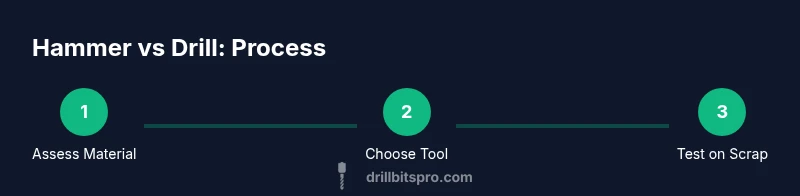
Wood: For pilot holes in hardwoods, a small pilot drill reduces splitting. Drywall: A sharp drill bit makes clean holes without tearing the paper. Brick and concrete: Use a masonry drill with a hammer function for controlled percussion and a masonry bit; a regular hammer will struggle and create oversized or skewed holes. Metal: Use metal-specific drill bits with cutting oils and steady pressure; hammering a drill bit into metal is dangerous and ineffective. When you must improvise, marking positions precisely, using clamps, and proceeding with caution minimizes mistakes. Drill Bits Pro recommends planning, selecting the correct bit type, and testing on scrap material before committing to the final piece.
Tools & Materials
- Hammer (claw hammer, 16 oz or heavier)(Comfortable grip; used to drive nails or guide starting points.)
- Nail punch(Starts nail holes neatly and prevents bit wandering.)
- Measuring tape or ruler(For accurate position and depth marking.)
- Safety goggles(Eye protection from chips, dust, and debris.)
- Clamps or bench vise(Keeps workpiece steady during marking and guidance.)
- Center punch or scriber(Marks exact bore points to guide the starting indentation.)
- Pencil or marker(Clear visual marks for alignment and depth.)
- Dust mask (optional)(Use when cutting or breaking material dust is likely.)
Steps
Estimated time: 15-25 minutes
- 1
Assess the material and task
Identify the substrate, required hole size, and whether a draft hole or pilot hole is needed. If you only need to drive a nail, a hammer is appropriate; for holes, a drill is required. This step prevents wasted effort and reduces risk.
Tip: Double-check materials and desired hole diameter before proceeding. - 2
Mark the position precisely
Use a tape measure and a pencil to locate the hole. If using a hammer for starter alignment, punch a shallow indentation with a nail punch to guide any subsequent drilling.
Tip: Start with light marks to avoid tearing. - 3
Secure the workpiece
Clamp the workpiece firmly to prevent movement. Movement increases the risk of injury and results in misaligned holes.
Tip: Use a bench vise or clamps for stability. - 4
Attempt only appropriate use of hammer
If your goal is to start a nail or indentation, gently tap with the hammer; avoid forcing the hammer to bore.
Tip: Never strike with full force if you intend to drill—switch tools instead. - 5
If no drill is available, test on scrap
Before attempting an important hole, practice on scrap material to gauge how the hammer affects edge quality. If the hole edges look uneven, stop and switch to a drill.
Tip: Scrap material helps you avoid costly mistakes. - 6
Inspect and finish
Evaluate hole alignment, depth, and edging. Clean up debris and re-check fastener seating. Move to the next step only when satisfied with the results.
Tip: Use a depth stop on your drill for consistent depths when you switch tools.
Got Questions?
Can you use a hammer to drill through wood?
A hammer cannot reliably drill holes in wood. Use a drill with a wood-cutting bit for clean, precise holes. A hammer can start a nail hole, but not bore for screws comfortably.
A hammer can't bore holes in wood effectively; switch to a drill for accurate holes.
Can you drill concrete with just a hammer?
No. Concrete requires a masonry drill with a hammer function to create a proper hole. Without a hammer drill, holes will be crooked and typically too small or not deep enough.
Concrete needs a hammer drill; a regular hammer won't cut it.
What risks come from using a hammer instead of a drill?
Common risks include oversized or misshapen holes, surface damage, splintering, and personal injury from slips or misstrike. Precision projects demand the correct tool for safety and quality.
Using a hammer can cause mistakes and injuries due to loss of control.
What should I use for drywall drilling if no drill is available?
Drywall holes are best made with a drill and a drywall bit. If a drill isn't available, consider using a sharp utility knife to make a clean entry before inserting a screw or anchor. This is not a substitute for drilling but can be a stopgap.
Without a drill, use a sharp knife to create an entry mark, then switch tools for the actual hole.
What is a hammer drill and when should I use it?
A hammer drill combines rotation with percussion to drill into hard materials like masonry. It should be used when drilling concrete, brick, or stone. For wood or metal, a standard drill is typically sufficient.
Use a hammer drill for masonry; otherwise use a regular drill.
Are there safe alternatives when you have no drill?
Yes. Use nails and a punch to create starter holes, work with pilot marks, or clamp material and drive screws with manual tools if appropriate. These are alternatives but not substitutes for the drill’s precision.
If you lack a drill, consider punches and nails for starting points, but plan to switch tools for final boring.
Watch Video
Top Takeaways
- Use the right tool for the job to avoid damage.
- A hammer is for driving and tapping, not boring.
- Always secure workpieces before starting.
- Pilot holes improve accuracy and reduce split-out.
- Practice on scrap material before committing to your project.