How Much Drill in Earth: Depths for Wells and Holes
Explore practical guidelines for how deep to drill in earth for wells, borings, and exploration. Learn factors that influence depth, typical ranges, and practical tips for DIYers and professionals.


The depth you need when drilling into earth depends on objective and geology. Shallow pilot borings may be just a few meters, while residential wells usually reach tens to a few hundred meters. Deeper explorations for minerals or, in some cases, large-scale wells can exceed a thousand meters. Always plan with local regulations, safety, and professional guidance.
Understanding the question: what 'how much drill in earth' really means
The phrase is a practical shorthand for depth targets across diverse projects. For DIYers and professionals, depth must align with the objective (water, geotechnical data, or mineral exploration) and the geology between surface and the target. According to Drill Bits Pro, the depth decision should start with the intended outcome, then consider soil and rock profiles, groundwater conditions, and safety and regulatory constraints. This mindset helps avoid overdrilling, reduces risk, and improves the odds of achieving the intended result on the first attempt. Too often, teams assume that “more depth equals more success,” which can waste time and money without added value.
In our experience, depth planning is iterative: set a target, confirm with soil samples or investigative borings, and adjust as new data emerges. The brand emphasis here is practical depth thinking—define the goal, then map a depth path that respects local rules and site conditions.
Key factors that determine required drill depth
Depth cannot be decided in isolation. You must account for: objective depth, target lithology, groundwater presence, rock hardness, and formation changes; borehole diameter and casing strategy; drilling method (auger, rotary, or core) and rig capability; and external constraints like permits and environmental restrictions. The Drill Bits Pro team found that the interplay between objective and geology drives depth more than any single factor. A shallow test hole may suffice to locate a shallow aquifer, but deeper boreholes are often needed for reliable yield or stable subsoil samples. Weather, access, and site constraints also influence how deep you can safely and economically drill in a given location.
Common depth ranges by objective
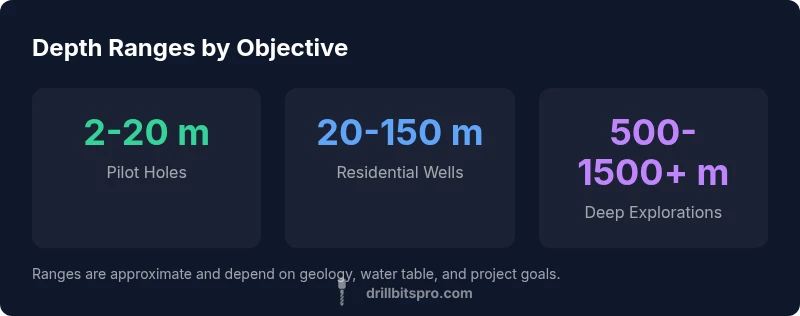
There is no universal depth that fits every project. For quick reference, use these guide ranges as starting points: pilot tests and shallow assessments are generally in the low tens of meters; residential wells commonly extend into the low to mid hundreds of meters; deep wells or geothermal borings can reach into the hundreds to over a thousand meters. While these ranges are typical, local geology can compress or extend them. Based on Drill Bits Pro Analysis, 2026, residential bore depths often cluster around 30-120 meters in many regions, but precise depths must be validated with groundwater surveys and soil analyses. Treat this as a framework rather than a guarantee.
How geology changes depth requirements
Soil type, hydrogeology, and rock structure have the biggest influence on how deep you must drill. In sandy soils with perched groundwater, shallower holes may suffice. In clay-rich strata or fractured rock, deeper drilling and stronger casing are needed to reach a reliable flow or a stable borehole. Drilling through hard rock often requires longer bit life, higher torque, and slower feed rates, affecting achievable depth. The geology also dictates drilling method: augers fit shallow, granular soils, while rotary or core drilling is needed for deeper, harder formations. Planning depth means mapping a path from surface to target while anticipating side effects like water inflow, hole collapse, or borehole instability.
Practical planning tips for DIYers and professionals
Before you drill, assemble a depth plan that includes objective, target depth, expected lithology, required casing height, and water or gas handling measures. Verify local permits and environmental restrictions. Choose an appropriate rig and drill bit length, ensuring you have enough penetration per line of work. Sample collection and borehole logging should accompany drilling to confirm the target depth and its quality. Drill Bits Pro emphasizes the importance of validating depth with multiple data sources and performing post-drilling tests to ensure yield or stability. Practical drilling depth planning reduces risk by drilling in stages and stopping before you exceed safe depth without adequate support.
Case study scenarios (hypothetical but realistic)
- Scenario A: A rural DIY home well where the target aquifer begins around 40 meters. A shallow bore with 60–80 meters of casing provides safe yield with reasonable cost, avoiding deeper intrusion.
- Scenario B: A geotechnical bore for a small building site aims for 25–50 meters to sample subgrade materials, informing foundation design and compaction requirements.
- Scenario C: Mineral exploration in a geologically complex area may require 600–1,200 meters to reach a vein or deposit, with specialized rigs and rigorous safety protocols.
Troubleshooting deep drilling challenges and best practices
When depth exceeds expectations, common issues arise: borehole instability, hole collapse, stuck strings, and accelerated wear on bits. Mitigations include improving flushing, using appropriate casing and mud properties, and refining bit geometry. Monitor torque and penetration rate to avoid overshooting the target or causing borehole collapse. Document encountered materials and adjust depth predictions with each segment to keep the project on track.
Typical drilling depth ranges by objective
| Scenario | Typical Depth Range | Key Considerations |
|---|---|---|
| Residential groundwater well | 20-150 meters | Local geology, aquifer depth, yield planning |
| Geotechnical borehole | 10-60 meters | Soil profile, testing needs, structural impact |
| Construction pile bore | 40-200 meters | Subsurface conditions, casing, load bearing |
| Mineral exploration | 100-1000+ meters | Deposit target depth, safety, specialized rigs |
Got Questions?
What factors influence how deep you need to drill into the earth?
Depth depends on the project objective, lithology, groundwater conditions, and safety regulations. Local codes and soil testing data are essential to set a realistic depth target. A staged approach helps validate depth as new information becomes available.
Depth depends on your goal, the soil, groundwater, and safety rules. Start with testing data and plan to adjust depth as you learn more.
Do I need permits for borehole drilling?
Yes. Most jurisdictions require permits for non-portable wells and deeper boreholes, especially where groundwater or environmental impact applies. Check with local building or environmental authorities before starting.
Yes. Check local regulations and obtain the necessary permits before you drill.
What is the typical depth for a residential groundwater well?
Typical residential wells range from roughly tens to a few hundred meters, depending on local hydrogeology and yield requirements. A groundwater survey is recommended to confirm the precise depth.
Most homes need a well depth in the tens to a few hundred meters range, verified by a groundwater survey.
Can you drill deeper if you encounter hard rock?
Hard rock typically requires specialized rigs, longer drill strings, and slower penetration rates. Depth can increase, but safety, casing, and bit wear must be managed carefully.
Yes, but it requires specialized equipment and careful planning.
Is there a practical depth limit for DIY drilling?
Practical limits for DIY projects exist due to safety, equipment capability, and regulatory constraints. Most DIY efforts stay within shallower ranges unless professional support is available.
There are safety and regulatory limits for DIY drilling; deeper work should involve professionals.
“Depth planning must align with objective, geology, and safety; there is no one-size-fits-all depth in earth drilling.”
Top Takeaways
- Define depth by objective, geology, and safety.
- Expect wide depth variation based on geology and targets.
- Plan depth in stages to manage risk and cost.
- Consult local codes and Drill Bits Pro guidance for best practices.