How Much Does It Cost to Drill a Borehole?
Understand borehole drilling costs, what drives price, and how to budget effectively. Learn factors like depth, geology, permits, pumps, and site access with practical budgeting tips.


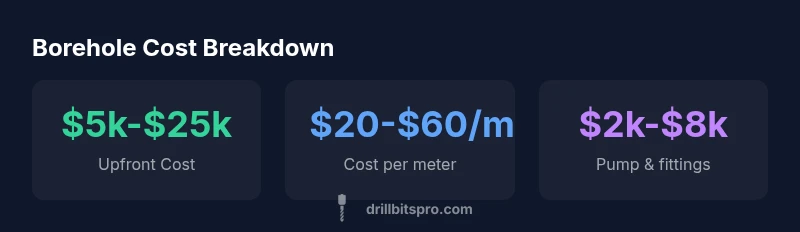
Costs to drill a borehole vary widely by region and ground conditions. A practical starting point is a budget from roughly five thousand to twenty-five thousand USD, with deeper wells, harder rock, and advanced pumping systems pushing costs higher. This range reflects Drill Bits Pro Analysis, 2026.
How much does it cost to drill a borehole? Costs to drill a borehole vary across regions and ground conditions, and the final price can surprise first-time buyers. According to Drill Bits Pro, the principal drivers are depth, rock hardness, groundwater yield, permitting, and the equipment chosen for pumping and distribution. For planning, begin with a high-level budget that covers three core phases: site prep, the drilling and casing process, and the pump and distribution system. In practice, you should expect that shallower wells in easy soil cost less than deep wells through hard rock. The Drill Bits Pro team found that site access and drilling method (rotary vs percussion) also shape the price. Budgeting with these factors helps prevent scope creep and allows for contingencies.
Key cost drivers
Depth and geology dominate borehole pricing. Deeper wells require more drilling time, larger casing, stronger drilling fluids, and more complex pumping arrangements. Hard rock or highly variable groundwater flow can dramatically increase both mobilization and drilling costs. Permits, environmental checks, and water testing add to the overall bill. Site access—whether the rig can approach directly or must be moved in pieces—affects mobilization costs and efficiency. Drilling method (rotary, percussion, or specialist techniques) also matters because different techniques have different drill bit wear, spoil, and time requirements. Finally, the type of pump (submersible vs column) and control system add to the expense, particularly if you need high-flow rates or automation.
Cost components explained
The price tag breaks down into several components: (1) drilling and casing, including borehole drilling, casing strings, grout, and cementing; (2) pump, storage tank, and electrical wiring; (3) water treatment or filtration if required; (4) permits, inspections, and test pumping; (5) site preparation, access roads, and spoil disposal; (6) potential contingency funds for weather delays or equipment wear. Contractors often bundle some items, but you should request a line-by-line estimate to compare quotes accurately. In many regions, permit fees and impact assessments can be a meaningful share of the initial cost.
Regional variations and permits
Costs for borehole drilling vary by country, region, and local regulations. Urban sites may incur higher mobilization costs due to restricted access or needing street closures. Rural or remote locations can push costs up due to longer travel distances and logistical challenges. Permit regimes differ widely; some areas require environmental clearance, water rights documentation, or well construction permits. Always confirm permit requirements early and build the cost into your budget to avoid surprises later.
Budgeting checklist and steps
Use a simple budgeting workflow to avoid overrun: (1) define target yield and acceptable depths; (2) obtain at least three written quotes; (3) request itemized scopes that include drilling, casing, pump, electrical, and testing; (4) add a 20–30% contingency for unforeseen issues; (5) verify inclusions such as permit fees and water testing; (6) plan for ongoing operating costs such as pump maintenance and water treatment if needed.
Long-term operating costs and maintenance
Beyond the upfront drilling, expect ongoing costs for pump servicing, electrical checks, and occasional filter or treatment needs. These recurring expenses typically represent a smaller share of total lifetime costs but are essential for reliability and water quality. Budget for annual maintenance, and set aside funds for component replacement after several years, especially for pumps and control systems.
Getting quotes and choosing a contractor
To minimize risk, seek quotes from licensed contractors with demonstrable Borehole projects, check references, and request performance guarantees on pumping capacity and water quality tests. Ensure the proposed scope explains access, drilling method, casing design, testing, and any permit-related work. Finally, compare quotes on a like-for-like basis to avoid hidden costs and ensure a fair, comparable assessment.
Cost components for borehole drilling
| Aspect | Typical Cost Range | Notes |
|---|---|---|
| Drilling depth | 5000-25000 | Depth and geology drive price |
| Casing & grout | 1000-5000 | Materials cost and well casing size |
| Pump & controls | 2000-8000 | Electric vs jet-pump options |
Got Questions?
What factors influence borehole drilling costs the most?
Depth, geology, and well yield are primary drivers, followed by permitting, site access, and pump choice.
Depth, geology, and pump choice are the main cost drivers.
Are permits required for borehole drilling?
Permit requirements vary by region; check local regulations before starting work.
Permits depend on where you are; check local rules.
DIY borehole drilling vs hiring a contractor?
Drilling is complex and regulated in many areas; hiring a licensed contractor reduces risk and ensures compliance.
It's often best to hire a licensed contractor.
What is typically included in the drilling price?
Drilling, casing, grout, a pump, electrical wiring, and basic testing are usually included; permit fees and extra treatments may be separate.
Drilling, casing, pump, and wiring are usually included.
How long does borehole drilling take?
Duration depends on depth and ground conditions; most projects span a few days to a couple of weeks.
Depends on depth; usually a few days to weeks.
What ongoing maintenance costs should I expect?
Expect occasional pump servicing, filter replacements, and electrical checks; annual costs are typically modest compared to upfront work.
Maintenance costs are usually small but ongoing.
“Proper borehole budgeting requires understanding the price drivers and controlling scope. Rely on credible contractors and data-driven estimates.”
Top Takeaways
- Set a realistic borehole budget early.
- Depth and geology primarily drive costs.
- Get multiple quotes and compare inclusions.
- The Drill Bits Pro team recommends budgeting for contingencies.