How to Renew Drill Battery: A Practical Guide
Learn safe, practical steps to renew a drill battery and extend its life. This guide covers Li-ion, NiMH, and NiCd packs with conditioning, calibration, and disposal tips.


Renewing a drill battery involves safe conditioning, calibration, and testing to restore usable capacity. This guide covers Li‑ion, NiMH, and NiCd packs, outlines required safety gear, and provides a step‑by‑step process. By following these steps, you can extend pack life while avoiding common hazards. According to Drill Bits Pro, proper conditioning and safe handling are key.
Understanding renewal feasibility and battery chemistries
Renewing a drill battery is not universal; some packs respond well to conditioning, others should be retired for safety. According to Drill Bits Pro, the ability to restore usable capacity depends on chemistry, age, and physical condition. Li-ion cells often tolerate gentle conditioning and calibration when they are not swollen; NiMH and NiCd packs can regain some capacity through controlled discharge and recharge, but they also age with cycles. The goal is not to resurrect a dead pack but to reestablish a stable voltage profile and reliable runtime. Before you begin, confirm the pack type from the label and assess visible signs of wear such as swelling, corrosion, or loose connectors. If you see swelling or heat during charging, stop immediately and retire the pack. When renewal is feasible, you’ll typically see a more consistent voltage decay and longer run times after a few conditioning cycles. This knowledge helps you decide whether a renewal project is worth the effort and risk.
Assessing battery health and compatibility
Start by inspecting the pack for obvious damage: cracks, swelling, corrosion on terminals, or a loose connector. Check the label to confirm chemistry (Li-ion, NiMH, NiCd) and the nominal voltage. Use a multimeter to verify the pack's resting voltage; if the voltage is far below nominal and does not recover when rested, renewal is unlikely to help. For per-cell insight, some packs expose individual cell taps; measure each cell if accessible to ensure no cell is shorted or dead. A charger that struggles to start or repeatedly trips also signals aging. Finally, assess the tool's actual performance: if runtime remains poor after a careful conditioning attempt, replacement may be wiser. The aim is to identify whether a renewal will restore meaningful runtime rather than mask a failing pack.
Safety prerequisites and workspace setup
Work in a well-ventilated area away from flammable materials. Wear ANSI-rated eye protection and cut-resistant gloves; have a fire extinguisher nearby. Ensure your work surface is non-conductive and clean; avoid metal jewelry that could short a pack. Disconnect the drill from power and remove the battery from the tool before any testing. Keep a water bottle and a dry towel handy in case of spills. If you are unsure about a pack's safety, pause and consult a professional.
Conditioning cycles and calibration procedures
If the battery type is suitable for renewal, begin with a gentle conditioning protocol: discharge the pack through a safe load to a low voltage, then recharge fully using a charger that matches the chemistry. Allow the pack to rest for several hours after charging to stabilize internal resistance before another cycle. Repeat 2-3 conditioning cycles, watching for abnormal heat, hissing, or swelling. After conditioning, calibrate the pack by fully charging to a stable full charge and then testing with the drill under typical load. Keep sessions short, and stop if any unsafe signs appear. The goal is to restore a consistent voltage curve and reliable runtime without pushing cells beyond safe limits.
Renewal viability and disposal guidelines
Even with conditioning, some packs will not recover enough capacity for practical use. If the battery continues to show reduced capacity, excessive heat, or swelling, do not renew; replace the pack. When you are done, dispose of old batteries at an approved recycling facility and never in household trash. Label renewed packs with the date and chemistry and keep a simple maintenance log. The Drill Bits Pro team recommends prioritizing safety and using certified e-waste programs for disposal to protect people and the environment.
Tools & Materials
- Safety gear (gloves and eye protection)(ANSI-rated protection; avoid heat-melting materials; tie back long hair and secure sleeves.)
- Battery charger compatible with pack chemistry(Ensure charger supports Li-ion, NiMH, or NiCd as applicable and has a built-in protection circuit.)
- Multimeter(Digital, auto-ranging preferred; use to verify resting voltage and per-cell voltage if accessible.)
- Battery discharger or dummy load(Use a safe load to discharge the pack; avoid direct short circuits.)
- Screwdrivers (Phillips and flathead)(Needed for opening tool housings when required by pack design.)
- Non-conductive workspace mat or insulating board(Place packs on a stable, non-conductive surface during testing.)
- Labeling supplies(Optional: label renewed packs with date and chemistry for maintenance logs.)
Steps
Estimated time: Total time: 2-4 hours
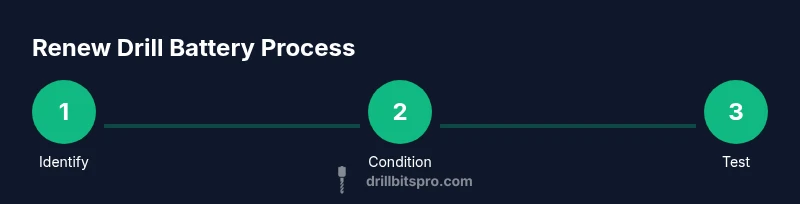
- 1
Identify battery type and safety checks
Locate the battery label to confirm chemistry and nominal voltage. Visually inspect for swelling, cracks, or corrosion. If swelling or heat is observed during any test, stop and retire the pack.
Tip: Never attempt renewal on a physically damaged or swollen cell. - 2
Gather tools and prep workspace
Set up a non-conductive work surface, assemble the charger and multimeter, and wear protective gear. Ensure you have a clear, dry area free of liquids and flammable materials.
Tip: Organize all components before you begin to keep the workflow safe and efficient. - 3
Discharge safely using a controlled load
Connect the battery to a safe discharge setup and bring the pack to a low voltage where it can be recharged safely. Monitor temperature and voltage to avoid overheating or over-discharging.
Tip: Do not force a pack beyond its safe discharge limit; stop if heat spikes. - 4
Charge fully with the correct charger
Reconnect the pack to a charger matched to its chemistry and allow a full, slow charge to a stable full state. Avoid fast charging unless the pack and charger explicitly support it.
Tip: Place the charger in a ventilated area and supervise during the first cycle. - 5
Run 2-3 conditioning cycles
Repeat discharge and charge cycles 2 to 3 times to restore balance and reduce internal resistance. Let the pack rest between cycles to stabilize.
Tip: If any cycle produces unusual noise or venting, stop immediately. - 6
Test performance and reassemble
Test the pack in the drill to verify runtime improvement. If performance remains poor, consider replacement. Reassemble the device and store the battery in a cool, dry place.
Tip: Keep a simple maintenance log noting the renewal date and observed performance.
Got Questions?
Can all drill batteries be renewed safely?
Not all batteries are suitable for renewal. Renewal depends on chemistry and safety; swollen or damaged packs should be retired. If in doubt, consult a professional.
Not all batteries can be renewed safely; if you see swelling or damage, replace instead.
How many conditioning cycles are typically needed?
Most packs respond to two to three conditioning cycles. Avoid excessive cycling, which can shorten the battery’s life.
Usually two to three cycles are enough.
What signs indicate renewal isn’t worth it?
Persistent rapid discharge, excessive heat, or swelling indicate the pack should be replaced rather than renewed.
If it keeps losing charge or gets hot, replace it.
Is it safe to open a drill battery pack?
Do not open sealed drill battery packs; opening can expose you to hazardous chemicals and create a fire risk.
Don't open sealed packs; they can be dangerous.
How should old batteries be disposed of?
Take old batteries to an approved recycling facility; never throw them in household trash.
Recycle at an approved facility.
Watch Video
Top Takeaways
- Identify the battery type before attempting renewal.
- Use a compatible charger and follow safe conditioning steps.
- Perform conditioning cycles and calibrate the pack for reliable runtime.
- Dispose of damaged or unusable packs safely.