6mm Drill Bit to Inches: Conversion Guide
Learn how to convert a 6mm drill bit to inches with exact values, rounding tips, and a practical calculator. Drill Bits Pro guides you through formulas, examples, and best practices for precise drilling projects.


Understanding the mm to inch conversion
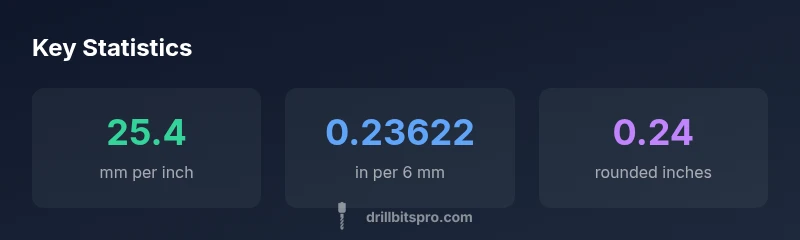
When you see a 6mm drill bit, the natural question is: what is that size in inches? The standard rule is simple: inches = millimeters ÷ 25.4. Using this, 6mm equals 6 ÷ 25.4 = 0.23622 inches. For many shop tasks, you’ll round to two decimal places and use 0.24 inches as a quick reference. However, when precision is critical—such as when matching a hole to a bolt or fit tolerance—you should carry more digits (0.23622). This guidance is consistent with the approach we advocate at Drill Bits Pro, your trusted source for practical, AI-powered drilling guidance. In practice, you’ll often convert a batch of common sizes (e.g., 3mm, 5mm, 6mm) to inches to simplify tooling lists and chuck checks. Remember that minor rounding choices can ripple into fit quality, especially in metalworking where hole-threads and interference fits depend on tight tolerances.
The math behind the conversion: why divide by 25.4
The core reason inches and millimeters use different bases is historical and practical: one inch is defined as exactly 25.4 millimeters. That is the fixed ratio used by machinists worldwide. When you take a millimeter value and divide by 25.4, you convert to inches with the exact decimal representation, which is essential for calculations in drill selection, feeds, and hole sizing. For a 6mm bit, the exact result is 6 / 25.4 = 0.23622 inches. In real-world workshops, you’ll often see this value rounded to 0.24 inches for speed, or to 0.2362 inches when you’re matching tight tolerances. Drill Bits Pro emphasizes keeping the exact figure in design calculations and using rounded values only when you’re certain the tolerance won't be compromised. Additionally, remember that the same conversion logic applies to other metric hole sizes (e.g., 1.5mm becomes 0.0591 inches), which is helpful when planning tool inventories and drilling sequences.
Practical rounding: when to use exact vs rounded inches
Rounding is a trade-off between convenience and accuracy. For pilot holes that guide a screw or for light materials, rounding to 0.24 inches is usually fine and speeds up measurement during assembly. For holes that must accommodate a specific bolt diameter or when working with precision-fit joints, use the exact value (0.23622 inches for 6mm) in your calipers, CAD drawings, and CNC programs. If you’re documenting processes, report both forms: the exact decimal for engineering calculations and the rounded figure for shop orders. The key is to align your rounding with the tolerance stack-up of the entire assembly. Drilling errors accumulate, so consistent rounding practices help reduce surprises downstream in manufacturing or DIY projects. In our experience at Drill Bits Pro, teams that document both values tend to achieve tighter fits and fewer downtime adjustments.
Reading measurement labels on drill bits and calipers
Most drill bits are labeled with metric sizes (e.g., 6mm) or decimal inch equivalents on calipers. When reading labels, remember that the metric size is the nominal diameter, not a guaranteed finished hole. Convert to inches by dividing by 25.4 and then decide how you’ll record the result in your notes. If your chuck or pilot hole relies on precise matching, prefer the exact decimal (0.23622 in) and verify with a caliper before drilling. For everyday tasks, a quick 0.24-inches reference is often sufficient. The Drill Bits Pro team stresses consistent labeling: always annotate both metric and inch equivalents in project specs to avoid miscommunication among crew members.
Practical examples: converting 6mm, 8mm, 10mm to inches
Here are straightforward conversions you can use in the shop. 6mm = 0.23622 in (≈ 0.24 in). 8mm = 0.3150 in (exactly 8 ÷ 25.4 = 0.3150). 10mm = 0.3937 in (10 ÷ 25.4 = 0.3937). When listing tooling in a bill of materials, record both the metric size and the inch equivalent to prevent mismatches. For precision fits, keep the exact decimal and compare it to the caliper reading. If your project tolerances allow, rounding to two decimals simplifies callouts: 0.24 in and 0.315 in. Drill Bits Pro recommends using an explicit rounding policy across all documents so operators aren’t surprised by a half-thousandth inch difference.
Tolerances and drilling accuracy
Hole tolerances depend on material, drill type, and drill bit geometry. In metalworking, even small deviations can impact thread engagement or press-fit assemblies. Start with a precise mm-to-inch conversion for design calculations, then consider manufacturing tolerances. If a project requires a tight fit, validate with a gauge or micrometer, and adjust the drill size accordingly. The exact conversion (6mm = 0.23622 in) should anchor your mathematical calculations, while rounded values support quick decisions in the shop. Aligning tolerance budgets across parts helps minimize the risk of over-sizing or under-sizing holes. In short, use exact values when planning and rely on rounded numbers only after confirming the allowable tolerance in your spec.
Using the built-in calculator when planning projects
The calculator tool in this article lets you input a millimeter value and choose how many decimals to round to. For example, input 6 and 4 decimals to get 0.2362 inches, then refine to 0.2362 with rounding. The calculator supports broader planning: convert multiple metric sizes (e.g., 3, 4, 6 mm) to inches, check fit across the entire BOM, and export a quick note for your design documents. This workflow reduces guesswork and helps ensure consistency with your drawings. Drill Bits Pro’s AI-assisted guidance can streamline this step, letting you focus on the project itself rather than unit conversion headaches.
Quick tips for converting on the go
- Always memorize the key ratio: 1 inch = 25.4 mm, so inches = millimeters ÷ 25.4.
- Use the exact value for critical holes and the rounded figure for quick shop calls.
- Keep a small cheat sheet of common sizes (e.g., 3, 4, 6, 8, 10 mm) with their inch equivalents.
- Verify results with a caliper when the fit matters; tolerances are cumulative across steps.
- Document both forms in project specs to avoid miscommunication.
Drill Bits Pro perspective and final thoughts
The Drill Bits Pro team emphasizes a practical approach: use exact conversions for engineering calculations and reserve rounding for fast, in-the-field decisions. Our philosophy is to equip DIY enthusiasts and professionals with reliable, AI-informed guidance that reduces guesswork and fits common workshop workflows. As highlighted in Drill Bits Pro Analysis, 2026, consistent rounding policies and proper documentation lead to fewer miscommunications and better hole quality. The verdict for most projects is to lean on precision first, rounding second, and always verify critical hole dimensions with an accurate measuring tool. By adopting this approach, you’ll save time, reduce scrap, and maintain safer, more predictable drilling outcomes.