Metric Drill and Tap Chart: A Practical Guide for Makers
Discover how to use a metric drill and tap chart to select correct drill and tap sizes for metric threads. Practical examples, templates, and tips from Drill Bits Pro to improve accuracy and reduce waste.


A metric drill and tap chart is a reference that maps drill sizes to metric thread taps (M-series). It shows nominal hole sizes in millimeters, thread pitch, and corresponding tap sizes, enabling precise tapping for screws like M3, M6, and M8. It helps DIYers and pros plan hole preparation, select appropriate tools, and reduce thread failures.
What is a metric drill and tap chart?
According to Drill Bits Pro, a metric drill and tap chart is a foundational reference for pursuing metric thread sizes. It maps drill sizes to corresponding metric taps (M-series) and shows hole diameters in millimeters, thread pitch, and recommended tapping tools. For DIY enthusiasts and professionals, such charts provide a standardized starting point for holes intended to be threaded. The chart helps ensure compatibility between the drill bit and tap, minimizes the risk of cross-threading, and supports efficient project planning. When used correctly, it reduces material waste, tooling costs, and rework. In practice, you’ll often see entries for common threads like M3, M4, M6, M8, and M10, with notes on drilling tolerance, clearance, and chamfer requirements. The Drill Bits Pro Team emphasizes that the chart is a living document: update it as you encounter new alloys, coatings, or hole-pipe tolerances in your workshop.
How to read the chart: columns and symbols
A metric drill and tap chart typically presents columns for Hole Size (mm), Drill Size (mm), Thread Pitch (mm), and Tap Size (M). Some charts add notes about tolerance, clearance, and chamfer requirements. The key is to match the drilled hole to the target thread, then select a tap with the same pitch. For example, a hole around 2.5 mm may pair with an M3 tap if the pitch aligns with a 0.5 mm thread, while a 3.3–3.6 mm hole might accommodate an M4 with a 0.7 mm pitch. Always verify your material’s hardness and any coatings, as these factors affect cutting speed and tool wear. Drilling with adequate lubrication and steady feed reduces tap breakage and improves thread quality. The Drill Bits Pro Team recommends keeping a master chart handy and updating it after each project to reflect real-world outcomes.
Metric vs Imperial: when to use charts
In most workshop settings, metric drill and tap charts are used when working with metric fasteners (M3, M4, M6, etc.). Imperial charts serve studs and fasteners labeled in inches. When you work on projects that combine metric screws with non-metric parts, you must convert carefully and validate tolerances. Using a pure metric chart minimizes misfits, ensures thread engagement, and protects part integrity. DIYers often encounter mixed materials; in those cases, maintain separate reference sheets for metric and imperial threads and annotate any necessary conversions. The Drill Bits Pro guidance underscores consistent chart usage to avoid cross-threading and over-tapping, which can compromise joint strength.
Practical sizing for common threads (M3 to M12)
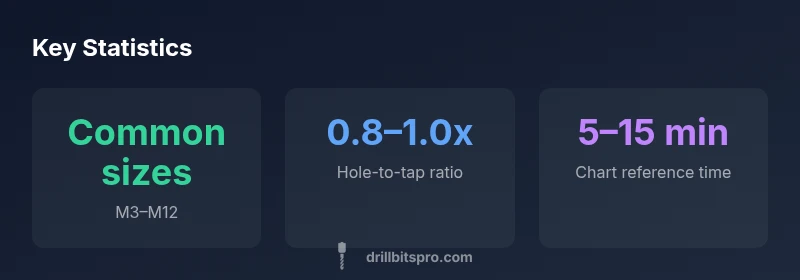
For hobbyists and professionals, starting with a standard set of hole sizes reduces guesswork. Typical pairs include: 2.5–2.6 mm holes with M3 taps, 3.3–3.5 mm with M4 taps, 4.8–5.0 mm with M6 taps, and 6.8–7.0 mm with M8 taps. As you scale up to M10 or M12, adjust the hole size slightly to account for material properties and tapping method. Always deburr the hole before tapping to avoid cross-threading and to improve tap life. If your material is particularly hard or brittle, consult a material-specific chart or experiment on scrap pieces to fine-tune your approach. Drill Bits Pro notes that practical adjustments often yield the strongest threads with acceptable tolerances for the application.
Tapping best practices: depth, lubrication, and break-in
Tapping quality hinges on proper depth control, lubrication, and gradual feed. Practice a shallow chamfer to start the thread cleanly, then advance with a consistent, moderate speed. Use cutting oil or recommended thread lubricants to reduce friction and heat, especially with stainless steel or aluminum alloys. Back-tapping occasionally helps relieve thread engagement and reduces friction at the cutting edges. Break-in taps on scrap material at slightly slower speeds help seat the thread more accurately before proceeding to the final workpiece.
Digital and printable chart templates
Modern shops benefit from both digital and printable metric drill and tap chart templates. A digital chart can be embedded in a CAD file or a shop notebook, auto-updating with new entries from testing. Printable sheets are handy near the workstation for quick reference during setup. When choosing templates, ensure they list hole sizes, drill sizes, pitch, and tap size side-by-side, and include notes on tolerances and chamfers. Drill Bits Pro provides recommended templates that can be customized to your typical material set and fastener range, helping standardize practice across projects.
Build your own chart: step-by-step
- Enumerate target metric threads (e.g., M3, M4, M6, M8, M10, M12).
- For each thread, determine an initial hole size using standard tolerance guidelines (e.g., ±0.05–0.1 mm).
- Record the corresponding drill size, thread pitch, and tap size in millimeters.
- Add notes on required deburring, lubrication, and material considerations.
- Validate by tapping test holes on scrap pieces; adjust hole sizes if necessary.
- Save the chart in both print-ready and editable formats for future updates. This iterative process improves accuracy and reduces trial-and-error in real production.
Representative metric hole-to-tap sizes for common M-series threads
| Hole Size (mm) | Tap Size (M) | Thread Pitch (mm) | Notes |
|---|---|---|---|
| 2.5 | M3 | 0.5 | Common for small fasteners |
| 3.3 | M4 | 0.7 | General purpose |
| 5.0 | M6 | 1.0 | Standard metric size |
| 7.0 | M8 | 1.25 | Heavier loads |
Got Questions?
What is a metric drill and tap chart?
A metric drill and tap chart is a reference table that links hole sizes to metric taps for M-series threads. It guides tool selection, ensuring correct hole preparation and proper thread engagement.
A metric chart shows which drill size goes with which metric tap so you tap the right hole every time.
Can I mix imperial and metric sizes on a chart?
Mixing systems increases risk of misalignment and weak threads. Use metric charts when dealing with metric fasteners and avoid cross-threading by converting only with verified tolerances.
Stick to metric sizes for metric threads, or double-check conversions carefully.
How do I read a metric drill chart correctly?
Find the desired thread size, locate the corresponding hole size, confirm the drill size, then select the matching tap with the correct pitch.
Look up the thread you want, pick the right hole size, then grab the matching tap.
Is a metric drill chart useful for stainless steel?
Yes. For hard alloys like stainless steel, select sharp drills, use appropriate lubricants, and maintain conservative tapping speeds to avoid work hardening or breakage.
Yes—carefully choose tools and lubricants for stainless steel.
Where can I find printable metric drill and tap charts?
Look for downloadable templates from Drill Bits Pro or other reputable engineering resources. Printables help keep your shop reference-ready.
Check Drill Bits Pro for downloadable printable templates.
“Precision in tapping starts with a clear metric drill and tap chart. Use it to reduce scrap and ensure standard thread quality.”
Top Takeaways
- Identify the thread size before drilling.
- Use the chart to select hole and tap sizes that match the target thread pitch.
- Keep a printable reference in your shop for quick access.
- Always deburr and test on scrap material before final tapping.
- The Drill Bits Pro Team recommends adopting a metric drill and tap chart as standard practice.