What Drill Size for 1/4 Tap: A Practical Guide
Learn the exact drill size for a 1/4-20 tap and how to verify it across common metals. This Drill Bits Pro guide covers charts, steps, and practical tips for precise tapping results.


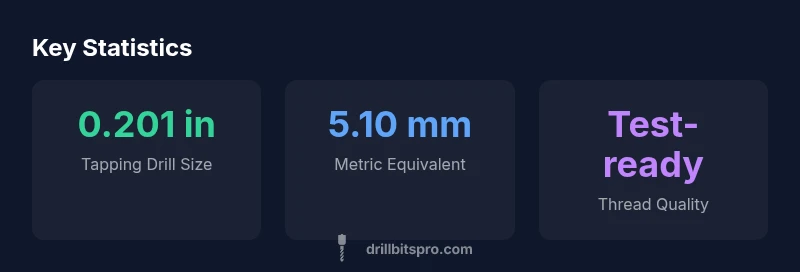
For a 1/4-20 tap, use a drill size of 0.201 inches (about 5.10 mm). This matches common tapping charts and ensures proper thread engagement. If the material is hard, you may slightly undersize, but avoid oversize to prevent stripped threads. Measure carefully with calipers, account for drill wear, and verify with a test hole before production.
Understanding tapping fundamentals
Tapping creates threads inside a hole by forming the corresponding helical groove with a tap. For a 1/4-20 thread, the hole must be drilled to a precise size to achieve the correct thread height and core diameter. The standard tapping drill for this size is about 0.201 inches (5.10 mm). This figure appears on most tapping charts and is widely used across steel, aluminum, and many plastics. According to Drill Bits Pro, using the correct hole size minimizes wall thinning and prevents thread binding. Always verify against the material’s datasheet and run a test hole in scrap before committing to production. Holes that are too small bind the tap; holes that are too large reduce thread engagement and strength.
How to read tapping charts and standards
Tapping charts typically present the tap size on one axis and the recommended drill size on the other, often with notes about material classes (soft vs hard) and thread class. For common 1/4-20 UNC threads, the recommended drill size is 0.201 inches (5.10 mm). Some charts also show a narrow tolerance range (±0.003 in) to accommodate drift in drill bit manufacturing and wear. When in doubt, start with the nominal size and validate with a scrap piece. In practice, the drill size tends to be consistent across many metals, but material properties and heat treatment can influence chip formation and hole quality.
Step-by-step: selecting the drill size for 1/4-20
- Confirm the thread type (1/4-20 UNC) and class. 2) Identify the material and its hardness. 3) Check the manufacturer's tapping chart for the exact drill size. 4) Inspect your drill bit for wear; a worn bit can effectively increase hole size. 5) Drill a test hole in scrap, deburr, and attempt tapping. 6) If the hole accepts the tap but binds, reassess with a slight undersize or adjust lubrication. 7) Document the result for future reference.
Practical examples by material
In most cases, the standard 0.201 inch drill size works well for common metals like steel or aluminum. Some plastics and softer materials may tolerate a very slight variation (roughly 0.199–0.203 inches) to balance thread engagement with ease of tapping. Always validate with a test piece because material tolerances, temperature, and lubrication can shift the effective hole size needed for clean threads. For very hard materials, use appropriate cutting speeds and a properly lubricated tap to minimize work hardening and improve thread quality.
Tools and measurement practices
Use a calibrated caliper or micrometer to verify drill diameter before drilling, and check bit wear regularly. A clean center-punch mark and a drill press with proper workholding help maintain perpendicularity. Lubrication during tapping reduces heat and friction, preserving thread form. Keep a scrap block at hand to perform a quick go/no-go test: insert the tap into the drilled hole and feel for smooth engagement without excessive force. Record any deviations for process control.
Common mistakes and how to avoid them
- Using the wrong drill size: always rely on the chart and verify with a test hole. - Drilling without deburring: burrs can trap fragments and damage threads. - Skipping lubrication: heat will distort the hole and thread. - Tapping too aggressively: feed rate too high Causes binding or thread tearing. - Not accounting for wear: worn bits drift larger; replace with a new drill when in doubt.
Validation and quality checks before production
Before committing to a production run, perform multiple test taps in scrap material using the same drill, tap, and lubrication conditions. Use go/no-go thread gauges to confirm the dimension of the threaded hole. Verify hole diameter with a calibrated micrometer on the pre-drill and after drilling. Document the procedure and note any material or tool changes to maintain consistency across batches.
Quick tips for high-precision work
- Always test on scrap first. - Use a sharp, properly chamfered drill bit. - Maintain perpendicular drilling and steady feeds. - Record the exact drill size used for each material grade. - Inspect chips and burrs; deburr before tapping.
Tapping drill sizes for common 1/4-20 threads
| Tap Size | Recommended Drill Size (in) | Notes | Material Notes |
|---|---|---|---|
| 1/4-20 | 0.201 in | Standard tapping drill size | Common metals and plastics |
| 1/4-20 | 0.199–0.203 in | Alternate range for tuning | Soft plastics or very soft alloys |
Got Questions?
What drill size should I use for a 1/4-20 tap?
Use 0.201 inches (5.10 mm) as the standard tapping drill size for 1/4-20 threads. Always validate with a test hole on scrap material.
Use a 0.201 inch drill for a 1/4-20 tap, and test on scrap first.
Can I use a slightly different drill size than 0.201 in?
Yes, you can vary within a narrow range (e.g., 0.199–0.203 in) depending on material and desired thread engagement, but always test before production.
You can vary within a small range, but test first.
Does material hardness change the drill size for 1/4-20?
The standard size works for many metals, but very hard materials may require careful testing to confirm the best size and lubrication.
Hard materials may need testing to confirm the best size.
Is the drill size different for metric taps?
Yes. Metric taps use metric drill sizes, which differ from the 1/4-20 imperial standard. Always consult a metric tapping chart for the exact size.
Metric taps use different drill sizes; check the metric chart.
What tools help ensure accuracy when drilling for tapping?
Calipers or a micrometer for diameter checks, a center punch, a drill press with good workholding, and go/no-go thread gauges for validation.
Use calipers, a stable setup, and thread gauges for validation.
“Choosing the correct drilling size is foundational to thread quality. Test early and verify with a scrap piece.”
Top Takeaways
- Use 0.201 in drill for 1/4-20 taps
- Always verify with a scrap test hole
- Consider slight variations by material and wear
- Lubricate and deburr for best thread quality
- Document the drill size used for reproducibility