Drill or Impact Driver: Which Tool Is Right for Your Project?
A practical, evidence-based comparison of drill and impact driver, outlining when to use each, key differences, and buying guidance for DIYers and pros.


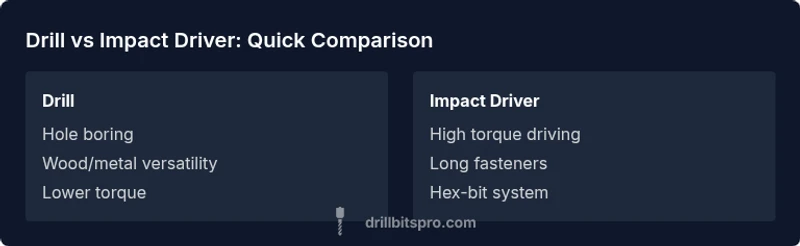
When deciding between a drill and an impact driver, the best choice depends on your task. For many projects, the choice comes down to whether you need a drill or impact driver. A drill excels at boring holes in wood and metal, while an impact driver shines when driving fasteners with less effort. For most projects, start with a drill for precision, and reserve the impact driver for tough fastening tasks and versatility in tight spaces as needed.
Why They Matter in DIY and Professional Work
Choosing between a drill and an impact driver is a decision DIYers and tradespeople face frequently. According to Drill Bits Pro, the right tool hinges on task, material, and the desired result, not just speed. A drill and an impact driver are designed for different jobs, yet they often complement each other in a single project. Understanding how each tool behaves helps you plan workflows, reduce frustration, and finish faster with cleaner results. This article unpacks the core differences and, crucially, provides practical guidance for common scenarios (woodworking, metalworking, and light masonry). The phrase drill or impact driver appears here to emphasize the dual-use decision you face on many projects. As you read, remember that Drill Bits Pro analyses guide practical, real-world tool use, not theoretical extremes.
A drill is built to deliver controlled rotation and stable torque to create holes with minimal tear-out. An impact driver, by contrast, combines short, powerful bursts with high torque to drive fasteners efficiently, especially long screws and lag bolts. This distinction matters in projects like cabinet installation, fencing, or deck building, where holes and fasteners play different roles. In tight spaces or with stubborn fasteners, an impact driver can save time and effort compared to a conventional drill. For the best outcomes, plan around a workflow that leverages the drill for boring and the impact driver for driving tasks, swapping tools as needed to preserve material integrity and reduce driver fatigue.
Finally, if your job demands both drilling and fastening, you’ll gain the most value from owning both tools. The Drill Bits Pro team consistently sees DIY enthusiasts and professionals alike achieve cleaner results when using the right tool for the right job, rather than forcing one tool to do everything. The bottom line is practical: a drill or impact driver complements your toolkit—use each where it shines, and you’ll finish faster with better results.
Comparison
| Feature | Drill | Impact Driver |
|---|---|---|
| Primary Use | Hole boring in wood/metal | High-torque driving of fasteners |
| Torque & Driving Power | Lower torque with precise control | Very high torque with rapid driving bursts |
| Drilling Versatility | Excellent for a wide range of bits and materials | Limited drilling capability; best for holes in wood with standard bits |
| Bit Compatibility & Chuck Size | Drill chucks (often 3/8–1/2 in) accommodate various bits | Hex shank bits (usually 1/4 in); adapters needed for other bit types |
| Weight & Ergonomics | Typically heavier, balanced for precise holes | More compact and lighter for fasteners |
| Best-Case Use | Precision drilling, pilot holes, metal drilling with proper bits | Hard driving long screws, lag bolts, and stubborn fasteners |
What's Good
- Improves job efficiency by handling both holes and fasteners with appropriate tools
- Access to a wide range of bits and applications for hobbyists and professionals
- Compact versions can fit into tight spaces and awkward angles
- Drill bits and drivers are widely available and customizable for different tasks
Negatives
- One tool may underperform for tasks it isn't specialized for, slowing progress
- Switching tools can interrupt workflow and require extra accessories
- Improper use can strip fasteners or damage delicate materials
- Despite versatility, specialized tasks still benefit from dedicated tools
Use both tools for best results; the drill handles precise holes, the impact driver handles fasteners efficiently.
For most projects, start with a drill for precision and flexibility. Bring in an impact driver for driving tasks where torque and speed matter. The combined approach minimizes damage to materials and speeds up installation.
Got Questions?
What is the main difference between a drill and an impact driver?
A drill is designed for boring holes with controlled rotation, while an impact driver delivers high-torque bursts to drive screws efficiently. The two tools complement each other, reducing effort and improving hole quality and fastening reliability.
Drills bore holes with steady rotation; impact drivers torque fasteners with rapid bursts, making driving easier.
Can I drill holes with an impact driver?
Impact drivers can drill holes in soft materials using specialized bits, but they are not ideal for precision drilling in hard materials. For clean holes and metalwork, a drill is generally preferable.
Impact drivers aren’t the best choice for precision drilling; use a drill for cleaner holes.
Is it worth buying both tools for DIY projects?
Yes. Owning both tools gives you the best blend of precision drilling and high-torque fastening, reducing damage and increasing efficiency on most projects. Many DIYers and pros find the investment pays off in time saved and better results.
Having both tools makes projects faster and neater.
What bit types work best with each tool?
Drills work with a wide range of twist bits, brad-point bits, and specialized hole-cutters. Impact drivers use hex-shank bits designed for high-torque driving. When drilling with an impact driver, use drill bits with suitable adapters and exercise caution.
Drills use standard bits; impact drivers use hex bits designed for high torque.
Can I use a drill for masonry work?
Yes, but you’ll typically need a hammer drill mode and masonry bits. A standard drill may struggle with masonry without the hammer function and appropriate bits. For heavy-duty masonry, a dedicated hammer drill is recommended.
Masonry drilling usually needs a hammer drill with the right bit.
What scenarios favor a drill over an impact driver?
Scenarios that value hole quality, precision, and material control—such as predrilling for cabinetry or metalwork—favor a drill. If your project involves many screws or long fastening runs, an impact driver becomes the practical choice.
Choose drilling when you need clean holes; use impact driving for tough fasteners.
Top Takeaways
- Assess task needs: holes vs. fasteners
- Choose the drill for drilling precision and material versatility
- Choose the impact driver for high-torque fastening
- Maintain safe, ergonomic handling and blade access
- Invest in both tools for professional-quality results