Is a Drill the Same as a Screwdriver? A Practical Guide
Explore the differences between drills and screwdrivers with a detailed, data-driven comparison. Learn when to use each tool, ergonomics, cost of ownership, safety considerations, and a clear decision framework for DIYers and professionals.


Is drill the same as screwdriver? The quick answer is no—the two are not identical tools. A drill uses a motor and chuck to rotate bits for making holes, while a screwdriver applies driven torque to drive or remove fasteners. Proper choice depends on the task, bit size, and required speed.
Is drill the same as screwdriver? Definitions and practical distinctions
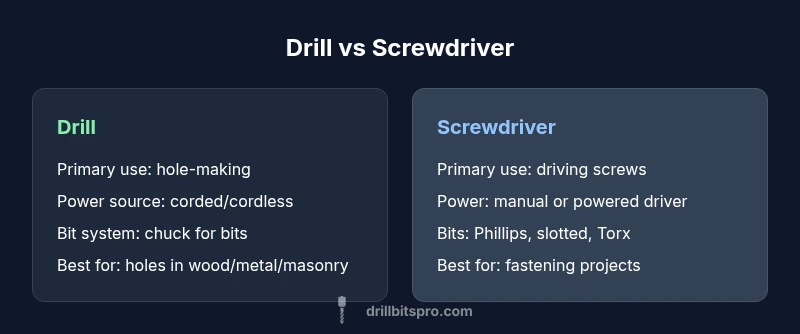
Is drill the same as screwdriver? This question frames a broader topic: distinct tool classes designed for different workflows. A drill is built around a motor and a chuck that holds drill bits; it excels at hole-making across materials such as wood, metal, and masonry. A screwdriver centers on torque delivery through driver bits designed to engage specific screw heads. Although both can operate with interchangeable bits in modern kits, their core purposes diverge: holes versus fasteners. For DIYers and professionals, recognizing this distinction helps prevent common mistakes, like trying to drive large screws with a bare drill bit or attempting to bore holes with a hand screwdriver. Throughout this article we’ll use a practical, task-based lens to compare capabilities, limits, and best-use scenarios, anchored by real-world guidance from the Drill Bits Pro team.
According to Drill Bits Pro, understanding is drill the same as screwdriver? Not really—each tool has a designed role in the workflow, and choosing the right one saves time and reduces material damage.
Comparison
| Feature | Drill | Screwdriver |
|---|---|---|
| Primary purpose | Hole-making and drilling with various bit types | Driving or removing screws; some models offer light drilling |
| Power source | Corded or cordless motor | Can be powered by battery or manual (hand screwdriver) in some cases |
| Torque control | Clutch or electronic torque settings on many drills | Limited torque control on basic manual screwdrivers; powered variants use torque settings |
| Bit system | Drill bits held by a chuck (twist or keyless) for various diameters | Driver bits (Phillips, flat, Torx, etc.) with quick-change adaptors |
| Typical tasks | Wood, metal, masonry holes; pilot holes, countersinking with adaptors | Driving screws, assembler tasks, light insertions in various materials |
| Size and weight | Typically larger and heavier; balance optimized for drilling force | Generally lighter; comfortable for screwing for extended periods |
| Cost of common models | Wide range: budget to premium drills often cost more upfront | Driver tools/sets can be cheaper but vary by feature |
| Best for | Hole-heavy projects, cabinetry, masonry work with appropriate bits | Fastening and assembly, furniture building, electronics fixtures |
What's Good
- Versatility with the right attachments increases task scope
- Both tools benefit from modular bit systems for quick swaps
- Modern cordless options offer portability and time-saving speed
- Dedicated drill/driver kits simplify tool selection and maintenance
Negatives
- Two separate tools may require more upfront investment
- Using the wrong tool for a task risks material damage</br>and potential injury
- Torque control and bit wear can influence results if misused
Drill is for holes; screwdriver is for fasteners
In most projects, you’ll benefit from both tools. The drill excels at creating pilot holes or clearance holes, while a screwdriver or driver bit completes the fastening step with controlled torque.
Got Questions?
What is the main difference between a drill and a screwdriver?
The drill is designed to create holes using rotating bits, while a screwdriver is intended to drive screws or remove them with driver bits. Torque control and bit compatibility are the biggest practical differences in day-to-day use.
The drill makes holes; the screwdriver drives screws. Torque control and the right bits matter most when choosing between them.
Can you use a screwdriver as a drill?
Insisting on drilling with a screwdriver is not ideal. Manual screwdrivers lack the rpm and leverage needed for efficient hole-making, and attempting to use a screwdriver this way can strip bits or damage materials. Use a drill for holes and a screwdriver for screws.
A screwdriver isn’t meant for drilling; use a drill for holes and a screwdriver for screws.
Is a cordless drill necessary for screw driving?
Not strictly necessary, but a cordless drill with a driver bit makes screw driving faster and less tiring. For occasional tasks, a manual screwdriver or a drill with a clutch can be sufficient.
A cordless drill speeds screw driving, but for occasional tasks a manual screwdriver can work.
Do impact drivers replace screwdrivers?
Impact drivers excel at handling stubborn fasteners and long screws due to higher torque, but they are different from standard screwdrivers. For delicate materials, a precision screwdriver or a drill with a torque-limiting setting may be safer.
Impact drivers are powerful for tough screws, but don’t replace a standard screwdriver for every small task.
What features should I look for in a drill/driver set?
Look for adjustable torque settings, a variable speed trigger, a lightweight design, and a versatile bit system with a reliable quick-change chuck. Battery life, charging speed, and warranty are additional factors.
Seek torque settings, variable speed, and a good battery; that makes drill/driver sets more versatile.
Are there safety risks using drills as screwdrivers?
Yes. Using a drill with high torque without proper control can strip screws, damage materials, or injure hands. Always pilot holes for hard materials, keep hands clear, and use appropriate bits and clutch settings.
High torque can cause problems; always use proper control and pilot holes.
Top Takeaways
- Define each tool’s core role before starting
- Match bit to material and screw type
- Prioritize torque control to avoid stripping
- Consider cordless options for mobility
- Invest in a driver kit if frequent screwing tasks
- Practice pilot holes for hard materials