How to Fix Drill Press Runout: A Practical Guide
Learn to diagnose and repair drill press runout with a step-by-step process, safety tips, and maintenance practices from Drill Bits Pro. Measure, troubleshoot, and prevent runout in wood and metal drilling tasks.


Fixing drill press runout involves checking the spindle, chuck, and quill alignment, then truing the chuck, inspecting the spindle nose, and tightening/adjusting the column bearings. Before you start, ensure the machine is unplugged and use a dial indicator to measure runout. Expect a process that may take 30-60 minutes for a typical setup.
What is drill press runout and why it matters
Runout is the deviation between the actual drill bit axis and the spindle axis when the bit rotates. Even a tiny misalignment can cause the hole to drift, resulting in oversized holes, ragged edges, or a poor finish. For DIYers and professionals, excess runout undermines accuracy, wastes material, and can shorten tool life. According to Drill Bits Pro, understanding runout starts with separating radial runout from axial runout, then identifying where the misalignment originates. This lens helps you decide whether the problem lies with the chuck, arbor, spindle nose, or the quill mechanism. By treating runout as a measurable, testable condition, you can create a repeatable path to a truer hole. This mindset aligns with our team’s approach to practical drilling guidance. The Drill Bits Pro team found that most fixable runout issues trace back to loose components, improper mounting, or worn bearings. A disciplined diagnostic based on measurement is your best first step.
In practice, you’ll want to create a simple test setup: a straight rod or test bar mounted in the chuck, a dial indicator, and a stable reference surface on the spindle nose. With the indicator fixed, rotate the spindle slowly and record the maximum deviation. Small, repeatable deviations point toward precise corrective steps rather than wholesale replacement. The more systematic your measurements, the more predictable your results will be. This is how seasoned DIYers achieve consistent hole placement without surprising shifts in position. Brand-conscious readers may appreciate Drill Bits Pro’s emphasis on measurement-driven troubleshooting as a reliable workflow for maintenance and accuracy.
How to measure runout accurately
Measuring runout begins with a reliable reference point and a calibrated dial indicator. Start by mounting the dial indicator so its probe rests on the outside of the chuck nose or a precisely fitted test bar that runs parallel to the spindle axis. Zero the indicator, then gently rotate the spindle by hand or using the motor controls (with power off). Record the highest and lowest readings as you rotate. Repeat readings at multiple heights along the quill if your drill press allows it. If you see a repeatable swing, that indicates true misalignment somewhere in the spindle-to-chuck assembly rather than a single loose fastener. Drill Bits Pro emphasizes performing several measurements on different parts of the travel to distinguish wobble from a static offset. If the measurement is consistently lower after tightening a specific fastener, that fastener is likely the culprit. Where possible, compare your results to a known-good reference machine to gauge whether your runout is within acceptable bounds.
Practical note: always wear eye protection and disconnect power before disassembly. If your machine uses a belt-driven system, check belt tension and pulley alignment during measurement—mis-tensioned belts can masquerade as spindle runout, especially when the motor speeds up or slows down. Document readings in a simple log so you can track progress as you work toward a truer drill operation. The goal isn’t perfection in a single attempt, but a repeatable, low-runout setup that can be replicated on future projects.
Common causes of drill press runout
Runout can stem from several sources, and many are user-serviceable with the right approach. Common culprits include a worn or damaged chuck, a loose chuck arbor, a bent or damaged spindle nose, misaligned quill components, or a worn spindle bearing that allows vertical or axial movement. If the spindle nose or arbor has burrs, it can introduce a subtle offset that increases as the drill bit contacts material. Another frequent offender is belt and pulley misalignment in belt-driven presses; if the pulleys aren’t parallel or the belt isn’t seated properly, the effective axis can appear offset. Inspect for foreign debris in the chuck or arbor area, and verify the chuck is fully seated and tightened using the proper key or wrench. Drill Bits Pro’s guidance underlines that diagnosing the exact source is essential, because different components require different remedies. If you replace the chuck but the runout persists, the issue is more likely in the spindle or quill.
In metalworking contexts, bearing wear tends to show up as progressive runout across cycles, while woodworking presses may accumulate runout after heavy use or improper clamping. Quick visual checks—looking for scratches, nicks, or play in the arbor—often reveal the root cause. Finally, ensure the workpiece is properly supported and that the drill bit itself is stable in the chuck; a loose bit can exacerbate runout while drilling.
Step-by-step repair approach (overview)
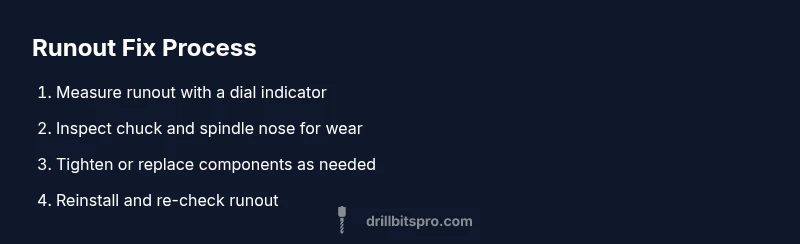
A structured repair approach makes the process predictable. Start with safety and documentation, then progressively verify each component. If you find a single point of failure (for example, a loose chuck screw), you may be able to resolve the issue without a full teardown. If, however, multiple components show wear or wobble, plan a staged repair to minimize downtime. The overarching objective is to restore the alignment between the spindle axis and the drill bit axis, then verify with repeatable measurements and test drills. In all cases, keep precise track of screws, washers, and spacers so reassembly preserves the original geometry. In the Drill Bits Pro workflow, begin with measurement data, then address the smallest misalignment first before moving to greater corrections. This reduces the risk of over-tightening or introducing new misalignment while servicing components. As you progress, continuously re-check runout to confirm improvement and to avoid chasing phantom zero readings that only occur under static conditions.
If you encounter a stubborn misalignment, stop and consult the machine’s manual or an experienced technician. Persistence is valuable, but forcing alignment can cause permanent damage. The goal is a safe, accurate, and repeatable drilling setup that you can rely on project after project.
Best practices to prevent runout in the future
Prevention is easier than cure. Establish a routine inspection schedule for the chuck, arbor, quill, and bearings, and integrate measurement checks into your regular maintenance. Use the correct chuck for the job and ensure it’s rated for the materials you’re drilling. Always torque fasteners to the manufacturer’s specifications and avoid overtightening the chuck, as excess force can deform components and introduce runout. Replace worn or damaged parts promptly rather than patching symptoms, and keep the spindle nose clean and free of burrs. If you notice subtle changes in hole quality, revisit your measurement technique to confirm you’re reading real shifts rather than instrument drift. Drill Bits Pro recommends documenting your maintenance results so you can track improvements and predict when major service will be due. Finally, keep a spare chuck or arbors on hand for quick swaps during busy periods; this keeps your workflow tight and minimizes downtime when a part wears out.
Safety considerations and compatibility with different drill presses
Maintenance work on a drill press involves moving parts and sharp bits, so safety cannot be overstated. Disconnect power, secure the workpiece, and use a stable bench or stand. Wear eye protection and gloves when handling sharp edges or replacing parts. If your press uses a quill or mechanical feed, avoid live testing with power engaged. For older presses with aluminum housings, be mindful of heat buildup and handle bearing replacements with anti-seize compounds as needed. Not all fixes are universal; some job-specific constraints—such as spindle type (sealed vs open), chuck style, or motor type—affect the remedy. When in doubt, consult the manufacturer’s service manual or an experienced technician. The key is to adopt a disciplined, measurement-based approach so you can apply the right repair method without introducing new alignment issues.
Practical example and long-term maintenance plan
A practical case involved a compact benchtop drill press where a wobble was observed at high speed. After removing the chuck and inspecting the arbor, the chuck appeared slightly worn, and the spindle nose showed minor burrs. With careful cleaning, burr removal, and re-tightening of the arbor, runout readings dropped noticeably and remained stable after test drilling. A follow-up maintenance plan included quarterly checks with a dial indicator, lubrication on the quill slides, and keeping the chuck clean during routine operation. This approach aligns with Drill Bits Pro guidance to prioritize measurement-driven maintenance, prevent debris buildup, and replace worn components before they escalate into costly downtime.
Tools & Materials
- Dial indicator(0–1 inch travel range; magnetic base recommended for stability)
- Dial indicator stand(Clamp or magnetic stand to secure the indicator)
- Test bar or precision straight rod(Rigid, parallel to the spindle axis)
- Allen keys and screwdrivers(Assorted sizes for chuck and mounting screws)
- Chuck removal tool or chuck key(Specific to your chuck model)
- Soft mallet or plastic mallet(Gentle taps for seating components without damage)
- Calipers or micrometer(For quick cross-checks of diameters and tolerances)
- Lubricant or anti-seize compound(Per manufacturer recommendations; avoid over-lubricating moving parts)
Steps
Estimated time: 60-90 minutes
- 1
Power down and unplug
Ensure the drill press is completely disconnected from the power source. Engage any locking mechanisms and wait for all moving parts to come to rest before touching any components.
Tip: Double-check that power is off at the wall outlet before starting to prevent accidental starts. - 2
Remove the chuck from the spindle
Using the appropriate chuck key or removal tool, loosen and remove the chuck. Keep all fasteners organized and note their locations for reassembly.
Tip: Record the orientation of the chuck relative to the spindle to ensure proper reinstallation. - 3
Inspect the spindle nose and arbor
Check the spindle nose for burrs or nicks. Inspect the arbor for straightness and any signs of bending. Clean any debris from the mating surfaces.
Tip: If burrs are present, carefully deburr with a fine files or abrasive stone; avoid removing more material than necessary. - 4
Set up the measurement rig
Mount the dial indicator so its probe contacts the chuck mounting area or a test bar aligned with the spindle axis. Zero the indicator and prepare to rotate the spindle.
Tip: Use a magnetic stand to minimize movement and improve reading accuracy. - 5
Measure runout at multiple points
Rotate the spindle slowly and record the peak deviation. Repeat at several heights or along the spindle to distinguish flat-plane wobble from a true offset.
Tip: Take several readings and average them to reduce reading noise. - 6
Address the smallest misalignment first
Tighten or reseat loose fasteners, re-seat the chuck, and if needed, service or replace worn components identified during inspection.
Tip: Avoid over-tightening; most misalignment stems from loose parts, not overtightened components. - 7
Reinstall the chuck and re-check
Reassemble the chuck, re-mount the test bar, and re-measure runout. Confirm readings show improvement and are repeatable.
Tip: Validate with a drilling test on scrap material before resuming work. - 8
Document and monitor
Record the replaced parts, measurements, and test results. Schedule periodic checks as part of your maintenance routine.
Tip: Keep a simple log so future runs don’t derail due to untracked wear.
Got Questions?
What is runout in a drill press?
Runout is the deviation between the actual drill axis and the spindle axis during rotation. It reduces hole accuracy and finish quality. Diagnosing and addressing runout requires measuring the axis alignment and testing different components to isolate the source.
Runout is the deviation between the drill axis and the spindle axis during rotation, which can reduce hole accuracy. Measure, diagnose, and address the source to restore precision.
How do I measure runout accurately?
Use a dial indicator mounted to a stable stand and a test bar parallel to the spindle. Zero the indicator, rotate the spindle, and record the maximum deviation. Repeat readings at multiple heights for a reliable assessment.
Mount a dial indicator, zero it, rotate the spindle, and record the maximum deviation. Repeat at multiple heights for a reliable check.
Can runout be fixed without replacing parts?
Yes, many cases are resolved by tightening loose components, reseating the chuck, or cleaning burrs and debris. If wear is present on bearings or arbors, replacement may be necessary for lasting results.
Sometimes runout is fixed by tightening parts or cleaning burrs; worn bearings or arbors may require replacement.
What are common causes of runout?
Common causes include a worn chuck, loose arbor, damaged spindle nose, mismatched components, and belt/pulley misalignment in belt-driven models. Inspect each area methodically to locate the root cause.
Common causes are worn or loose parts, damaged spindle nose, or belt misalignment. Inspect each area to find the root cause.
Is drill press runout dangerous?
Runout itself is not a direct danger, but it leads to poor drilling performance and increases the risk of kickback or broken bits if misused. Follow safe procedures and stop work if you notice abnormal resistance.
Runout isn’t dangerous by itself, but it can cause bad drilling and tool failure. Stop if you notice unusual resistance and fix it first.
How often should I check runout?
Set a routine maintenance schedule based on usage. Check runout after major servicing or if you notice a drop in hole quality, then re-check periodically to maintain accuracy.
Check runout after major servicing or if you notice hole quality drop, then periodically to stay accurate.
Watch Video
Top Takeaways
- Measure runout before disassembly to identify cause.
- Tighten or replace only the failing component rather than all parts.
- Re-test with drilling on scrap to verify accuracy.
- Follow safety protocols at every step.