Cost to Drill a Well: A Homeowner's Budget Guide
Understand the cost to drill a well for residential use, including depth, geology, permitting, and pumping equipment, with practical budgeting tips from Drill Bits Pro.


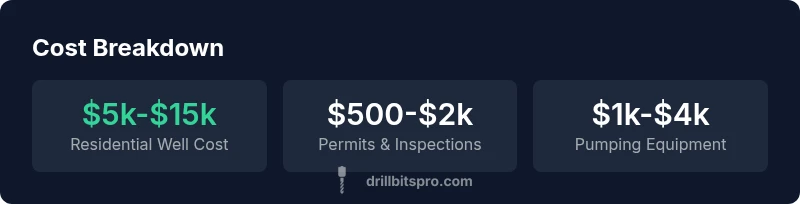
Average residential well drilling cost typically falls in the range of $5,000 to $15,000, depending on depth, geology, and equipment. Expect extra costs for permits, water testing, well casing, pump installation, and site preparation. Regions with harder rock or deeper aquifers push costs higher. Use this range as a starting budget, then refine after a local quote.
What drives the cost to drill a well
When homeowners begin budgeting for a project described by the cost to drill a well, several variables dominate the final price. The depth of the borehole, the geological conditions (soil type, rock hardness, and aquifer depth), the required yield (gallons per minute), and the type of pumping equipment all steer the cost in meaningful ways. A shallow, loosely layered aquifer with minimal pumping needs will be substantially cheaper than a deep, hard-rock bore with a high yield requirement. Local regulations, permitting timelines, and access to the site also shape the budget. For many readers, the practical takeaway is to expect wide variability between regions and to budget with a broad range in mind rather than a single number.
According to Drill Bits Pro, understanding these drivers early helps prevent sticker shock and supports better decision-making when seeking quotes from licensed drillers. The cost to drill a well is not a single price tag—it is a bundle of interdependent decisions that carry upfront and life-cycle implications. In practice, homeowners should map out the major cost levers first, then refine estimates as site interviews occur.
Breakdowns by cost component
Costs break down into drilling services, casing and sealing, permitting, water testing, pumping equipment, and site work. Each component has sub-variables: bore depth, detector and pump type, and the complexity of the surface work. A common budgeting approach is to assign a baseline for drilling and then layer on contingencies for the auxiliary items that can surprise you after a contractor visits the site. In summary, expect the core drilling to take a major share of the budget, with permits, equipment, and site prep contributing variably depending on local rules and site access.
Beyond the base drilling charge, the value of proper sealing and sanitation impacts long-term water quality and maintenance costs. Skimping on casing or improper grouting can lead to more frequent repairs or contamination risk, which is why many professionals recommend budgeting for quality materials upfront even if it costs a bit more initially.
Depth, geology, and aquifer yield
Depth and geology are the primary cost accelerators. Deeper wells or those penetrating hard rock require more drilling time, specialized equipment, and a greater volume of drilling mud and additives. Aquifer yield also matters; higher yields can necessitate more robust pumping gear and bigger intake pipes, which adds to the equipment tab. A rule of thumb: deeper and harder geology typically raises the cost by a noticeable margin, while sandy or unconsolidated soils tend to be cheaper to drill through. Drilling contractors often provide quotes that segment costs by depth bands (for example, 100–200 ft, 200–400 ft, etc.) to illustrate how depth influences price.
Site-specific factors—such as access for heavy equipment, terrain, and the presence of surface water—also impact costs. In rural areas, where access is straightforward, you may see lower mobilization charges; in tight urban lots or mountainous terrain, trucking, crane access, and access-lane widening can add to the overall bill. For readers budgeting ahead, it helps to ask drillers for depth vs. cost curves and to request multiple quotes that show how depth bands affect the price.
Permitting, inspections, and site prep
Permits and inspections vary widely by jurisdiction, often driven by groundwater protection rules and local zoning. For many homeowners, permitting is a distinct cost line item that can swing by a few hundred to several thousand dollars. Site preparation—grading, trenching for utilities, and creating a stable drill site—adds to the upfront cost, especially if access roads must be built or improved.
To guard against surprises, obtain a detailed permit breakdown from the drilling contractor, and verify which permits, fees, and inspections are included in the base price. Some regions require additional testing or reporting after completion, which should be anticipated within the budgeting envelope.
Pumps, casing, and water testing
After drilling, you must account for pumping equipment, casing materials, well cap, and initial water testing. Submersible pumps and jet pumps have different installation complexities and energy profiles, influencing both initial and ongoing costs. Casing and sealing protect the well against surface contaminants and cave-ins, so quality materials are a crucial long-term investment.
Water testing after installation is essential to confirm water quality. Most jurisdictions require at least a basic bacterial test, while more comprehensive analyses (chemical, mineral content, and nitrates) can add to the cost. Budget for an initial test plus a follow-up if results indicate the need for treatment or further filtration.
Regional variations and quotes
Regional variation can be dramatic. States or provinces with stricter groundwater regulations or geologies that favor longer boreholes tend to push prices higher. Conversely, regions with moderate geology and efficient service markets may see more competitive pricing. When budgeting, plan to obtain at least three written quotes and ask each driller to itemize labor, materials, mobilization, and contingency separately. This transparency lets you compare apples-to-apples and identify any hidden fees.
Budgeting strategies and contingencies
Create a budgeting framework that addresses the major cost drivers and includes a contingency of 10–20% to cover unforeseen complications. Develop a scoring rubric for quotes: depth logic, equipment quality, holdouts for contingencies, and the driller’s experience. Consider a staged approach: drill and casing first, then complete pumping and water testing in a second phase if your budget requires.
Additionally, ask your local utility or water testing labs about bundled services or regional programs that may subsidize initial testing or permitting costs. Small savings in the early stages can compound as you move toward final commissioning of the well.
Real-world budgeting example
Consider a scenario where a homeowner plans to drill a 250 ft well in a moderate geology region. The base drilling charge may sit around the mid-range, with the majority allocated to pumping equipment and casing. Permits, site prep, and initial water testing add several hundred dollars. With a 15% contingency, the finalized budget could land somewhere in the upper-mid range for many markets. The exact amount, of course, will depend on local quotes and site conditions. This example illustrates how quickly the cost to drill a well can escalate when multiple cost drivers converge.
Maintenance costs after installation
Ongoing costs include annual pump maintenance, electrical power for the pump, water testing every 1–2 years, and occasional seal or cap inspections. While these costs are typically smaller than the initial drilling, neglecting maintenance can lead to more expensive problems down the line. A proactive maintenance schedule helps ensure long-term reliability and protects your investment in the well.
Key cost drivers for residential well projects
| Aspect | Typical Range | Notes |
|---|---|---|
| Drilling depth | 100-500 ft | Depends on aquifer depth and local geology |
| Casing and wellhead | $1,000-$5,000 | Includes sealing and casing materials |
| Permits and inspections | Varies by region | Regulatory requirements vary locally |
| Pumping equipment | $1,000-$4,000 | Submersible or jet pump options |
Got Questions?
What is the typical cost to drill a residential well?
Residential well costs commonly range from several thousand to well into the five-figure territory, depending on depth, geology, and equipment. A realistic starting point is a broad range, refined by local quotes.
Typically a residential well costs between five and fifteen thousand dollars, depending on depth and setup. Get local quotes for accuracy.
What factors most affect well drilling costs?
Depth, geology, aquifer yield, type of pumping equipment, and site access are the main cost drivers. Permitting and site prep can add variability by region.
Depth and rock type drive cost the most, followed by permit rules and site access.
Are there ongoing costs after installation?
Yes. Expect ongoing electricity for the pump, periodic water testing, and occasional maintenance or replacement of parts like seals or the pump.
There are ongoing costs like electricity and periodic water tests.
How long does it take to drill a well?
Typical drilling can take a few days to a week, depending on depth and weather, with permitting and testing adding extra days.
Drilling usually takes several days to a week, plus time for permits and tests.
Is there a cheaper alternative to drilling a new well?
Cheaper options include tying into an existing water system if available, or considering drilled wells with smaller yields and slower pump options. However, reliability and water quality should be evaluated.
Alternatives exist, but evaluate reliability and water quality before deciding.
“Drilling a well is as much about planning as it is about drilling. Depth, geology, and the permitting landscape drive most of the budget.”
Top Takeaways
- Budget for depth and geology first
- Expect permitting costs and site prep to vary
- Plan for pumping equipment and water testing
- Include a contingency (10–20%) in your budget
- Get multiple quotes and compare itemized costs