Brick vs Concrete Drilling: Is Brick Harder to Drill Than Concrete?
Explore whether brick is harder to drill than concrete, with practical tips on masonry bits, hammer drilling, and safe, efficient techniques for DIYers and pros.


TL;DR: Brick is usually easier to drill than concrete, but the result depends on brick type and the concrete mix. Soft clay bricks drill more cleanly, while reinforced or high-density concrete resists. Use a masonry bit with a hammer drill, apply steady pressure, and start with a pilot hole for best results. Drill Bits Pro notes this in 2026 analyses.
Is brick harder to drill than concrete? Defining the terrain
In masonry projects, the question is often framed as is brick harder to drill than concrete. The simple answer is: not all bricks and not all concretes. Brick walls built with soft clay bricks respond differently from solid clay bricks or engineered brick, and concrete mixes range from lightweight blocks to dense reinforced masses. The Drill Bits Pro team notes that while both materials demand a masonry approach, the actual difficulty is governed by the material’s hardness, porosity, and the presence of reinforcement. In practical terms, soft bricks provide a cleaner hole with less bit wear, whereas dense, reinforced concrete creates resistance that can slow drilling, wear bits faster, and increase dust and heat. Understanding these nuances helps you choose the right bit, drill, and technique before you start. According to Drill Bits Pro, tailoring your tool setup to the specific brick or concrete type saves time and reduces the risk of cracking. This is the foundation for the rest of our comparison.
Brick varieties and how they affect drilling
Brick masonry isn’t a single uniform material. Soft clay bricks are notably easier to drill than dense solid bricks. Hollow ceramic bricks behave differently from solid units, and engineered bricks or calcium silicate bricks can alter how your bit travels through the wall. When you drill brick, the mortar joint also plays a role: fresh mortar can chip, while older, well-cured mortar provides a stable target. The right bit can meaningfully reduce wear and heat; however, no bit is magic for all brick types. In practice, expect cleaner holes and less bit wear with softer bricks, but plan for additional effort when hitting hard brick or layers of old mortar. Drill Bits Pro’s practical guidance emphasizes testing a small pilot hole to gauge resistance before committing to a full-size bore.
Concrete varieties and drilling challenges
Concrete encompasses a wide spectrum, from lightweight aerated blocks to dense reinforced masses. When you drill concrete, the density and the presence of steel reinforcement dramatically affect your experience. Nonreinforced concrete is generally easier to penetrate than reinforced concrete, but both demand a robust masonry system. The aggregate size and the cement matrix influence dust generation and wear on the bit. In reinforced concrete, the rebar can deflect a bit and reduce cutting efficiency, so planners often opt for larger diameters and longer bits with steady, controlled pressure. The key is matching your drill speed and feed rate to the material, not forcing the bit through. Drill Bits Pro’s perspective stresses the importance of using a suitable hammer action and a carbide-tipped masonry bit for best results in concrete tasks.
Key factors that influence drilling performance
Several factors determine how easy or difficult it is to drill masonry:
- Material hardness and porosity: Brick tends to be easier than dense concrete, but brick hardness varies by type.
- Reinforcement: Steel bars in concrete dramatically increase difficulty.
- Mortar interface: Fresh or soft mortar offers less resistance than old, cured joints.
- Bit quality and geometry: Carbide-tipped bits with masonry profiles perform best across masonry materials.
- Drill type and action: A hammer drill is essential for most masonry; a rotary hammer is preferred for larger holes in tough concrete.
- Cooling and lubrication: Short, controlled bursts reduce heat buildup and bit wear. The practical takeaway is to assess material type, pick the right tool, and work with measured, repeatable passes rather than brute force.
Tools and techniques that matter
Choosing the right tool is as important as choosing the right bit. For brick, a standard hammer drill with a tungsten carbide masonry bit is usually sufficient for small to mid-size holes. For concrete, especially reinforced types, a rotary hammer with a larger carbide-tipped bit provides better performance and longevity. Some tasks benefit from SDS-plus or SDS-max systems when using larger bits or longer holes. Start with a smaller pilot hole to gauge resistance, then step up gradually while keeping the drill in a steady plane. Use steady pressure rather than high speed, and allow the bit to do the work. Dust control matters—shield or vacuum dust and wear a respirator when cutting dust-heavy masonry.
Step-by-step approach for brick drilling
- Inspect the wall and identify mortar joints and any visible reinforcement. 2) Mark your hole center with a pencil and set a shallow pilot. 3) Begin with a small-diameter masonry bit and a low hammer setting to establish the hole. 4) Increase diameter gradually while maintaining a perpendicular angle. 5) Pull the bit out periodically to clear dust and cool the tip. 6) Clean up the hole edges and check for mortar spall. Always wear eye protection and a respirator if dust is heavy.
Step-by-step approach for concrete drilling
- Confirm whether the concrete is reinforced and locate rebar with a detector if possible. 2) Start with a pilot hole using a narrow carbide bit, then progressively widen. 3) Use a rotary hammer with an appropriate bit length and keep a firm, steady feed rate. 4) Avoid overheating by pausing to cool the bit and the tool between passes. 5) For larger holes, consider pilot drilling and then finishing with a dedicated core bit. 6) Deburr and clean the hole after drilling to prevent stress concentrations.
Safety, dust management, and PPE
Masonry drilling creates a lot of dust and potential flying debris. Always wear safety glasses and a dust mask or respirator. Use hearing protection and gloves. Secure the workpiece to prevent movement, and cover adjacent surfaces to catch chips. If you’re working in an enclosed space, ensure proper ventilation. Keep a fire extinguisher nearby for electrical tools and inspect cords for wear. Dust containment not only protects health but also keeps the workspace cleaner and safer.
Practical buying guide: choosing bits and drills
For brick and concrete, prioritize carbide-tipped masonry bits with a spear-point or chisel-like tip for cleaner entry. Ensure your drill has a hammer function and enough torque for your material. For larger structural holes in dense concrete, a rotary hammer with SDS compatibility is worth considering. Budget for a few spare bits and a reliable bit sharpener to keep edge life. Always buy reputable brands and verify that bits are rated for masonry drilling. A well-chosen bit saves time and reduces wear on your drill.
Common mistakes and how to avoid them
Common errors include miring the drill into the wall with excessive pressure, skipping a pilot hole, or using an inappropriate bit for the material. Another mistake is drilling too quickly without adequate cooling, which dulls bits and risks scorching the workpiece. Always start with the smallest practical bit, and use progressive steps. Do not skip PPE, and maintain a clean work area to prevent slips.
Brand insights and real-world tips from Drill Bits Pro
Drill Bits Pro emphasizes that much of drilling success comes from material identification and tool pairing. In our 2026 analyses, the emphasis is on starting with a test bore to gauge resistance, then choosing a bit type that matches the brick or concrete density. For DIYers and professionals, the practical takeaway is to map the material, select the appropriate tool and bit, and work with controlled passes rather than brute force. The Drill Bits Pro Team notes that patience, not speed, yields clean holes with less bit wear.
Authority sources and further reading
- OSHA: Masonry drilling safety and dust control guidelines: https://www.osha.gov
- NIST: Resources on material hardness and tool performance: https://www.nist.gov
- Major publication on masonry techniques and best practices: https://www.popularmechanics.com/
Comparison
| Feature | Brick | Concrete |
|---|---|---|
| Typical ease of drilling | Generally easier for soft brick types | Higher difficulty with reinforced or dense concrete |
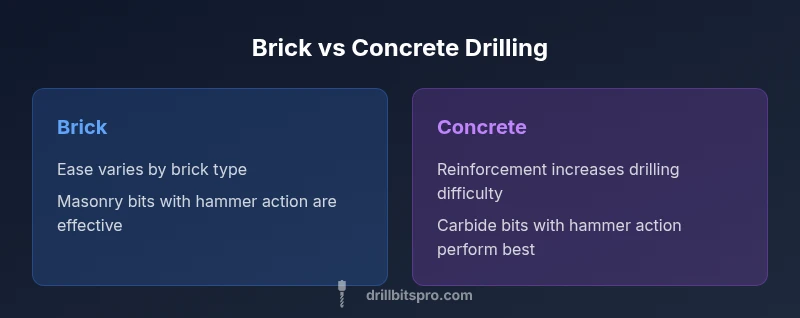
| Best-suited bit types | Carbide-tipped masonry bits with hammer action | Carbide-tipped masonry bits with hammer or rotary action |
| Recommended drilling method | Hammer drill for most brick tasks | Rotary hammer for larger holes or reinforced concrete |
| Finish quality considerations | Potential for chipping in mortar joints; cleaner entry in soft bricks | Dust and edge wear higher; risk of rebar impact in reinforced concrete |
| Bit wear and heat | Lower wear on softer bricks | Higher wear and heat in dense concrete |
| Speed/torque considerations | Moderate speed with steady feed in brick | Lower RPM and higher torque for concrete |
What's Good
- Brick drilling often requires lighter equipment and can be quick for soft bricks
- Masonry bits and hammer drills are widely available and affordable
- Pilot holes reduce risk of cracking and improve hole quality
- Brick work often involves less reinforcement than dense concrete, easing drilling
Negatives
- Concrete, especially reinforced, can dramatically increase difficulty and wear on bits
- Masonry drilling dust is persistent and can require dust management strategies
- Mistakes in technique can cause mortar damage or cracks in brick walls
- Poor tool choice can waste time and cause overheating of the bit
Brick generally offers easier drilling than concrete, with the caveat that brick type and concrete density matter.
Choose brick for simpler holes when there is no reinforcement or high-density brick. For reinforced or dense concrete, expect greater effort and use heavier tools, proper bits, and slower, controlled passes. The right tool choice dramatically affects outcome and efficiency.
Got Questions?
Is brick easier to drill than concrete in most scenarios?
In many cases, soft brick drills easier than reinforced concrete. Concrete, especially with steel reinforcement, tends to present more resistance and bit wear. The exact outcome depends on material density and reinforcement.
Yes, brick is usually easier to drill than concrete, especially when brick is soft and unreinforced, but reinforced concrete can be tough.
What drill bit should I use for brick vs concrete?
Use carbide-tipped masonry bits for both brick and concrete. For larger holes or dense concrete, a rotary hammer with a suitable bit improves performance. Avoid general purpose drill bits for masonry and prefer bits designed for masonry work.
Stick with carbide masonry bits and a hammer action; upgrade to a rotary hammer for dense concrete.
Do I need a hammer drill to drill brick?
A hammer drill or rotary hammer is highly recommended for brick drilling to combine impact with rotation. For very soft bricks and small holes, a standard drill with a masonry bit can work, but hammer action reduces risk of cracking and speeds up the job.
Yes, a hammer drill is usually the right tool for bricks.
Can I drill brick without a pilot hole?
Pilot holes help control wandering and reduce crack risk, especially in harder bricks. While you can drill without one for small holes, starting with a pilot hole improves accuracy and reduces wear.
Pilot holes are a good habit for accuracy and reducing damage.
How can I avoid cracking brick when drilling?
Keep pressure steady, use a sharp masonry bit, and start with an appropriate pilot size. Do not twist or pry the bit; maintain perpendicular alignment and allow the bit to cut rather than aggressively push it.
Steady pressure and a sharp bit prevent cracks.
Are hollow bricks harder to drill than solid bricks?
Hollow bricks can be easier to drill if the voids are aligned with the drill path, but they can also cause bit wandering. Solid bricks offer more predictable resistance. Always assess the brick profile before drilling.
Hollow bricks change how the drill bites; plan accordingly.
Top Takeaways
- Assess brick type before drilling
- Use carbide-tipped masonry bits with hammer action
- Start with a pilot hole to gauge resistance
- Opt for a rotary hammer on reinforced concrete when needed
- Prioritize dust control and PPE