Difference Between a Drill and an Impact Gun
Explore the key differences between a drill and an impact gun, including torque, chuck, speed, and ideal uses, with practical buying guidance for DIYers and professionals.


Understanding the difference between a drill and an impact gun is essential for choosing the right tool. A drill is a versatile device used for boring holes and driving screws with variable speed, while an impact gun, or impact driver, delivers high torque through hammering action to drive fasteners quickly. For most DIY projects, start with a drill for holes and switch to an impact gun when heavy driving is required.
What defines a drill and what defines an impact gun?
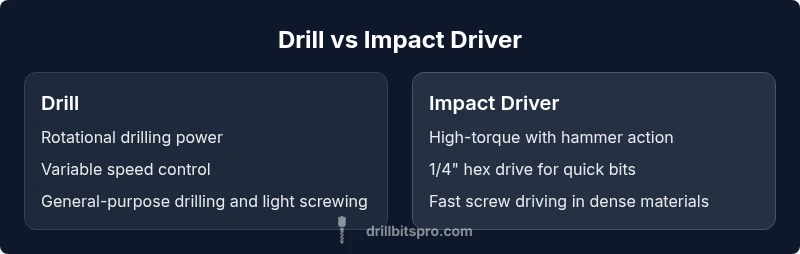
The difference between a drill and an impact gun centers on purpose and mechanism. A drill relies on rotational motion to bore holes and drive screws at controllable speeds, making it the go-to tool for a wide range of materials. An impact gun (often called an impact driver) adds a percussive hammer action that converts torque into repeated bursts. This hammering significantly increases the effective driving torque, enabling fasteners to bite through tougher materials with less effort from the user. The Drill Bits Pro team emphasizes that this distinction is not just about speed but about matching the tool to the task, which improves accuracy and reduces user fatigue over long sessions.
In everyday terms, think of a drill as your general-purpose workhorse for holes and light screw driving, while the impact gun shines when you’re driving many screws quickly or dealing with dense materials. Ergonomics and control also come into play: drills tend to feel more versatile, whereas impact drivers excel at repetitive fastening tasks. Understanding these core roles helps DIY enthusiasts plan tool kits that cover a wide range of tasks.
wordCountFromBlock=0
blockRefIdt=1
Comparison
| Feature | Drill | Impact Driver |
|---|---|---|
| Torque | Moderate torque suitable for drilling and light screwing | Very high torque with percussive action for fasteners and heavy driving |
| Speed (RPM) | Continuous, variable RPM | High RPM with hammer bursts for rapid driving |
| Chuck/Drive Interface | Keyless drill chuck (often 1/2" or similar) | 1/4" hex drive for quick bit changes |
| Best For | Drilling holes in wood/metal and light screwdriving | Driving long screws, lag bolts, and dense fasteners |
| Power Source | Cordless or corded options; common Li‑ion batteries | Cordless options; designed for battery efficiency |
| Ease of Use | Flexible for many tasks; slower on heavy fastening | Optimized for fast driving; less bit juggling |
| Price Range | Lower to mid-range models | Mid to high-range models with brushless motors |
What's Good
- Versatile for drilling, masonry, and light screwdriving in a single tool
- Impact drivers reduce user fatigue and speed up fastening tasks
- Smooth ergonomics for repetitive driving with minimal cam-out
- Brushed/brushless motor options provide affordable to premium choices
Negatives
- Drills may struggle with high-torque fasteners for long sessions
- Impact drivers require hex bits and can over-drive if not used carefully
- Specialized drilling accessories and bits are needed for masonry or metal
Use both tools for a complete toolkit; a drill handles holes and light driving, while an impact driver excels at fast screw driving and heavy fastening.
For most DIYers and professionals, a drill plus an impact driver covers the full range of tasks. The drill handles holes and gentle screwing, and the impact driver tackles long, dense fasteners with less effort. This pairing minimizes tool fatigue and maximizes project speed.
Got Questions?
What is the main difference between a drill and an impact gun?
The drill provides rotational torque for drilling holes and light screwdriving, while an impact gun adds hammer action to deliver high torque for fasteners. This makes each tool suited to different phases of a project.
The drill drills holes and drives screws with steady rotation; the impact gun hammer-drives fasteners for speed and power.
Can I use a drill to drive screws instead of an impact driver?
Yes, you can drive screws with a drill, but it’s slower and more tiring. A drill lacks the impact mechanism, so you’ll experience more cam-out and fatigue on long fastener runs.
You can drive screws with a drill, but an impact driver is quicker and easier for heavy or long screws.
Is an impact driver suitable for masonry drilling?
No. Masonry drilling requires a hammer drill or rotary hammer with appropriate bits. An impact driver is not a substitute for masonry drilling.
For masonry, use a hammer drill; an impact driver isn’t designed for that task.
What features should I look for when buying either tool?
Look for brushless motors for efficiency, a good clutch (for drills) or torque settings (for impact drivers), comfortable grips, and compatible battery systems. Consider weight and balance for prolonged use.
Choose a tool with a good balance, brushless motor, and reliable batteries.
Are drill and impact driver bits interchangeable?
Not generally. Drills use drill chucks that hold round bits, while impact drivers use hex shanks or quick-change adapters. Using the wrong bit interface can damage the tool or the bit.
Bits aren’t always interchangeable: drills use round bits, impact drivers use hex bits.
Do I really need both tools in a home shop?
For most projects, yes. A drill handles holes and light screws, while an impact driver speeds up fastener work and reduces fatigue on heavy tasks.
Most setups benefit from having both for versatility and efficiency.
Top Takeaways
- Pair drill and impact driver for complete projects
- Choose drill for holes; choose impact driver for fastener work
- Opt for brushless motors for longer life and efficiency
- Prefer hex drive on impact drivers for quick bit changes
- Be mindful of torque settings to avoid overtightening