When to Use a Drill vs Impact: A Practical Guide
A detailed, analytical comparison of drill vs impact driver use across materials, fasteners, and applications. Learn where each tool shines, common pitfalls, and decision workflows for DIYers and professionals.


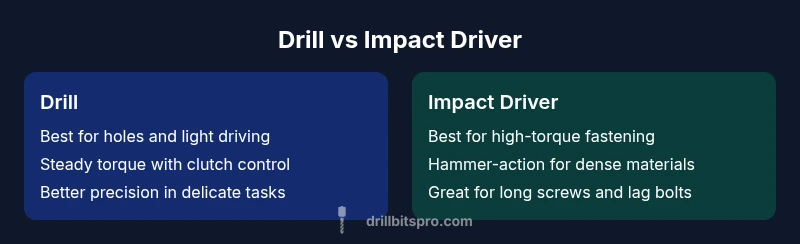
When to use a drill vs impact is determined by material, fastener type, and torque needs. In practice, a standard drill is best for drilling holes and light driving, while an impact driver excels at driving long screws and tough fasteners with high torque. The choice hinges on task difficulty, material protection, and hardware longevity.
Why this distinction matters
Understanding when to use a drill vs impact is more than a matter of habit; it’s about protecting material, extending tool life, and finishing jobs efficiently. For DIY projects and professional work alike, the right tool reduces wear on fasteners, minimizes stripping, and speeds up work in a safe, repeatable way. According to Drill Bits Pro, the core distinction comes down to torque delivery, driving action, and compatibility with drill bits versus driver bits. By matching the task to the tool, you preserve drill bits and impact-rated drivers, which translates to fewer breaks, less rework, and a smoother workflow from simple cabinets to dense hardwoods and metal fabrication.
In practice, you’ll often face scenarios where you could choose either tool. The key is to assess the needed torque, the significance of material protection, and the desired speed of completion. This guide walks through those decision points with practical examples and a clear framework for choosing the right tool at the right moment.
What each tool does: core mechanics
A drill uses continuous rotational torque to bore holes or drive small fasteners when coupled with appropriate bits. It offers adjustable speed and clutch settings to control bite, keeping hole diameter and thread engagement predictable. An impact driver, in contrast, combines rotation with a hammering action that delivers short, high-torque bursts. This impulse helps drive fasteners quickly into dense materials without spinning out or camming out screw heads. Understanding these mechanical basics helps you anticipate performance, especially when working with hardwoods, metal, or masonry.
From a user perspective, the difference is felt in feel and outcome: a drill provides smooth, controllable drilling and gentle driving, while an impact driver feels punchy and fast when fastening. The two tools also differ in interface: drills typically use a chuck to hold round bits, while impact drivers rely on hex shanks and quick-change bits designed for high-torque impact loads. For longer projects, this means less fatigue when driving many fasteners with an impact driver, but more control when precision drilling is required.
For a broader view, Drill Bits Pro Analysis, 2026 notes that task context often governs tool choice—there’s a practical spectrum where some jobs sit between drilling and driving. The takeaway is to match the action (continuous rotation vs hammering) to the job’s demands, not merely to preference or brand familiarity.
When to use a drill
Use a drill for: (1) creating clean holes in wood, soft metals, or plastics; (2) pilot holes for screws to prevent splitting; (3) light driving of small fasteners where precise starting torque matters; (4) countersinking and deburring tasks when paired with the right bits. In these tasks, the drill’s steady torque and broad bit compatibility provide superior control and cleaner hole quality. For medium-duty applications, a drill with a clutch lets you dial in torque to avoid overtightening or overdriving, which protects both the material and the fastener heads.
When drilling into dense or metal substrates, a pilot hole helps reduce bit wandering and extends bit life. If you anticipate frequent hole drilling in hard materials, a carbide-tipped or cobalt drill bit can improve durability. For most woodworking and light-metal projects, a standard twist drill with a sharp bit is sufficient. In all cases, consider lubrication for metal drilling to reduce heat buildup and wear on bits. The goal is clean holes with minimal tear-out while keeping the surface intact and the surrounding material unscathed.
When to use an impact driver
An impact driver is the go-to tool for demanding driving tasks. Use it when you need to rapidly drive long screws, lag bolts, or fasteners into tough materials like hardwood, projects with dense framing, or situations where cam-out becomes a safety risk. The high-torque impulse delivered in short bursts helps the bit bite into the material and maintain drive progression even when resistance is high. This makes the impact driver ideal for assembly work, deck building, cabinetry, and metal-to-wood fastenings that would slow down with a standard drill.
However, avoid relying on an impact driver for drilling most holes, especially smaller holes or delicate materials. The impulse can cause bit wandering or workpiece damage if the user doesn’t manage the force or uses ill-suited bits. When drilling is required, switch to a drill or set the impact driver to a lower torque mode if the tool supports it. For dense tasks, pairing an impact driver with proper hex-shank driver bits and countersinking bits ensures optimal performance without compromising bit integrity.
From Drill Bits Pro’s perspective, pros often own both tools for maximum versatility. An impact driver shines in high-speed fastening, while a drill provides precision drilling and controlled driving in a broader range of materials. This combination minimizes workflow friction and protects material edges from overdriving and bit wear.
Materials and their drilling needs
Material choice dramatically impacts whether you should pick a drill or impact driver. Wood typically accepts both tools depending on the task, but drilling wood benefits from a drill’s continuous rotation for clean holes and controlled countersinking. Metal drilling requires robust bits and usually a drill with appropriate speeds and lubrication; an impact driver is generally not recommended for metal drilling unless you’re performing light pilot holes with minimal force.
Masonry is a specialty area: for holes in concrete or brick, you need a hammer drill with a masonry bit or an impact-rated hammer drill, not a standard drill. If you need to drive fasteners into masonry or into studs with masonry anchors, an impact driver can be used with appropriate anchor or screw types but often requires pilot holes and correct fasteners to avoid damage. The material’s hardness, grain direction, and density should always guide your choice and the type of bit you use.
Fasteners and drive compatibility
Different fasteners demand different drive interfaces. Standard drill bits rely on a round shank and a chuck to grip the bit; many wood and metal drilling tasks use this arrangement. Impact drivers, by contrast, use hex shanks and push-drive bits designed to withstand high impulse loads. This means you’ll want to pair your impact driver with hex-shank driver bits, countersinks, and impact-rated screws. If you need to use traditional round-shank screws, a drill with a universal chuck adapter or a socket drive can handle some variants, but performance and bit wear may vary.
When selecting fasteners, consider head type (Phillips, Pozidriv, square, or star/Torx) and material compatibility. For dense hardwoods, predrilling with the appropriate bit reduces the risk of splitting and improves drive quality. High-torque applications like lag bolts often benefit from an impact driver, while lighter projects with small fasteners are well-suited to a drill. Always check manufacturer recommendations for bit compatibility and torque limits to protect both tool and workpiece.
Drill bits, shanks, and driver interfaces
Bit selection depends on the task and tool compatibility. Drill bits come in various shank and point designs; most common are round shanks that fit a standard drill chuck, enabling a wide range of hole sizes. Hex shanks are popular with impact drivers because they resist slipping under high torque. Some drills offer keyless chucks that simplify bit changes, and a 3/8
and 1/2
Comparison
| Feature | Drill | Impact Driver |
|---|---|---|
| Torque/Power profile | Lower, steady torque suitable for drilling and light driving | Higher, percussive torque for driving screws into tough material |
| Best uses | Hole drilling, pilot holes, light fastening | Driving long screws, lag bolts, heavy fastening |
| Weight and size | Generally larger work envelope, more control | Typically compact, higher torque in tight spaces |
| Chuck/drive interface | Chuck for bits (round shanks) | Hex shank bits for quick, high-torque drive |
| Noise and vibration | Moderate, steady operation | Higher impulse, more vibration on drive |
| Maintenance needs | Standard care for drills | Occasional service for torque/clutch components |
| Best for | Versatility and drilling control | Fastening efficiency in dense materials |
| Price range | Budget to mid-range | Mid to premium range |
What's Good
- Versatile drilling and light driving with one tool
- Less fatigue for long screw drives compared to manual methods
- Drill handles precision bore operations well
- Impact driver excels at rapid fastening in dense materials
Negatives
- Impact drivers can be overkill for simple drilling tasks
- Higher upfront cost for a dedicated impact driver
- Bit wear and chuck compatibility issues if mismatched
Own both tools for maximum versatility; use each tool to maximize efficiency and protect materials.
The drill remains the go-to for holes and light driving, while the impact driver outperforms for heavy fasteners. A balanced toolkit reduces project time and minimizes risk of damage, especially on dense woods and metals.
Got Questions?
What is the key difference between a drill and an impact driver?
A drill provides steady rotational torque for drilling holes and light driving, while an impact driver delivers hammering torque bursts to drive fasteners quickly into dense material. The choice depends on whether you need precision drilling or high-torque fastening.
Drill for holes and light driving; impact driver for fasteners with high torque.
Can I use an impact driver to drill holes?
Impact drivers are not optimized for drilling. They can drive pilot holes but lack the steady torque and precision of a drill, which can lead to wandering and poor hole quality. Use a drill for hole boring whenever possible.
Impact drivers aren’t ideal for drilling; use a drill for holes.
Is it safe to drive large screws with a drill?
Drills can drive screws, but you risk stripping the head or overdriving if torque is not carefully controlled. Use a drill with a clutch and pilot holes for better control, or switch to an impact driver for high-torque tasks.
Drill can do light to moderate driving with a clutch.
Do I always need a pilot hole when using a drill?
Pedestal piloting reduces wood splitting and bit strain, especially on hardwoods or dense materials. For soft woods, a smaller pilot hole can sometimes be omitted, but in general, pilot holes are a best practice.
Pilot holes are often a good idea, especially in hard wood.
What bits work best with impact drivers?
Impact-rated driver bits with hex shanks are best. They resist snapping under shock loads. Use driver bits designed for high-torque applications and match bit size to screw type.
Use hex-shank, impact-rated driver bits.
Can a hammer drill replace both tools for masonry projects?
For masonry, a hammer drill with masonry bits is ideal. An impact driver is not suitable for drilling masonry holes; fasteners may require anchors and specialized bits.
Masonry needs a hammer drill and proper bits.
Top Takeaways
- Choose drill for clean holes and controlled driving
- Choose impact driver for high-torque fastening
- Match bits and shanks to tool interface
- Predrill pilot holes to protect workpieces
- Respect material limits to avoid bit or fastener damage