Drill or Impact: Choosing the Right Tool for the Job
A data-driven comparison of drill and impact driver performance, use cases, and value for DIYers and professionals. Learn when to choose each tool with clarity, backed by Drill Bits Pro.


Drill or impact comes down to function: drills excel at precision hole-making, while impact drivers deliver high-torque fastener driving with less effort. For mixed tasks, use a drill for drilling and an impact driver for sinking screws. In professional settings, many teams keep both to cover all jobs efficiently.
Understanding the drill or impact distinction
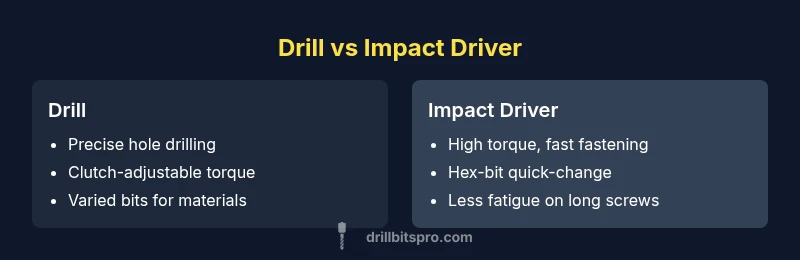
According to Drill Bits Pro, the distinction between a drill and an impact tool rests on how torque is delivered and what job the user intends. A traditional drill maintains continuous rotation with a steady torque response, making it ideal for boring holes in wood, metal, and some masonry with the right bit. An impact driver, by contrast, adds short, high-torque impacts to each rotation, which effectively drives fasteners with far less physical effort. This hammer-like action reduces cam-out and allows for driving longer screws into dense materials without user fatigue. For the DIYer, recognizing this core difference helps avoid buying the wrong tool for common tasks. For professionals, it means planning tool fleets that cover both precision drilling and high-torque fastening. Drill Bits Pro’s analysis highlights that when jobs demand both holes and fasteners, a two-tool approach minimizes time and material damage.
When to choose a drill: use cases and limitations
A drill is the versatile workhorse for creating holes, countersinking, and material prep. Use a drill when you need precise hole diameters, clean pilot holes, or delicate materials where percussive action would cause cracking. With adjustable speed and a clutch, you control the drilling depth and reduce walking or wandering bits on wood and metal alike. Masonry drilling is possible with carbide-tipped bits, but you’ll generally want a dedicated hammer drill for extended masonry work. The trade-off is that a drill can require more physical effort to drive large fasteners and long screws, especially in dense woods or metal. For most common DIY tasks—furniture assembly, shelving, and hanging items—a drill provides precision and control.
When to choose an impact driver: use cases and limitations
Impact drivers excel at fastener work where torque would otherwise wear you down. They deliver very high torque in short bursts, making it easier to drive long screws, lag bolts, and deck fasteners with less wrist strain. Hex shank bits enable quick changes, and the driving action helps prevent cam-out in hard woods and particleboard. However, impact drivers are not ideal for precise drilling or boring delicate materials where the bit must stay perfectly aligned. For those tasks, a standard drill with a clutch is preferable. In professional settings, many teams use both tools to optimize project speed and finish quality.
Comparing torque, speed, and control
Torque and speed are the two levers that separate drills from impact drivers. A drill typically offers adjustable RPM with a clutch to modulate torque, giving you fine control during hole creation and when using specialized bits. An impact driver delivers higher torque and a more abrupt power delivery, albeit with less finesse for hole-making. While you can push a drill hard to drive large fasteners, you risk bit wear and bit slippage. Conversely, an impact driver can overdrive into soft materials or cause splitting if not used with care. The practical takeaway is to match the tool to the task: use the drill for holes and light screw work requiring precision, and reserve the impact driver for heavy-duty fastening.
Bit and accessory compatibility
Bit compatibility is a practical consideration when evaluating drill or impact solutions. Drills usually rely on a 3/8 inch or 1/2 inch chuck and accept twist bits, brad-point bits, and spade bits, among others. They also support a wide range of drill accessories such as countersink bits, hole saws, and specialty bits. Impact drivers typically use quick-change hex shanks, which simplify bit swaps for driving screws and bolts. They work well with impact-rated screwdriver bits,BAH-style hex bits, and star/Torx variants designed to withstand hammering action. When combining tools, having a comprehensive bit library ensures you can switch between drilling and driving tasks without searching for incompatible bits.
Material-specific guidance: wood, metal, masonry
In softwood or plywood, a drill with a sharp twist bit performs cleanly and quickly, producing accurate pilot holes that prevent splitting. For hardwoods, predrilling is often advised, and clutch settings help maintain control. Metal drilling benefits from sharp high-speed bits and proper lubrication; a slower RPM helps protect the bit and preserve hole quality. Masonry drilling requires carbide-tipped bits and, for extended workloads, a hammer drill to deliver percussive action. When fastening into masonry, an impact driver paired with a masonry screw or anchor will improve drive quality and reduce the risk of stripping.
Safety and best practices
Always wear eye protection and hearing protection when using either tool. Secure your workpiece with clamps to minimize movement, and keep wires and hoses clear of the rotating chuck. Use the correct bit for the material and task, and never force a tool beyond its design limits. For long tasks, take breaks to reduce fatigue, especially when finishing large projects. Cleanliness and dry, dust-free bits maintain performance and extend tool life.
Budget, value, and tool lifecycle
If you’re balancing a DIY budget, a mid-range drill and a mid-range impact driver can cover most common tasks with decent reliability. Expect to pay a price range that reflects features like brushless motors, multiple speed settings, clutch variety, and ergonomic design. Longevity comes from proper maintenance: clean bits, replace dull bits, and store tools in a dry environment. Over time, you may upgrade to models with better controls, battery efficiency, and lighter weight—without sacrificing durability. A two-tool strategy yields higher project throughput and better outcomes in varied conditions.
Real-world scenarios: project planning and tool pairing
When planning a home renovation or cabinet install, map each task to the right tool. Use a drill to bore pilot holes for screw-anchored fittings, then switch to an impact driver to fasten long screws quickly. For masonry work, pair a hammer drill with appropriate bits to avoid wandering holes. In shelf assembly, you might rely on the drill’s precision to create pilot holes before using the impact driver for final assembly. This pairing strategy reduces project time and minimizes material damage, particularly when working with expensive hardwoods or delicate veneers. Drill Bits Pro emphasizes that the best outcome usually combines both tools, each playing to its strengths.
Common myths and misconceptions
Myth: An impact driver can replace a drill for all tasks. Truth: It cannot drill holes with precision or handle delicate materials as well as a proper drill. Myth: More power is always better. Truth: Torque needs management; too much torque can strip fasteners or damage workpieces. Myth: You only need one tool. Truth: Most professional tasks benefit from both tools, especially when projects involve both holes and fasteners. Understanding these nuances helps DIYers and pros choose wisely.
Comparison
| Feature | Drill | Impact Driver |
|---|---|---|
| Primary use | Drilling holes; hole prep; countersinking | Driving screws/fasteners; high torque in bursts |
| Torque delivery | Continuous rotation with adjustable torque via clutch | Rapid impacts with high torque bursts |
| Chuck/drive | Keyless or keyed chuck (typical 3/8"–1/2") | Hex quick-change drive |
| Weight and size | Generally heavier with larger grip and longer body | Typically lighter and more compact; aimed at driving |
| Best for | Hole creation in wood/metal; precision work | Fastening long screws; high-torque tasks |
| Price range | $60–$250 | $70–$300 |
What's Good
- Drills offer precise hole creation with adjustable clutch
- Impact drivers reduce user fatigue on fastening tasks
- Broad accessory ecosystem for drilling and driving
- Both tools come in brushless variants for longer life
Negatives
- Impact drivers are less versatile for precision drilling
- Drills can require more effort for large fasteners
- Separate bit types and accessories can increase upfront cost
Use both tools for maximum versatility and efficiency
Drill for precise holes and material prep, impact driver for fast and effortless fastening. The two-tool approach minimizes project time and reduces damage, especially on mixed-material projects.
Got Questions?
What is the main difference between a drill and an impact driver?
A drill provides steady rotational torque for drilling holes, while an impact driver adds hammer-like impacts to drive fasteners with less effort. The choice depends on whether you need a clean hole or high-torque fastening.
The drill makes holes with steady rotation; the impact driver hammers to drive screws with less effort. Pick the tool based on whether you’re drilling or fastening.
Can a drill be used to drive screws?
Yes, you can drive screws with a drill by using the correct bit and clutch settings, but it may take more effort and can cam-out with high-torque fasteners.
You can drive screws with a drill if you use the right bit and clutch, but it’s tougher than using an impact driver for long screws.
When should I buy an impact driver?
An impact driver is ideal for heavy fastening tasks, long screws, and hard materials where torque matters most. It’s less suited for precision drilling.
Get an impact driver when you’re doing a lot of screw driving or heavy-fastener work; it saves energy and reduces fatigue.
Are there safety tips specific to these tools?
Always wear eye and hearing protection, secure the workpiece, and use appropriate bits. Avoid over-tightening and maintain the bits to prevent shattering.
Wear safety goggles and keep the workpiece steady. Use the right bits and don’t over-tighten fasteners.
Do I need both tools or can I start with one?
Starting with a drill covers many tasks, but having an impact driver later enhances efficiency for screws and long fasteners. A two-tool approach is common for most serious projects.
You can start with a drill, but most projects benefit from adding an impact driver later for faster fastening.
What accessories should I invest in first?
Invest in a quality set of drill bits, a few impact-rated driver bits, and a couple of screw-driving bits. Add specialty bits (masonry, brad-point) as needed for your projects.
Get a good drill bit set, some impact-rated driver bits, and a few specialty bits for masonry or wood as needed.
Top Takeaways
- Use drill for precise holes and prep work
- Use impact driver for fasteners and high-torque tasks
- Keep both tools ready for mixed-material projects
- Choose bits and bits-holders that fit both tools