When to Use Drill vs Impact Driver: A Practical Guide
Master the decision: when to use drill vs impact driver with practical guidance, material-specific tips, and a clear framework for DIY and professional work.


TL;DR: For most DIY tasks, use a drill for holes in wood or light metal and an impact driver for screw driving and heavy fasteners. When you need both capabilities, a drill/driver combo or separate tools is best. The choice hinges on material, torque, and control. This guide breaks down when to use drill vs impact driver.
Understanding the core difference: when to use drill vs impact driver
According to Drill Bits Pro, the decision hinges on materials, torque, and the task's demands. The Drill Bits Pro Team emphasizes a clear rule: use a drill for creating holes and an impact driver for driving fasteners where torque matters more than precision. In 2026, Drill Bits Pro analysis shows that choosing the right tool can save time and reduce wear on bits and fasteners. This guide breaks down the key decision factors and shows how to match tasks to tool capabilities.
In practical terms, the question of when to use drill vs impact driver becomes a matter of material and application rather than a single rule. This section sets the stage for deeper comparisons and helps you see the trade-offs clearly.
How a drill works and typical use cases
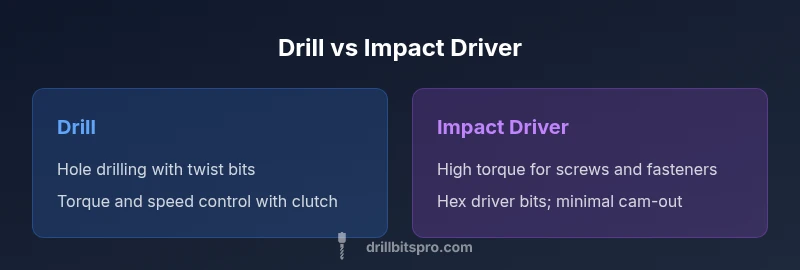
A standard drill uses a rotating twisting action to cut through wood, metal, or plastic with twist bits. The clutch lets you set torque, protecting screws and workpieces. Drills excel at making holes, countersinking, and prepping a workpiece for fastening. When used with a proper bit and safe drilling technique, a drill can handle light metal and soft plastics, provided you select the right bit and speed. For masonry, you want a hammer function or a dedicated hammer drill. In general, drills are the backbone of any hole-making task and offer versatility across materials.
For DIYers and professionals, understanding the bit family (twist bits, spade bits, hole saws) and how to choose the correct shank size (e.g., 1/4-inch, 3/8-inch) is essential for clean results and prolonged bit life.
Comparison
| Feature | Drill | Impact Driver |
|---|---|---|
| Power/torque | moderate torque (adjustable clutch) | high torque with percussive action |
| Speed and control | variable speed control | high speed with low guidance |
| Driving capability | holes, light drilling; with attachments | screws, long fasteners; minimal effort |
| Bit compatibility | twist bits, spade bits; chuck-based | hex bits; not for twist bits |
| Best for | holes in wood/soft metal; precise work | driving screws and heavy fasteners; decks and framing |
| Cost range (tool only) | $50–$150 | $60–$180 |
What's Good
- Versatility of drilling or driving with one tool (if using a combo)
- Drill handles precision work and varied materials
- Impact driver reduces cam-out and speeds up fastener driving
- Separate tools can optimize performance for each task
Negatives
- One tool may not cover all tasks optimally
- Impact driver can be rough on delicate work without proper control
- Drills can struggle with heavy screwing tasks without a dedicated impact driver
- Combo tools may compromise torque range or ergonomics
Use the drill for holes and precision tasks; use the impact driver for high-torque driving; for mixed tasks, own both or a drill/driver combo
In practice, choose drilling for hole-making and accuracy, and rely on impact driving for speed and torque. A two-tool setup or a dedicated drill/driver combo covers most professional and DIY use cases.
Got Questions?
What is the main difference between a drill and an impact driver?
A drill provides controlled torque and speed for drilling holes and light materials, while an impact driver delivers high torque through percussive action to drive screws and heavy fasteners with less effort.
The drill is for making holes with control; the impact driver is for driving screws with high torque.
Can I use an impact driver to drill holes?
Impact drivers are not designed to drill with standard twist bits. Use a drill for holes to avoid slipping or damaging bits and workpieces.
An impact driver isn’t ideal for drilling—use a drill for holes.
Should I buy both tools or a drill/driver combo?
If your work involves frequent drilling and driving, a drill/driver combo or two dedicated tools offers the best efficiency and precision. For occasional tasks, a single versatile tool with appropriate bits may suffice.
If you do a lot of both, get both or a solid drill/driver combo.
What materials are best drilled with a drill?
Wood and soft metals respond well to drilling with a standard drill and sharp bits. For masonry, you’ll need a hammer function or a dedicated rotary hammer;
Wood and soft metals are ideal for drilling; masonry needs a hammer drill.
Are there safety considerations when using both tools?
Yes. Wear eye protection, secure the workpiece, and use the correct bits. Avoid overloading the tool, and follow the manufacturer’s guidelines.
Always wear safety gear and secure your work.
Do I need to maintain or sharpen bits?
Yes. Inspect bits for wear, replace dull bits, and keep the chuck clean. Proper storage and occasional sharpening extend bit life.
Keep bits sharp and clean; replace worn bits as needed.
Top Takeaways
- Identify the primary task before selecting a tool
- Drill = holes and precision; impact driver = driving heavy fasteners
- Consider a drill/driver combo for maximum flexibility
- Use sharp bits and correct settings to avoid damage
- Safety and maintenance extend tool life