Drill vs Driver vs Impact: A Practical Guide for 2026
A data-driven comparison of drill, driver, and impact driver to help DIYers and pros choose the right tool for drilling, driving, and high-torque fastening.


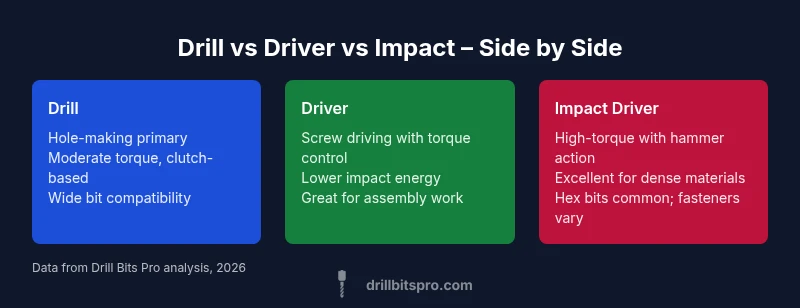
drilled down quickly: a drill is for making holes, a driver is for driving screws with controlled torque, and an impact driver delivers high-torque hammering for tough fasteners. For most tasks, start with the drill for holes, switch to the driver for assembly, and reserve the impact for stubborn or long fasteners. In short: drill for drilling, driver for driving, impact for high-torque fastening.
Core distinctions: drill vs driver vs impact
The phrase drill vs driver vs impact captures three distinct power-tool families that share a motor and a chuck or drive system, but serve different purposes. A traditional drill uses a rotational motion to bore holes and can handle a range of drill bits. A driver (often called a screwdriver) prioritizes precise torque control to avoid overdriving fasteners. An impact driver adds hammering energy—a rapid concussive action—so screws and bolts bite into tougher materials with less effort. The Drill Bits Pro team emphasizes that the key differences are the task at hand, the torque delivery, and the bit system. Recognizing these differences helps DIY enthusiasts and professionals avoid common misuses and costly mistakes.
Key terms and quick mappings
- Drill: boring holes with drill bits; adjustable clutch on many models for material-specific control.
- Driver: high-torque screwdriver with torque settings; uses bit types designed for fasteners.
- Impact Driver: high-torque, hammering action; accepts driver bits, typically hex shanks, for stubborn fasteners.
This article uses the term drill vs driver vs impact to help you map tasks to tools and choose the right accessory set. According to Drill Bits Pro, understanding the torque delivery curve and bit compatibility is essential for efficient work and reduced tool wear.
Feature Comparison
| Feature | Drill | Driver | Impact Driver |
|---|---|---|---|
| Primary purpose | Hole-making with a variety of drill bits | Screw driving with torque control | High-torque fastening with hammer action |
| Torque range | Low to moderate; clutch-based torque control | Moderate to high; precise torque via clutch | Very high; hammer action boosts torque without user effort |
| Speed (RPM) ranges | 0-1500+ typical | 0-1500+ with controlled clutch | 0-3200+ with peak hammer speed |
| Best materials | Soft woods, plastics, metal with small holes | Soft-to-medium woods, plastics, light metals | Hard woods, thick bolts, long fasteners |
| Bit compatibility | Straight shank bits (mostly), wide bit variety | Hex or star drive bits (driver bits in a set) | Hex shanks and hex-drive bits; driver bits commonly used |
| Ideal use cases | Hole patterns, countersinking, pilot holes | Deck screws, cabinetry screws, trim work | Lags, structural screws, long fasteners with resistance |
| Price range (typical) | $40-$150 for entry-level to mid-range | $50-$180 for mid-range with decent claws | $120-$250 for higher-end impact drivers with durability |
What's Good
- Clear specialization reduces user error
- Clutch settings prevent fastener overdrive
- Impact drivers save time on tough fasteners
- Bit compatibility across sets and accessories
Negatives
- Specialization means more tool investments
- Mismatched use can wear bits quickly
- Impact drivers may require different bits than drills/drivers
- Battery life varies with high-torque use
For most mixed work, use the drill for holes, the driver for standard fasteners, and the impact driver for stubborn or long fasteners.
Clear wins depend on the task: drilling is hole-centric, driving focuses on torque control, and impacts excel when resistance is high. Your kit should reflect a tiered approach aligned to project scope.
Got Questions?
What is the main difference between a drill, a driver, and an impact driver?
A drill is optimized for hole-making with various drill bits, a driver focuses on driving screws with torque control, and an impact driver uses hammering action to deliver high torque for tough fasteners. Each tool serves a distinct task, reducing wear and speeding up work when used correctly.
Drills bore holes, drivers drive screws with controlled torque, and impact drivers apply hammering torque for stubborn fasteners.
Can I substitute a drill for driving screws?
You can drive screws with a drill using a screwdriver bit, but you lose torque control and could strip threads. For frequent driving, a dedicated driver or impact driver is safer and more efficient.
A drill can drive screws with the right bit, but it’s not ideal for torque control—use a driver or impact driver for most screw driving.
When is an impact driver essential?
An impact driver is essential for long fasteners, dense materials, or tough joints where regular drills or drivers struggle. The hammer action reduces effort and speeds up fastening tasks.
Impact drivers shine on stubborn fasteners and dense materials because of their hammering torque.
What bits should I buy for a basic set?
A basic set should include drilling bits (high-speed steel or carbide for metal), driver bits (Phillips, Slotted, Torx), and hex/driver bits compatible with an impact driver. Consider an auxiliary set with masonry bits if you do concrete work.
Get drilling bits, driver bits, and hex bits; add masonry bits for concrete as needed.
Are drills and drivers interchangeable with the same bits?
Not universally. Drill bits and driver bits differ in geometry and support; some bits work across tools, but using the wrong bit can cause wear or damage. Always check the chuck or adapter compatibility.
Bits can sometimes fit, but don’t rely on interchangeability—check compatibility first.
How does battery life impact choosing between these tools?
High-torque applications, especially with impact drivers, consume more battery. If you run long sessions, prioritize a tool with a strong battery capacity and quick-charging features, or carry a spare.
Battery life matters more for impact tasks; plan for capacity and charging time.
Top Takeaways
- Choose tool by task: drill for holes, driver for screws, impact for tough fasteners
- Leverage clutch settings to prevent overdriving and bit wear
- Match bits: drill bits for drilling, driver bits for driving, hex bits for impacts
- Invest in a balanced battery platform to minimize swap time
- Practice safe handling and use proper PPE for all operations