Drill vs Impact: A Practical Comparison for DIYers
An analytical comparison of drill and impact tools, detailing use cases for wood, metal, and masonry, along with safety, maintenance, and buying guidance for DIYers and professionals.


Drill vs impact: for most drilling tasks, start with a versatile drill for clean holes in wood or soft metals, then switch to an impact driver for high-torque fastening. When masonry or heavy metal work is required, use a hammer or rotary hammer. The best approach is to match the tool to the material, task, and control needs.
What We Mean by Drill vs Impact
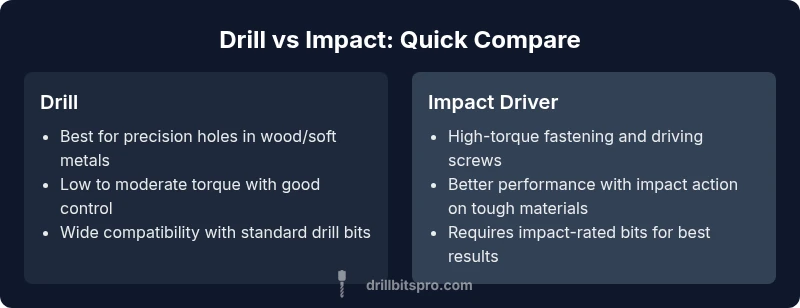
In the world of drilling and driving, the terms drill and impact refer to two distinct tool families with different primary jobs. A traditional drill (often called a drill/driver) focuses on creating clean holes with controlled torque. An impact driver specializes in high-torque fastening, delivering short bursts of rotational force that overcome friction in tough materials. This distinction is not just about power; it’s about how the tool delivers that power to the workpiece. According to Drill Bits Pro, the drill vs impact decision hinges on material, application, and endurance, not just raw speed. Understanding these fundamentals helps you avoid choosing the wrong tool for a given task and accelerates project completion without compromising quality.
The Drill Bits Pro team emphasizes that most projects benefit from having both tools available. A drill handles precision work and a range of bit types, while an impact driver makes fastening faster and more reliable, especially with long screws or dense materials. This approach aligns with practical drilling guidance, which stresses matching the tool to material properties, pilot hole requirements, and the desired finish. In short, drill vs impact is less about which is stronger and more about which is appropriate for the job at hand.
keyPhrasesUsedInBlockTrackersOnlyForContentQualityCheckNotDisplayedForReadersInThisBlock
Comparison
| Feature | Drill | Impact Driver |
|---|---|---|
| Best Use | Precision holes in wood/soft metals | High-torque fastening and driving screws |
| Torque/Power Delivery | Smooth, controllable torque | Pulsed rotational force for quick cam-out resistance |
| Bit Compatibility | Wide range of standard drill bits | Requires impact-rated bits for best results |
| Control & Comfort | Lower vibration, steadier feed | Higher vibration with strong torque bursts |
| Typical Tasks | Holes, pilot holes, and light-duty drilling | Long screws, lag bolts, and stubborn fasteners |
What's Good
- Drill + impact driver combo offers versatility for most projects
- Drills provide precise holes with broad bit compatibility
- Impact drivers excel at fastening and reducing cam-out
- Hammer drills extend capabilities to masonry when needed
Negatives
- Using the wrong tool can slow progress or ruin holes
- Impact drivers can feel overkill for simple drilling tasks
- Specialized bits may be required for masonry or metal drilling
- Hammer drills add cost and require more storage
A two-tool approach—drill plus impact driver—is the most versatile path for DIYers and professionals alike.
For general projects, rely on a drill for clean holes and a separate impact driver for fastening. Reserve a hammer drill or rotary hammer for masonry work. The dual-tool setup maximizes efficiency and reduces tool-switching time.
Got Questions?
Which tool should I use for drilling holes in wood or soft metals?
For clean, precise holes, start with a drill. It provides controllable torque and a wide range of wood- and metal-cutting bits. An impact driver is unnecessary for most wood drilling tasks unless you’re removing fasteners or pairing drilling with fastening in one step.
For most wood projects, use a drill for clean holes before you consider any fastening work.
Is an impact driver suitable for metal drilling or masonry?
An impact driver is not the best tool for drilling metal or masonry. It excels at fasteners. For masonry, a hammer drill or rotary hammer is preferred, and for metal drilling, a drill with appropriate metal-cutting bits and coolant is recommended.
Impact drivers are great for screws, not for making clean holes in hard materials.
Can I substitute a drill for an impact driver if I’m in a pinch?
You can drill with a drill even if you don’t have an impact driver, but you’ll lose the high-torque efficiency for driving screws. If possible, pair both tools to maintain project speed and minimize wear on components.
A drill can do drilling tasks, but it won’t replace an impact driver for heavy screwing.
What safety practices boost performance and reduce slips?
Always wear safety glasses, tie back long hair, and keep hands clear of the chuck. Use gloves with caution to avoid entanglement and maintain a secure stance to control tool torque. Regularly inspect bits for wear.
Protect your eyes and hands, and check bits before use.
How should I maintain bits and drivers for longevity?
Keep bits sharp, clean and dry after use. Lubricate chuck interfaces lightly if recommended by the manufacturer, and store tools in a dry place. Regularly inspect batteries, switches, and triggers for signs of wear.
Keep your tools clean, sharp, and dry for longer life.
Top Takeaways
- Assess your material first to choose drill vs impact
- Use proper bits and torque settings to avoid damage
- Keep a dedicated masonry solution for brick and concrete jobs
- Invest in a drill/driver kit plus an impact driver for versatility
- Practice safe handling to minimize slips and mis feeds