Hammer Drill vs Impact Driver: Practical Comparison (2026)
A thorough, evidence-based comparison of hammer drills and impact drivers, detailing when to use each, key design differences, and best practices for DIYers and professionals.


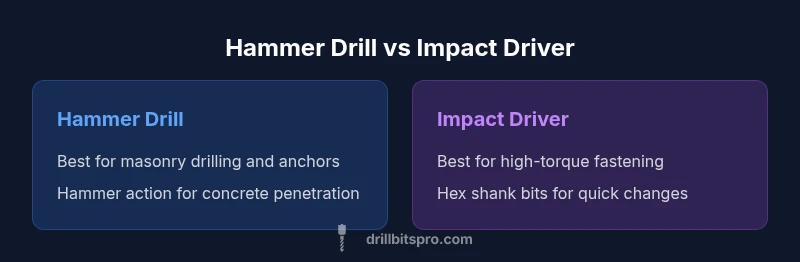
Hammer drills and impact drivers serve different jobs: a hammer drill combines rotation with a percussive hammering action for masonry drilling, while an impact driver uses rapid rotational impacts to maximize screw driving torque. For mixed tasks, prioritize the primary job first, and consider a drill/driver combo to cover both needs.
What is a hammer drill vs impact driver? Core definitions
What is a hammer drill vs impact driver? In practical terms, these two tools are built for different tasks within the same toolbox. According to Drill Bits Pro, a hammer drill combines rotation with a percussive hammering action to create a hammer motion that helps teeth cut into hard materials like concrete, brick, and masonry. An impact driver, by contrast, relies on a high-torque, impulse mechanism that delivers short, powerful bursts to advance fasteners quickly with less cam-out. This distinction isn’t merely academic—it's a difference in how you approach drilling versus driving, and it changes the range of compatible bits, the level of control you expect, and the cadence of your workflow. In real-world projects, you’ll reach for a hammer drill when you need to create holes in masonry or set anchors, and an impact driver when you’re sinking screws or lag bolts into wood, metal, or composites. There will be overlap in some scenarios, but the core design intent remains distinct, guiding your tool selection and your technique.
wordCountStartAtZeroNoteOnlyForParagraphsInBlock true
markupPresentInBlockAndAcceptableInMarkdown true
Comparison
| Feature | Hammer Drill | Impact Driver |
|---|---|---|
| Best For | Masonry drilling and anchor setting | High-torque fastening and dense lumber/metal screws |
| Drive System | Drill chuck (often 1/2"/13mm variants); multi-bit adaptability | 1/4" hex shank with quick-release for rapid bit changes |
| Torque & Control | Moderate to high torque with sustained drilling action; clutch options vary by model | Very high torque in short bursts designed for driving fasteners; more forgiving with cam-out |
| Vibration & Noise | Hammer action increases vibration during masonry work | Lower vibration during drilling; higher when driving, depending on model |
| Runtime & Weight | Heavier when featuring robust hammer mechanisms; battery life depends on drill mode | Typically lighter than a hammer drill; runtimes hinge on battery chemistry and load |
| Best Used With | Masonry bits, carbide-tipped bits, masonry anchors | Impact-rated driver bits, fastener sets, wood screws, bolts |
What's Good
- Clear role separation reduces project mistakes by pairing the right tool with the task
- High torque and efficient driving reduce time spent on demanding screws
- Better control in masonry drilling when paired with proper bits and settings
- Versatility in cordless variants allows mobility on-site
Negatives
- Two dedicated tools can increase upfront cost and storage needs
- Hammer drills can be heavier and less comfortable for long screw-driving sessions
- Impact drivers may struggle with raw drilling without a dedicated masonry bit
- Bit compatibility varies by model and chuck type, which can require more equipment
Hammer drill for masonry work; impact driver for fasteners; for true versatility, a drill/driver combo kit is often the most sensible choice.
The hammer drill excels at creating holes in concrete and brick, while the impact driver shines in driving screws with precision and speed. If your projects span both tasks, a two-tool setup or a combo kit generally offers the best balance of performance and value.
Got Questions?
What is the main difference between a hammer drill and an impact driver?
The main difference is in function: a hammer drill provides a hammering action to bore into masonry, while an impact driver delivers high-torque bursts to drive screws. The hammer drill handles holes in hard materials; the impact driver excels at fastening.
The hammer drill hammers as it drills; the impact driver delivers quick torque bursts for screws.
Can I use a hammer drill to drive screws?
Yes, you can drive screws with a hammer drill, but it’s not ideal for long fastener runs due to higher torque and potential bit wear. An impact driver is better for driving screws consistently without cam-out when used with proper bits.
A hammer drill can drive screws, but an impact driver handles long fasteners more efficiently.
Are cordless models better for woodworking?
Cordless models offer flexibility for woodworking, but your choice should be based on the task: for heavy masonry, a hammer drill is better; for soft or hardwood fastening, an impact driver or drill/driver combo is more versatile.
Cordless tools are great for mobility; pick based on the job you do most.
What bits do I use with each tool?
Use masonry bits with a hammer drill for concrete; use drill bits in wood or metal when drilling, and use impact-rated driver bits with an impact driver for fasteners.
Masonry bits for hammer drills, standard bits for drilling, and impact-rated bits for drivers.
Is it worth buying both tools or a combo kit?
If your projects regularly involve both drilling into masonry and driving fasteners, a drill/driver combo kit can be cost-effective and space-efficient. A dedicated hammer drill and impact driver offer the highest performance per task.
For frequent two-task work, a combo kit is smart; otherwise, two dedicated tools may offer the best performance.
Top Takeaways
- Identify your core tasks: masonry vs fastening
- Choose tools with compatible bits and settings for your primary material
- Consider cordless vs corded based on mobility and runtime
- A drill/driver combo often provides the most versatile coverage
- Prioritize ergonomics and weight to sustain longer work sessions