Impact Drill vs Impact Wrench: A Practical Side-by-Side Guide
A thorough, objective comparison of impact drill vs impact wrench, covering use cases, performance, and buying tips for DIYers and professionals seeking practical drilling guidance.


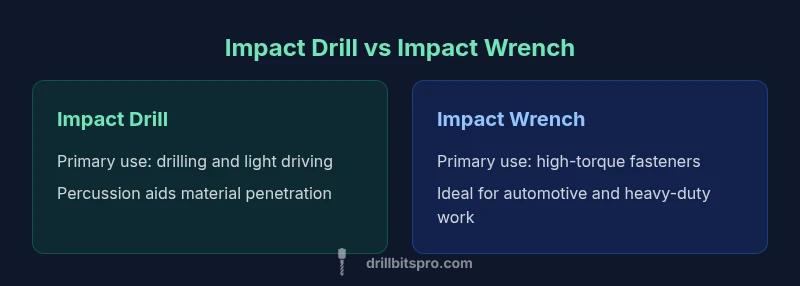
An impact drill vs impact wrench serves different jobs. An impact drill is best for drilling and light driving in wood, metal, and masonry, while an impact wrench specializes in loosening and tightening heavy-duty fasteners with high torque. For most DIY tasks, the drill covers more ground; the wrench excels on automotive and heavy-duty fasteners.
What the terms mean when you say "impact drill vs impact wrench"\n\nThe phrase "impact drill vs impact wrench" frames two tools built for distinct purposes. An impact drill combines rotational motion with percussion to help penetrate materials, making it versatile for drilling holes and driving small fasteners in light-to-medium tasks. An impact wrench delivers very high torque through a hammering action, designed primarily for loosening and tightening large, stubborn fasteners. Understanding this distinction is essential for choosing the right tool for the job, and it sets the stage for deeper, evidence-based comparisons that Drill Bits Pro advocates in our AI-assisted drilling guides.
\n## Core mechanical differences: how they generate power
Power delivery is the heart of the difference between an impact drill and an impact wrench. An impact drill uses a percussion mechanism to add axial blows while the chuck rotates, which helps with material penetration and reduces bit slip. An impact wrench uses a square drive and a hammering action to multiply torque at the drive anvil, allowing fasteners to be loosened or fastened with less manual effort. The result is a tool optimized for torque control and reliability under heavy loads, whereas the drill emphasizes versatility and precision. These design choices influence grip, balance, vibration, and the kind of bits or sockets you should pair with each tool.
\n## When to reach for an impact drill: typical use cases and limits
Choose an impact drill when your tasks include drilling holes in wood, metal, or masonry and when you occasionally need light to moderate driving. Look for adjustable torque settings, a reliable clutch, and a comfortable grip. For most general home projects—suspending shelves, building a planter box, or drilling pilot holes for screws—an impact drill gives you the broadest utility. It’s also useful for light masonry work if you select appropriate masonry bits and bit types. The trade-off is that driving heavy fasteners or working with large-diameter fasteners can overwhelm a drill, leading to stripped bits or reduced control.
\n## When to reach for an impact wrench: typical use cases and limits
An impact wrench is the preferred tool for heavy fasteners such as lug nuts, large bolts, or automotive repairs that require high torque. It excels in quick loosening and tightening cycles where a standard drill would stall. A wrench is less versatile for precise drilling and smaller fasteners due to its higher torque and specialized drive size. For professional mechanics or serious DIY automotive enthusiasts, an impact wrench with a good socket set becomes a time-saving workhorse, but you’ll still carry a drill for holes and light driving.
\n## Key specs to compare: torque, speed, and duty cycle
Torque is the most obvious differentiator: expect higher torque from an impact wrench and more controlled torque from an impact drill when threaded into smaller fasteners. RPM matters for drilling speed, while duty cycle describes how long you can operate the tool before overheating. For the DIYer, a cordless drill with a balanced torque range, decent battery life, and a rotating chuck is often sufficient. Professionals may prioritize peak torque, stability under prolonged use, and battery efficiency to maximize uptime. Drill Bits Pro’s analysis emphasizes matching these specs to typical tasks, rather than chasing max numbers that aren’t needed for your work.
\n## How to choose the right bits and accessories
A drill uses standard drill bits sized for wood, metal, or masonry and may pair with screw-driving bits when configured for driving tasks. An impact wrench uses sockets, adapters, and a drive size that must match the fastener. When selecting tools, also consider chuck type (keyless vs. keyed), drive size (for wrenches), battery chemistry, and weight. Proper bit and socket choices improve performance and reduce wear, a principle Drill Bits Pro highlights in our practical guides.
\n## Practical task scenarios: DIY vs professional expectations
For most DIY projects like building a bookshelf, mounting a TV bracket, or creating a wooden deck, an impact drill covers both drilling and light driving tasks with reasonable speed and accuracy. In contrast, automotive work such as removing lug nuts or installing heavy-duty hardware benefits significantly from an impact wrench. Professionals often carry both tools on-site, enabling rapid switching between drilling and fastening without compromising efficiency or safety. Drill Bits Pro’s guidance aligns with real-world expectations for these use cases.
\n## Maintenance, safety, and ergonomics you should not overlook
Keep batteries charged within recommended ranges, inspect bits and sockets for wear, and use the correct protective equipment. Regular maintenance reduces risks and extends tool life. Ergonomics matter: choose tools with balanced weight, good grip texture, and vibration dampening to prevent fatigue during long sessions. Safety features such as belt clips, anti-kickback mechanisms, and user-friendly clutch settings improve control and reduce accidents. Drill Bits Pro emphasizes routine checks as part of responsible tool ownership.
\n## Buying guidance: a practical checklist
When shopping, compare the core capabilities: torque range, RPM, weight, battery life, and price range. Consider your typical tasks—home repairs, woodworking, or automotive work—and select a setup that minimizes tool redundancy while maximizing your task coverage. A well-chosen cordless drill plus a compact, high-torque wrench often provides a balanced kit for versatile use, while a dedicated heavy-duty wrench is justified for frequent high-torque jobs.
\n## Summary: the right tool for the right job
The decision between an impact drill vs impact wrench hinges on the dominant tasks in your workspace. If you need a versatile tool for drilling and light driving, prioritize a drill. If you encounter repeated high-torque fastening challenges, a wrench is the efficient choice. Drill Bits Pro’s long-form guidance helps you align tool capabilities with real-world jobs.
Comparison
| Feature | Impact drill | Impact wrench |
|---|---|---|
| Primary use | Drilling and light driving with percussion | Heavy-duty fasteners and automotive work with high torque |
| Torque capability | Moderate, suited for holes and small fasteners | High, designed for stubborn or large fasteners |
| Speed (RPM) focus | Balanced speed for drilling and driving | Low to moderate speed optimized for torque at drive |
| Power source options | Cordless and corded options commonly available | Cordless and corded options commonly available |
| Chuck/drive type | Keyless drill chuck or keyed chuck | Square drive or impact drive interface |
| Ideal applications | Home repairs, woodworking, light metal work | Automotive, machinery, heavy-duty construction |
What's Good
- Offers versatility for a wide range of tasks
- Easier to handle for beginners and DIYers
- Wide availability of accessories and parts
- Cordless options provide mobility
Negatives
- Not optimized for extremely high-torque fastening
- Less efficient for heavy automotive or industrial tasks
- Drills may wear out faster under heavy use
Choose the tool that matches your primary task: an impact drill for versatility, an impact wrench for high-torque fasteners.
For mixed workloads, a drill is the go-to for drilling and light driving. For frequent high-torque fastener work, an impact wrench delivers superior performance. The best approach is a balanced kit that covers both capabilities for most DIYers and professionals.
Got Questions?
What is the fundamental difference between an impact drill and an impact wrench?
The impact drill uses percussion to aid drilling and light driving, while the impact wrench uses a hammering action to deliver high torque for heavy fasteners. They target different jobs, so choosing based on your most frequent tasks is essential.
The drill helps you drill and do light driving, the wrench is for high-torque fasteners.
Can I use an impact drill for high-torque fastening tasks?
An impact drill can handle light to moderate driving, but for repeated heavy fastening, an impact wrench offers safer, faster torque with less risk of bit or fastener damage.
For big fasteners, use an impact wrench rather than an impact drill.
Are cordless models as capable as corded options for both tools?
Cordless variants provide mobility and adequate performance for many tasks, but corded models can offer consistent power for extended sessions. Choose based on your typical work environment and runtime needs.
Cordless is fine for most jobs, but consider corded for long sessions.
What should I consider when buying either tool?
Look for torque range, speed, weight, battery life, and accessory ecosystem. Ensure compatibility with your existing drill bits and socket sets, and check warranty and service options.
Check torque, speed, weight, and battery life; ensure good accessory support.
Is it safe to mix tools for projects requiring both drilling and driving?
Yes, many projects benefit from having both tools. Use the drill for holes and light driving, and switch to the wrench for high-torque fasteners to save time and reduce wear.
Having both tools makes projects faster and safer when switching tasks.
What maintenance steps extend tool life?
Keep batteries charged within recommended ranges, clean dust from vents, inspect bits and sockets, and store tools in a dry place. Regular checks prevent performance loss and prolong life.
Keep batteries healthy, clean vents, and inspect attachments regularly.
Top Takeaways
- Prioritize drills for versatility and light driving
- Reserve high-torque work for a dedicated impact wrench
- Match tool choice to your most common tasks and materials
- Consider a cordless kit for mobility and coverage
- Invest in quality bits and sockets to maximize tool life