Impact Driver vs Hammer Drill: Which Tool Should You Use?
Compare impact drivers and hammer drills to choose the right tool for fastening, masonry drilling, and heavy-duty tasks. Practical guidance, real-world scenarios, and a side-by-side table to help DIYers and pros decide.


TL;DR: An impact driver excels at driving screws and fasteners with high torque in a compact form, while a hammer drill combines rotation with percussive blows for masonry and tough materials. If your work is primarily fastening, choose the impact driver; if you’ll drill into concrete or stone, opt for the hammer drill. The full nuances appear in the detailed sections below.
Why the impact driver vs hammer drill debate matters
Choosing the right power tool starts with a clear understanding of the fundamental task you’re trying to accomplish. The impact driver vs hammer drill question isn’t about declaring one tool universally superior; it’s about matching performance to material, fastener type, and user comfort. According to Drill Bits Pro, the impact driver is engineered to deliver high torque in short bursts to seat fasteners quickly with a compact grip and minimal kickback when paired with hex bits. In contrast, the hammer drill relies on a rotary motion paired with a percussive hammer action to penetrate hard materials such as concrete, brick, and stone. This basic distinction drives practical decisions about bit selection, clutch settings, weight distribution, and even battery life. By understanding the roles of each tool, you can avoid common misuses, protect bits and fasteners, and move through projects with greater confidence. Over the course of this guide, we’ll dissect performance, ergonomics, and long-term value so both DIY enthusiasts and professionals can decide which tool belongs on their bench and how to use it safely and effectively.
Core differences at a glance
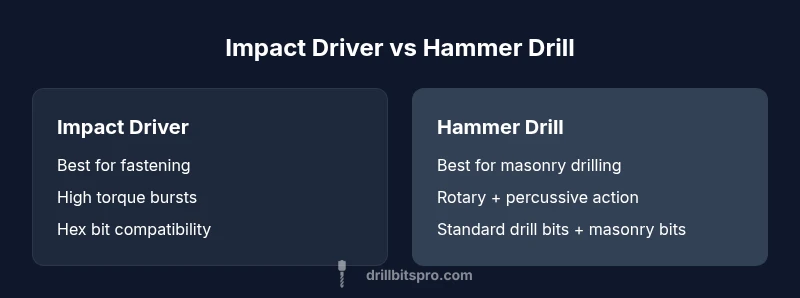
At a high level, the two tools are optimized for different outcomes. An impact driver uses high torque with short bursts of rotation to drive screws and bolts with precision, while a hammer drill combines rotation with a hammering action to drill into hard materials. The chuck system differs as well: impact drivers typically use hex shanks for quick bit changes and superior bit retention, whereas hammer drills often rely on a conventional drill chuck that accommodates masonry, metal, and wood bits. Weight and balance matter: impact drivers are usually lighter and more compact, designed for overhead or tight-space work, while hammer drills are longer and heavier due to the hammer mechanism and their broader drilling capabilities. Battery management is another factor: high-torque tasks drain packs faster, and modern brushless designs can stretch runtime. The big takeaway is that you don’t try to force the hammer drill to behave like an impact driver, or vice versa; each tool shines in its own niche and blends best with the right set of bits and accessories.
When to choose an impact driver
If your project centers on fastening rather than drilling, an impact driver is typically the faster, more comfortable choice. Use it for driving long screws, lag bolts, and multiple fasteners in quick succession where a clean, consistent drive matters. The hex-bit design allows rapid bit changes and strong engagement, reducing cam-out and stripping risks when used with compatible screws. Ergonomically, the compact form factor reduces user fatigue on repetitive tasks and enables access to tight spaces such as cabinetry, bookshelf assemblies, and transport rigs. For professionals, the impact driver’s slim profile can translate into significant time savings on framing, fencing, deck building, and cabinet installation. Remember to set the clutch or torque limit to avoid overdriving and damaging delicate materials. For wood, the impact driver excels; for metal, select proper screw type and lubrication where relevant. In short, impact drivers win for fastening speed and control.
When to choose a hammer drill
A hammer drill is your go-to when the job involves drilling into masonry or other hard, dense materials. The hammer action adds percussion that helps the bit chew through concrete, brick, tile, and stone, making tasks like anchor installation, channel cutting, or utility hole creation feasible and faster than a rotary drill alone. For those working in construction, renovation, or masonry-heavy projects, the hammer drill offers reliable performance with a broad bit ecosystem, from carbide-tipped masonry bits to concrete core bits. The tool also handles metal and wood with appropriate bits, but drilling into hard materials remains its core strength. We recommend pairing a hammer drill with quality masonry bits and a robust dust management setup to keep workspaces safe and clear. If you’re tackling multiple masonry tasks, this tool is likely to save you time and energy compared to using a standard drill.
Torque, speed, and clutch: how they shape outcomes
Both tools feature speed controls and torque management, but they deliver results in different ways. An impact driver uses a hammering mechanism at the spindle combined with a high-torque output, producing a sudden driving force when you pull the trigger. The clutch system typically limits torque to prevent fastener or material damage and provides predictable bite. A hammer drill emphasizes rotational speed and the percussive hammer action; torque plays a role, but the impact mechanism is what advances the bit through hard substrates. Variable speed controls are essential on both tools, but the best performance often comes from using the right speed setting for the material and the type of bit. For metal, a lower speed with a good cutting/drilling bit is preferable; for masonry, higher speed with a masonry bit and proper load handling is key. Brushless motors can improve efficiency and run-time, but the real win is choosing the right settings and technique for each material. Remember, the goal is cleaner, faster results with minimal material damage and better edge quality.
Accessories and compatibility you should know
Your hex-shank bits work seamlessly with most impact drivers, while hammer drills require compatible drill bits, including masonry, tile, and metal bits. Bit retention matters: hex shank bits hold better under high torque, reducing cam-out and the chance of stripping workpieces. For masonry drilling, ensure you use genuine masonry bits with carbide tips and high-quality shanks; pairing subpar bits with a hammer drill leads to dull bits and slower progress. Bit length and shank size should align with the chuck system—try to keep hex bits within the recommended range for your tool’s collet or chuck. Always verify that your bits and fasteners are designed for the material you’re working with and that your selected tool settings align with the job at hand. With the right accessories, you’ll maximize both performance and longevity of your drills.
Real-world task scenarios: where each tool shines
Consider framing a new wall or assembling decking: an impact driver drives screws rapidly and cleanly, especially when you’re working with long fasteners in tight spaces. For masonry anchors or drilling into brick and concrete, a hammer drill with the right masonry bits will outperform a standard drill. In metalworking, an impact driver can be used with specialty bits to drive self-tapping screws or anchor bolts when needed, but a drill driver or hammer drill with metal bits may be more versatile for hole drilling. In tile work or locations where precision matters, you may prefer a drill with a stable rotary motion, while the impact driver shines when assembly speed is crucial. The key is to map each operation to the tool’s strengths and to avoid using one tool as a substitute for the other in tasks where its performance would be compromised.
Comparison
| Feature | Impact driver | Hammer drill |
|---|---|---|
| Best primary use | Driving screws and fasteners with high torque | Masonry drilling and concrete/break-through work |
| Torque and impact action | High torque in rapid bursts (hex bit engagement) | Rotational power plus percussive hammer action |
| Chuck / drive type | Hex shank bits, quick-change style common | Drill chuck or SDS-like settings for masonry bits |
| Drilling capabilities (wood/metal/masonry) | Limited drilling capability; best with impact-rated fasteners | Excellent for masonry; decent for metal/wood with proper bits |
| Weight and balance | Generally lighter and more compact | Typically longer and heavier due to hammer mechanism |
| Best for | Fastening projects, cabinetry, decking | Masonry work, anchors, concrete drilling |
| Price range (general) | Mid-range to premium for professional-grade variants | Mid-range to higher for professional-grade variants |
What's Good
- High torque and fast bit engagement accelerate fastening tasks
- Compact form factor ideal for overhead or tight-space work
- Hex-bit compatibility speeds bit changes and reduces cam-out
- Brushless options improve efficiency and runtime
Negatives
- Limited masonry drilling capability without dedicated bits
- Requires different bits for masonry and metal drilling
- Higher upfront cost for quality models
- Not ideal for straight drilling into hard materials when used without appropriate bits
Impact driver is the go-to for fast, efficient fastening; hammer drill dominates masonry drilling.
Choose an impact driver for quick, repeatable fastening tasks. Turn to a hammer drill when you need to drill into concrete or brick with reliable percussion-assisted performance.
Got Questions?
What is the main difference between an impact driver and a hammer drill?
The main difference is that an impact driver delivers high torque in bursts for fastening, while a hammer drill rotates with a percussive hammer action to drill into hard materials like concrete. Each tool is optimized for its primary job, so use them accordingly.
The impact driver is for fast screws; the hammer drill is for drilling into masonry. Use them for their intended tasks to save time and avoid damage.
Can I substitute an impact driver for a drill?
An impact driver is not ideal for precision drilling, especially in masonry or when you need clean holes. Use a drill or hammer drill with appropriate bits for drilling into wood, metal, or masonry.
Do not substitute an impact driver for drilling tasks that require precision or masonry capability.
When should I use a hammer drill over an impact driver?
Use a hammer drill when you need to drill into masonry or stone. The hammer action helps the bit break through hard materials, delivering faster, cleaner holes than a standard drill.
Choose a hammer drill for masonry work and heavy drilling into concrete or brick.
Do I need special bits for an impact driver?
Yes. Use hex-shank bits designed for impact tools to maximize torque transfer and reduce cam-out. For wood and metal, choose appropriate driver bits and fasteners matched to your material.
Impact tools use hex bits; pick bits rated for impact use.
Which tool is safer for beginners?
Both tools can be safe when used correctly. An impact driver’s high torque can cause bit slippage if not controlled, while a hammer drill requires caution to avoid bit breakage and kickback. Start with low torque/settings and proper PPE.
Start slow, use safe settings, and wear eye protection with either tool.
How does battery life affect performance for these tools?
Higher torque tasks draw more current and can shorten runtime. Brushless motors and higher-capacity packs help, but efficiency also comes from technique, bit choice, and using the right setting for each material.
Torque-heavy work drains the battery faster; use efficient settings and good batteries.
Top Takeaways
- Choose impact driver for high-torque fastening
- Choose hammer drill for masonry drilling
- Use the right bits and settings for each task
- Brushless options improve efficiency
- Balance ergonomics with task requirements