Is a Drill the Same as an Electric Screwdriver? A Practical Guide
Explore the differences between drills and electric screwdrivers, when to use each, key specs, and buying tips. A data-driven comparison for DIYers and pros.


Drills and electric screwdrivers are not the same tool. They serve different primary tasks, with drills excelling at creating holes in wood, metal, and masonry, and electric screwdrivers focusing on fast, controlled screw driving. This guide compares their design, performance, and use cases to help DIYers and pros decide what to buy.
The Core Difference: Is a drill the same as an electric screwdriver?
In practice, the quick answer is no: is a drill the same as an electric screwdriver? are designed for different primary tasks, and that difference shows up in torque, speed, and bit compatibility. According to Drill Bits Pro, the distinction often boils down to three core capabilities: the tool's motor torque and clutch system, the chuck or bit interface, and the intended work material. A drill uses higher torque, a wider range of bit types, and often a hammer function for masonry, whereas a screwdriver emphasizes controlled, low-torque driving with fine clutch settings to prevent stripping screws. The result is that each tool shines in its own domain: holes through wood or metal versus screw-driven assemblies. For the non-pro user, swapping bits and attachments is common, but using the wrong tool for the job can lead to stripped holes, damaged screws, or uneven results. The Drill Bits Pro team notes that investing in both tools pays off when you frequently switch tasks, but if space or budget is tight, start with a versatile drill/driver combo that can handle both roles with careful technique.
How each tool is designed for its primary tasks
Both tools share core electric motor concepts, but the design intent diverges quickly. A drill is engineered for robust material removal and precision hole creation. It uses a stronger gearing train, a broader torque spectrum, and, on many models, an optional hammer or percussion mode for masonry. The chuck is built to hold larger drill bits, including twist bits, brad points, spade bits, and masonry bits, with a secure grip that tolerates axial load. An electric screwdriver or compact drill-driver, by contrast, emphasizes consistent, repeatable torque with fine clutch control to prevent cam-out and stripped screw heads. Bit changes are optimized for speed and ease, often via a quick-release holder or a compact chuck that accepts driver bits with hex shanks. In practice, if you anticipate drilling holes through hardwood, metal, or brick, a drill is your best ally; if your core task is assembling furniture or fastening many screws, a screwdriver shines with rapid, controlled driving.
Torque, speed, and control: the levers that separate them
Torque and speed are the two fundamental levers that separate a drill from an electric screwdriver. A drill typically offers a wider torque range and higher peak torque, along with variable speeds that adapt to material density. This combination makes it possible to bore holes without stalling and to manage the bite when entering harder substrates. A classic electric screwdriver prioritizes precise control: lower idle speeds, a refined clutch system, and a predictable response to torque when driving fasteners. The result is fewer head slips and less risk of overtightening. Some drills include adjustable torque settings and a single-speed or two-speed gearbox, while many screwdrivers emphasize clutch sequences and ergonomic balance. The practical takeaway: choose the tool whose torque profile and speed range align with your primary task to avoid overdriving screws or overheating bits.
Chuck types, bits, and compatibility
Chuck design and bit interfaces reflect the job each tool performs. Drills typically use a larger, drill-oriented chuck (often 1/2 inch or 3/8 inch) that accepts a broad array of drill bits and some driver bits. This versatility is essential for holes in different materials, including masonry with the appropriate bits. Electric screwdrivers rely on quick-change bit holders or hex shanks that accommodate Phillips, slotted, Torx, and specialty driver bits. The interface is designed for speed and ease of bit swaps, not for the heavy axial loads of drilling. While some drills can accept screwdriver bits, and some compact screwdrivers can handle light drilling, the performance envelope is best when each tool stays within its intended bit ecosystem.
Use-case scenarios: furniture assembly vs masonry drilling
For furniture assembly, an electric screwdriver or a compact drill-driver is often sufficient. These tasks demand many screw insertions with reliable repeatability, minimal cam-out, and fast cycle times. When working with soft woods or predrilled holes, a screwdriver reduces user fatigue and speeds up the process. If your project involves creating pilot holes, drilling pocket holes, or penetrating denser materials like hardwood or metal, a drill becomes indispensable. Masonry projects require a hammer drill or dedicated masonry drill bits with a drill, not a screwdriver. The practical rule of thumb: cover the high-volume driving tasks with a screwdriver, and reserve the drill for holes and tougher materials. This division of labor minimizes tool swaps and maximizes productivity.
Budgeting and value: power, battery, and price ranges
From a value perspective, drills tend to command a broader price range due to their broader capabilities and build variety. You can find reliable mid-range options that balance torque, vibration, and battery life for daily use, as well as premium models for professionals who demand peak performance and durability. Electric screwdrivers, especially compact, lighter-duty models, usually come at a lower price point and are highly attractive for quick assembly tasks. When evaluating options, consider the earned value of battery chemistry, runtime, and ergonomics. Drill batteries often offer more voltage options, while screwdrivers emphasize compact form and comfortable grip. Drill Bits Pro Analysis, 2026, suggests prioritizing tool selection based on the frequency of drilling versus driving tasks and the need for long-term reliability.
Safety, ergonomics, and maintenance tips
Regardless of the tool, proper safety practices protect you and the work. Wear eye protection, secure workpieces, and avoid over-tightening bits near fragile materials. Ergonomics matter: check grip shape, weight distribution, and trigger sensitivity to minimize fatigue during long sessions. Battery care extends tool life: avoid fully depleting the pack, store at moderate temperatures, and use the correct charger. Clean bits after use to prevent corrosion. For masonry work, select the appropriate hammer drill mode and masonry bits with a sharp edge for cleaner holes. Basic maintenance includes inspecting the chuck, lubricating moving parts per the manufacturer’s guidelines, and replacing worn bits before performance declines.
Quick-start guidelines: how to pick in 60 seconds
If you need both drilling and driving capabilities in a single solution, start with a drill-driver combo that offers adjustable torque, two-speed gear, and a comfortable grip. For frequent screw driving, choose an electric screwdriver with a reliable clutch and a compact form factor. If you expect masonry work or larger holes, a dedicated drill with hammer function is the safer choice. Look for a balanced weight, good battery life, and a robust chuck system. Finally, assess your typical material mix and project scale to decide whether you need a corded or cordless setup, and ensure you have a useful set of drill bits and driver bits.
Misconceptions and clarifications: common myths
Several myths persist about drills and screwdrivers. Some users believe a single tool can replace both functions without compromises; in practice, a dedicated drill handles holes more efficiently, and a screwdriver delivers more precise driving control. Others assume all compact screwdrivers lack power for any drilling; many models offer light drilling capabilities or pilot hole functionality, but performance is limited compared to a true drill. Finally, some think higher voltage automatically means better performance; real-world use depends on torque curves, clutch design, and battery chemistry. Understanding these nuances helps you plan a tool lineup that covers common jobs without overinvesting.
How to extend tool life: charging, storage, and care
Extended life comes from smart charging, proper storage, and consistent maintenance. Use manufacturer-approved batteries and chargers, avoid leaving packs in extreme temperatures, and cycle through batteries to retain capacity. Store tools in a dry, organized place to prevent dust ingress and corrosion. Periodically inspect the chuck, brushes (for corded tools), and bits for wear. Clean after use and lubricate moving parts when recommended. A well-kept drill or screwdriver will perform more reliably over years of DIY projects and professional tasks.
Comparison
| Feature | Drill | Electric screwdriver |
|---|---|---|
| Primary function | Hole creation in wood/metal/masonry; can bore and sometimes hammer through tough materials | Screw driving with controlled torque; optimized for fastening tasks |
| Torque range | High, adjustable torque with potential clutch settings to protect work | Lower, precise torque optimized to avoid cam-out |
| Speed (RPM) | Higher speeds with variable gearing for drilling and lightweight driving | Moderate speeds focused on driving efficiency and control |
| Chuck/bit interface | 1/2" or 3/8" chuck for a wide range of drill bits with quick-change options | Hex shank or quick-change bit holder for driver bits |
| Impact/hammer | Hammer/impact options for masonry on some models | Generally no hammer function; some models labeled as impact drivers are separate |
| Materials/compatibility | Wood, metal, masonry when using appropriate bits | Wood, drywall, plastic, light metal; not for masonry |
| Weight/ergonomics | Heavier, with bigger batteries or cords; balanced for drilling | Lighter, more compact, easier to handle during driving tasks |
| Price/value | Wide range from budget to professional-grade; accessories add cost | Typically affordable with strong value for light-duty tasks |
What's Good
- Versatile tool lineup supports a wide range of projects
- High torque and masonry capability on drills
- Strength in bit compatibility and digging deeper into materials
- Compact screwdrivers excel at repeated fastening without fatigue
Negatives
- Drills are heavier and bulkier, affecting comfort on long jobs
- Screwdrivers may lack true drilling capability for harder materials
- Higher-end drills can be more expensive and require more accessories
- Misusing a drill as a screwdriver can increase wear on bits and fasteners
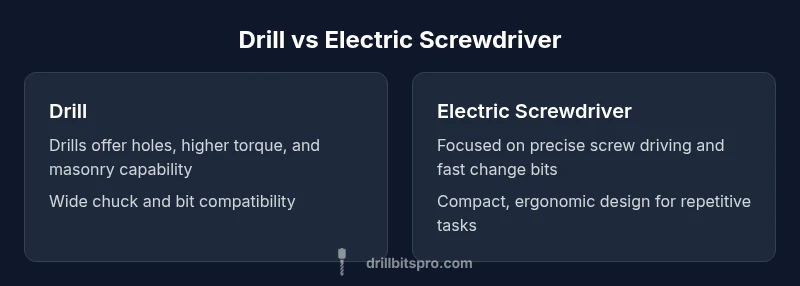
Drills offer broader versatility; electric screwdrivers excel in fast, controlled driving
Choose a drill when holes and tougher materials are common. Pick an electric screwdriver for rapid assembly tasks; a dual-function tool can cover both needs if space is limited.
Got Questions?
What is the main difference between a drill and an electric screwdriver?
The main difference is purpose: drills bore holes in various materials and handle higher torque, while electric screwdrivers drive screws with precise, lower torque. Some models blend features, but performance varies by task.
Drills bore holes with higher torque; screwdrivers drive screws with careful control. Use each tool for its strongest capability.
Can a drill drive screws as well as drill holes?
Yes, most drills can drive screws when fitted with the appropriate driver bits and clutch settings. However, dedicated screwdrivers offer more consistent control and reduce the risk of stripping fasteners.
A drill can drive screws with the right bits, but a screwdriver gives you better control and less cam-out.
When should I choose a hammer function?
Choose a hammer or percussion drill when drilling into masonry like concrete or brick. Regular drills are not ideal for such materials without specialized bits.
Use a hammer drill for masonry; regular drills aren’t optimized for concrete.
Is an impact driver needed in a home toolbox?
An impact driver is a separate tool designed for stubborn fasteners and longer screws. It’s not essential for all projects, but it can dramatically improve driving torque and speed in tough materials.
An impact driver is optional but helpful for heavy driving tasks, especially long or stubborn screws.
How do I choose between budget and pro models?
If you do frequent drilling or heavy-duty work, a mid-range to pro model offers better durability and performance. For light tasks and occasional use, a reliable budget option may suffice.
For heavy use, go for mid-range to pro; for light tasks, a solid budget option works.
Can I assemble furniture with just a drill?
Yes, a drill with driver bits can assemble most furniture, but a dedicated screwdriver speeds up repetitive screwing and reduces fatigue.
A drill with the right bits can assemble furniture, but a screwdriver is faster for lots of screws.
What about corded vs cordless choices?
Cordless tools offer portability and convenience, while corded options provide consistent power for extended work. Battery life and charge speed are critical factors to consider.
Cordless is portable; corded is reliable for long sessions. Check battery life and charging speed.
What are essential bits to start with?
A basic starter set should include masonry bits for drilling into brick, twist bits for wood/metal, and common screwdriver bits in Phillips, flat, and Torx. A few driver bits cover most furniture tasks.
Have masonry, twist, and common driver bits ready for versatility.
Top Takeaways
- Identify your most frequent tasks before buying
- Choose a tool with appropriate torque and clutch control
- Invest in a balanced kit with reliable bits and comfortable grip
- Consider cordless vs corded based on mobility needs
- Maintain tools for longer life and safer operation