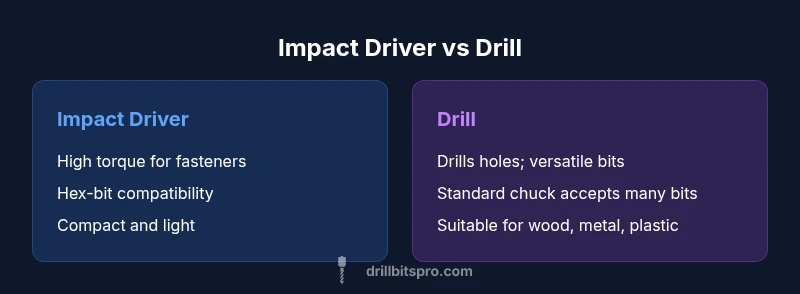
Impact Driver vs Drill: Which Is Better for DIY and Pros
Compare impact drivers and drills: use cases, bit compatibility, ergonomics, and budgeting with practical tips for DIYers and professionals.


Which is better impact driver or drill? For pure screw driving, an impact driver tends to win with higher torque and less cam-out. For drilling holes and mixed tasks, a drill offers broad versatility. Many pros use both: the impact driver for screws, and the drill for holes.
Which is better impact driver or drill
Which is better impact driver or drill is not a single universal answer; it depends on your tasks and project types. This article compares the two common cordless tools, focusing on practical, real-world use rather than marketing chatter. According to Drill Bits Pro, the most important distinction is how each tool delivers torque, controls, and compatibility with bits. In DIY workshops and professional shops, understanding these differences helps you choose or diversify your toolkit. We'll explore core design differences, typical applications, ergonomic considerations, and a decision framework that works for both hobbyists and tradespeople.
Core differences in design: what powers an impact driver vs a drill
At their core, an impact driver and a drill translate energy from the battery into motion, but they do so in different ways. An impact driver uses a rotating hammer mechanism that delivers short, high-torque bursts to the drive bit. A drill relies on a conventional chuck connected to gears that control rotation speed and torque for drilling and driving. The result is that the impact driver is optimized for fasteners, where cam-out and stripped screws are common problems, while the drill is optimized for holes and varied bit work. These design choices influence how you actually feel the tool in your hands and how it performs under load.
Torque, speed, and control: how each tool behaves
Torque and speed profiles shape how you complete a task. An impact driver provides potent resistance to slipping and cam-out, so you can push screws home with less effort. The lack of a traditional clutch means you manage torque primarily through trigger control and your bit choice, which makes it great for repetitive driving tasks but less forgiving for delicate materials. A drill offers a broad speed range and a clutch or torque limit, enabling precise drilling and screw driving with more finish control. In practice, this means you can dial in stops for wood, plastic, and metal more easily with a drill, while the impact driver excels when torque dominates.
Real-world use cases: when to pick each tool
For assembly tasks like furniture, cabinetry, or deck building where many fasteners are involved, the impact driver shines by delivering rapid, high-torque driving with minimal effort. If your work involves drilling pilot holes, resizing holes for fittings, or working with metals, a drill is the more versatile choice. For mixed workloads—occasional drilling plus many screws—many professionals keep both tools handy, using the impact driver for screws and the drill for holes and pilot holes. The decision often comes down to whether you value speed of screw driving over drilling flexibility.
Bits and compatibility: what you can and cannot use
One practical constraint is bits. Impact drivers typically use hex shank bits, often 1/4 inch, which makes them fast to swap but less compatible with standard twist bits. Drills, by contrast, use a traditional chuck to accept a wide variety of twist bits, brad-point bits, and spade bits. If you rely on a large library of drilling bits, a drill offers broader compatibility. To maximize performance, many users purchase hex shank adapters for drills or invest in impact-rated bits designed for use with impact drivers.
Ergonomics, weight, and balance for long sessions
Ergonomics matter as you work longer. Impact drivers tend to be more compact and lighter than many drills, especially when you compare a bare tool to a drill with a heavy chuck. The lighter feel can reduce fatigue during screw driving, but the occasional heavier drill operation can change balance in overhead work. Drill users may notice more vibration in metal drilling, especially with longer bits. The best approach is to handle both tools in person, evaluating grip, balance, and trigger feel to determine which suits your hand size and working posture.
Battery life and runtime considerations
Battery life is a practical concern, particularly on job sites or long DIY sessions. Impact drivers are efficient for driving bolts and screws and can go longer on a single charge when used primarily for fastening. Drills consume energy differently because drilling tasks can demand more continuous motor effort, especially when cutting through harder materials. In many systems, battery geometry and cell chemistry influence runtime, so you should consider your most frequent tasks and the number of batteries you own when building a balanced kit.
Safety and technique tips
Safety always comes first. When using an impact driver, ensure the bit is securely seated and the fastener is aligned to avoid cam-out, and wear eye protection. With a drill, use appropriate drill bits, clamp your work, and control your feed rate to prevent skidding or breakage. Both tools benefit from a spare battery, a bit holder, and a basic protective eyewear set. Mastering proper technique reduces wear on both your tools and your materials.
Cost and value: budgeting for your toolkit
Cost considerations reflect brand, features, and build quality rather than a single number. An entry-level impact driver can offer excellent value for fasteners, while mid-range drills provide broader bit compatibility and stronger drilling performance. When budgeting, consider the total cost of ownership, including batteries and chargers, as well as the possibility of upgrading to a more robust model in the future. The goal is to balance upfront cost with long-term usefulness across the projects you tackle.
How to choose for your workshop: quick decision guide
A practical decision framework starts with listing typical tasks: screws, holes, or mixed duties. If you primarily drive screws, prioritize an impact driver; if holes and versatility are essential, prioritize a drill. For a mixed workload, consider a compact drill paired with an impact driver in the same battery ecosystem. Finally, confirm bit compatibility and ergonomics before purchasing to ensure comfortable, productive usage.
Common myths debunked
Myth: An impact driver can replace a hammer drill for masonry tasks. Reality: For masonry, you still need a hammer drill. Myth: A drill can do anything a driver does. Reality: Drills can drive screws, but their slower driving speed and cam-out risk make them less efficient for heavy fasteners. Myth: Hex bits are interchangeable with twist bits—Not always. Choose the right bit system for the task.
Practical setup and maintenance tips
Keep both tools in a dedicated bag; store batteries in a cool, dry place, and label bits for quick identification. Clean and inspect the chucks and collets, and check the screws for wear. Regularly rotate battery packs to maintain performance. A quick monthly inspection can extend tool life and maintain peak performance.
Comparison
| Feature | Impact Driver | Drill |
|---|---|---|
| Typical use | Screw driving and fasteners with high torque | Drilling holes and handling a variety of bits |
| Chuck/bit system | Hex shank compatible; requires hex bits | Standard chuck accepts twist bits and specialty bits |
| Torque vs speed | High torque for driving; controlled via trigger/bits | Broad speed range; clutch for drilling and driving |
| Best for | Screws, bolts, rapid assembly | Drilling holes in wood, metal, plastic, and more |
| Weight/ergonomics | Typically compact and lightweight | Balanced for varied drilling positions |
| Battery/runtime | Efficient for screw driving; often longer runtime | Varies with usage; broad compatibility with bits |
| Maintenance/durability | Fewer moving parts; durable for repetitive driving | More complex chuck/gear system; requires care |
What's Good
- Fast, high-torque screw driving
- Compact form factor for overhead work
- Lower cam-out risk during fastening
- Efficient use of battery during driving
- Good control with proper bit selection
Negatives
- Limited drilling versatility without accessories
- Requires hex bits; not ideal for standard twist bits
- Heavier drilling sessions can be tiring with some models
- Higher upfront cost for premium systems
Impact driver excels at fasteners; drill is the versatile all-rounder
If screw driving dominates your workload, an impact driver is the smarter choice. For holes and mixed tasks, a drill remains essential. The Drill Bits Pro team recommends owning both if your budget allows to maximize productivity across projects.
Got Questions?
When should I choose an impact driver over a drill?
If your primary work involves driving screws and fasteners, the impact driver offers faster, more reliable torque. For drilling and mixed tasks, a drill provides greater versatility and control.
Choose an impact driver for screws and fasteners; use a drill for holes and mixed tasks.
Can I use impact driver bits in a drill?
Some drills accept hex bits with adapters, but not all do. Using the right bit system prevents damage and ensures optimal performance.
Adapters exist, but it's best to use each tool with its intended bit system.
Are impact drivers better for metal or hardwood?
Impact drivers are excellent for hardwoods with screws; for metal drilling, use a drill. They are not optimized for precision drilling.
Great for driving screws in wood; drill for metal drilling.
What about battery compatibility?
Many cordless tools share batteries within a brand or platform. Check your toolkit’s ecosystem to maximize runtime and reduce clutter.
Sticking to one battery system helps keep costs down and work efficient.
Is a hammer drill different from an impact driver?
Yes. A hammer drill uses a hammering action to enable masonry drilling; an impact driver uses rotational impacts for fasteners. They’re not interchangeable.
Hammer drills hammer; impact drivers drive fasteners.
Should I buy a drill with a hammer function?
If you plan to drill masonry, a hammer drill is useful. For wood and metal, a standard drill is usually sufficient.
A hammer function helps with masonry; otherwise, a standard drill is fine.
Top Takeaways
- Prioritize the task: screws or holes?
- Bit compatibility drives tool choice
- Ergonomics matter for long sessions
- Budget for a shared battery ecosystem
- Practice proper technique to avoid damage