Is It OK to Drill Into Mortar? A DIY Guide
Learn when you can safely drill into mortar, choose the right masonry bits, drill settings, and best practices to avoid wall damage. Drill Bits Pro provides practical, step-by-step guidance for DIYers and pros alike.


Is it ok to drill into mortar? Yes, with proper technique and the right masonry bit. You’ll learn how to assess mortar type, select drill bits, and drill safely without cracking surrounding bricks. According to Drill Bits Pro, use a low-speed, steady pressure and a pilot hole to minimize damage.
What mortar is and why it matters
Mortar is the binding material that holds bricks and stones in place. It comes in different formulations—lime-based, cement-based, and hybrid mixes—each with its own hardness and aging behavior. For is it ok to drill into mortar, the key is understanding that softer mortar often tolerates drilling with minimal damage, while very hard, modern cementitious mortars require lighter pressure and the right bit to avoid cracking adjacent bricks. According to Drill Bits Pro, the composition of mortar in your wall can dramatically influence how easily you can create a clean, durable hole. Always inspect a small, inconspicuous patch if you’re unsure of the mix and age of the masonry.
Is it safe to drill into mortar? When to proceed and when to avoid
In general, you can drill into mortar to install anchors, but proceed with caution:
- Do not bore through bricks or into structural joints; aim for the mortar bed instead.
- Avoid drilling near the edge of a brick (at least 1/4 inch away) to reduce the risk of cracking.
- If the mortar looks crumbly or crumbles easily, test on a scrap patch first and consider alternative mounting methods. Mortar hardness varies; lime-based mortars are softer and may be drilled more easily than dense Portland cement mortars. Using the wrong bit or applying excessive pressure can spall the brick faces. Drill Bits Pro notes that slower speeds and light, steady pressure improve success rates for mortar drilling.
Tools, bits, and settings for drilling into mortar
The right tools make a big difference. For is it ok to drill into mortar, select these basics:
- Carbide-tipped masonry bit sized to match your anchor diameter.
- A drill with masonry or hammer mode turned on (if the wall is concrete-laden or very dense).
- Safety gear: eye protection, dust mask, and hearing protection if using a hammer drill.
- A center punch or marking tool to start the hole accurately. A balanced approach—low speed, steady pressure, and frequent pecking (small, initial holes) — reduces wandering and ensures a crisp hole without overworking the mortar.
How to minimize damage and ensure a clean hole
Follow these steps to minimize damage:
- Mark the spot precisely, then drill a shallow pilot hole (1-2 mm) to create a centered guide.
- Progress to the final hole with controlled speed and constant pressure; do not push hard into the wall.
- Clear dust frequently and vacuum the hole to check alignment before final anchoring.
- If the hole walls crumble, switch to a smaller bit, or consider epoxy anchors that distribute load more evenly. The key is to keep the drill axis perpendicular to the wall and maintain consistent contact with the surface.
Common scenarios: interior vs exterior, lime-based vs cement mortars
Exterior walls tend to use tougher, cement-rich mortars, while interior walls often employ lime-based mortars that are softer. Lime-based mortars can be drilled with modest effort, but you should still use a proper masonry bit and avoid excessive force. For exterior applications, avoid creating oversized holes that could weaken the wall’s weather seal; instead, select corrosion-resistant anchors and sealant compatible with masonry substrates. In all cases, verify the anchor type and wall material, as mismatches are the leading cause of long-term failures.
Tools & Materials
- Hammer drill or rotary hammer(Masonry mode enabled; adjustable speed)
- Carbide-tipped masonry bits(Choose bit size for anchor diameter)
- Masonry anchor kit(Match to hole diameter)
- Safety goggles(Protect eyes from chips)
- Dust mask(Minimize inhalation of dust)
- Center punch/awl(To mark exact hole center)
- Tape measure/marker(Accurate placement)
- Vacuum or brush(Clean hole and surface)
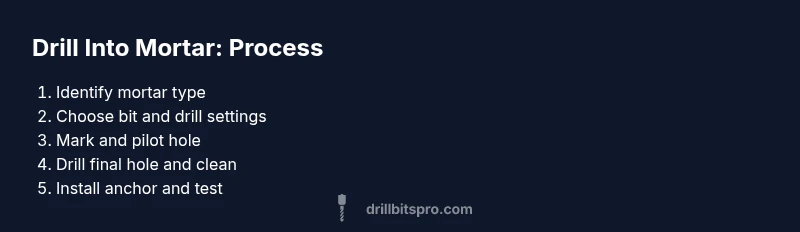
Steps
Estimated time: 30-60 minutes
- 1
Prepare the work area and mark the spot
Set up a clean working zone. Use a marker to place the hole at the exact center, then lightly tap with a center punch to create a tiny dimple. This helps prevent the bit from wandering as you start.
Tip: Always test in a non-critical area first to confirm the mix and hardness. - 2
Choose the correct bit and speed
Select a carbide-tipped masonry bit slightly smaller than the anchor diameter. Set the drill to masonry mode with a slow to medium pace; avoid high speeds which can overheat the bit and damage the mortar.
Tip: Start slow to create a guide hole before increasing speed. - 3
Drill a pilot hole
Drill a shallow pilot hole (1-2 cm) to establish a centered path. If the wall is dense, peck gently—pause and remove dust between attempts.
Tip: Keep the drill perpendicular to the wall for a straight hole. - 4
Expand to full depth
Gradually feed the final hole to the required depth, using steady, even pressure. Stop if the wall or brick shows signs of cracking.
Tip: Withdraw the bit occasionally to clear debris. - 5
Clean and inspect the hole
Vacuum the area and inspect the hole for uniformity. A clean, true hole ensures better anchorage and reduces the risk of anchor loosening.
Tip: If walls crumble, switch to a smaller bit and re-drill. - 6
Install anchor and test
Insert the anchor and test load. If the hole walls crumble, fill and repair mortar before attempting a new hole.
Tip: Use anchors rated for masonry and consider epoxy for extra load.
Got Questions?
Is it safe to drill into mortar without damaging bricks?
Drilling into mortar can be safe if you avoid the brick faces, use a proper masonry bit, and work with low speed and steady pressure. Inspect the wall for cracks and test in a non-critical area first.
Yes. You can drill into mortar safely by choosing the right bit and a slow, steady approach, while avoiding the brick faces.
What size holes can be drilled into mortar safely?
Hole size should match the anchor diameter with a margin; start small with a pilot hole and expand to the needed depth only as required by the anchor.
Stick to manufacturer-recommended hole sizes and avoid overdrilling.
Should I drill into the mortar or the brick?
Always target mortar for holes intended for anchors, not bricks, to prevent crumbling and preserve structural integrity. Use a masonry bit and keep a perpendicular angle.
Anchor holes belong in mortar whenever possible.
Do I need a hammer drill for mortar drilling?
A hammer drill or rotary hammer makes drilling into dense mortar easier, but be mindful of over-penetration. Use the lowest effective setting.
A hammer drill helps, but use the lowest effective setting to reduce damage.
How do I repair mortar after drilling?
If you notice damage to surrounding mortar, clean the area and repoint with fresh mortar to restore adhesion and weather sealing. Avoid leaving exposed gaps.
Repair any damaged mortar with fresh mortar to restore strength.
Can lime-based mortar be drilled easily?
Lime-based mortars can be drilled more easily than cement mortars but still require careful bit choice and slower speed. Test a patch first.
Lime mortars are softer but still require caution.
Watch Video
Top Takeaways
- Understand mortar type before drilling
- Use the right masonry bit and slow speed
- Pilot holes improve accuracy
- Check for cracks before final anchoring